
Choosing the right process for sheet metal welding can make the difference between a clean, flat assembly and a part that requires extensive grinding, straightening, or rework.
MIG, TIG, and laser welding can all produce strong, reliable sheet metal joints. However, they differ significantly in heat input, welding speed, appearance, equipment cost, and the amount of operator control required.
For a small fabrication shop, the most economical option may be a MIG welder. A workshop producing custom stainless steel components may prefer TIG. Meanwhile, a manufacturer welding hundreds of similar sheet metal enclosures may benefit from the speed and reduced distortion offered by laser welding.
So, which method should you choose?
This guide compares MIG, TIG, and laser welding under the same practical criteria, helping you select the best process for your material, sheet thickness, production requirements, and budget.
1. Which Welding Method Is Best for Sheet Metal?
For general-purpose sheet metal fabrication, MIG welding is often the most practical choice. For precision, low-volume work, TIG provides excellent manual control. For repeated thin-sheet production with well-fitted joints, laser welding can offer higher speed and less distortion.
However, no single process is best for every application.
Choose MIG welding when:
You need an economical, versatile process for everyday fabrication, repairs, brackets, frames, and assemblies where some finishing work is acceptable.
Choose TIG welding when:
Your work requires precise control of the weld pool, attractive visible seams, or careful welding of thin stainless steel and aluminum components.
Choose laser welding when:
You regularly weld similar sheet metal parts, need to minimize warping, and can maintain consistent joint preparation and a suitable laser-safe working environment.
These recommendations are starting points rather than fixed rules.
A 1 mm stainless steel panel used in a decorative enclosure has different requirements from a 3 mm carbon steel bracket, even though both may be described as sheet metal fabrication.
The right choice depends on six factors: material, thickness, joint fit-up, production volume, required finish, and total manufacturing cost.
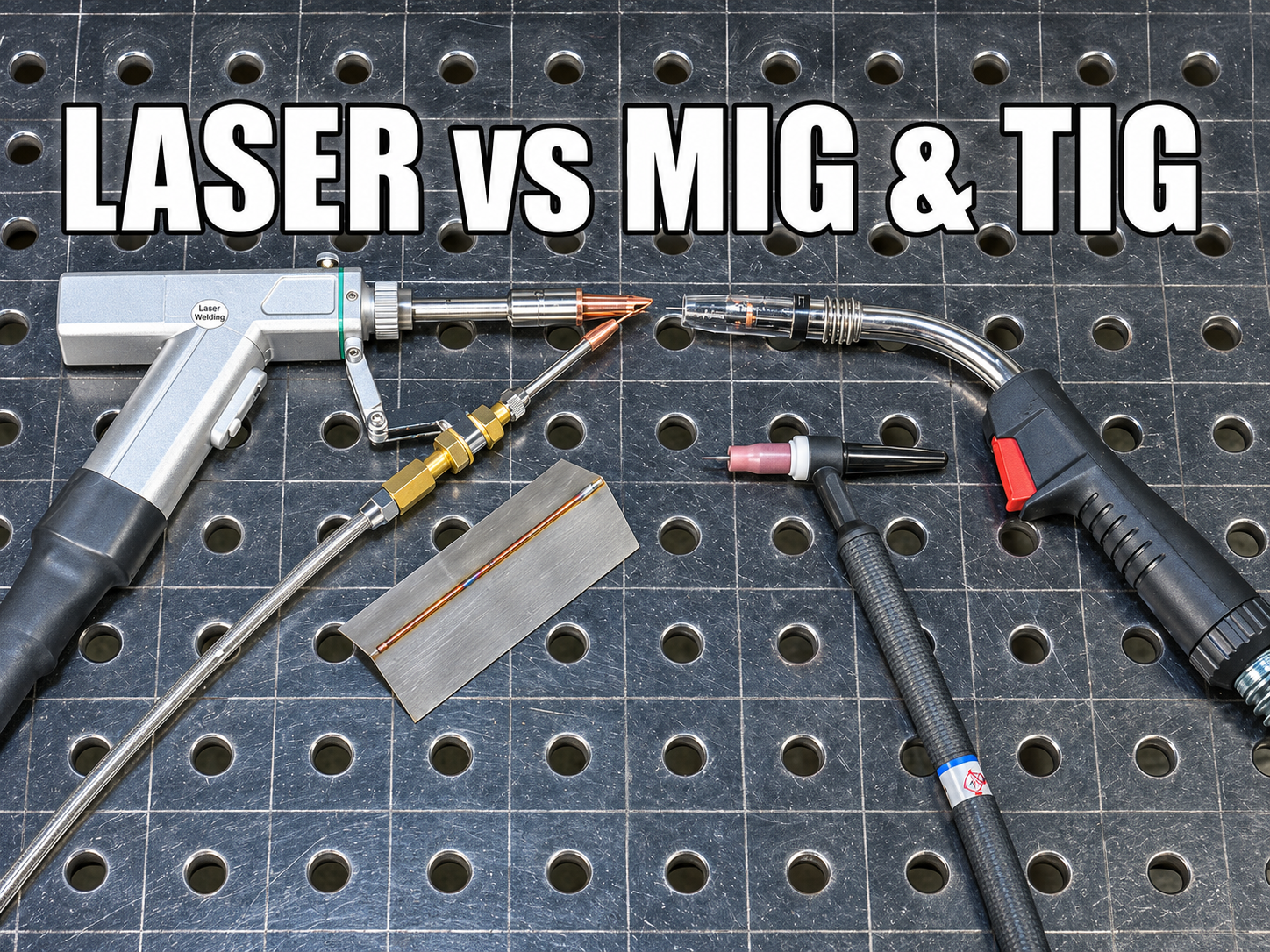
2. MIG vs TIG vs Laser for Sheet Metal Welding
The most useful way to compare these processes is to evaluate how each performs on the same type of workpiece.
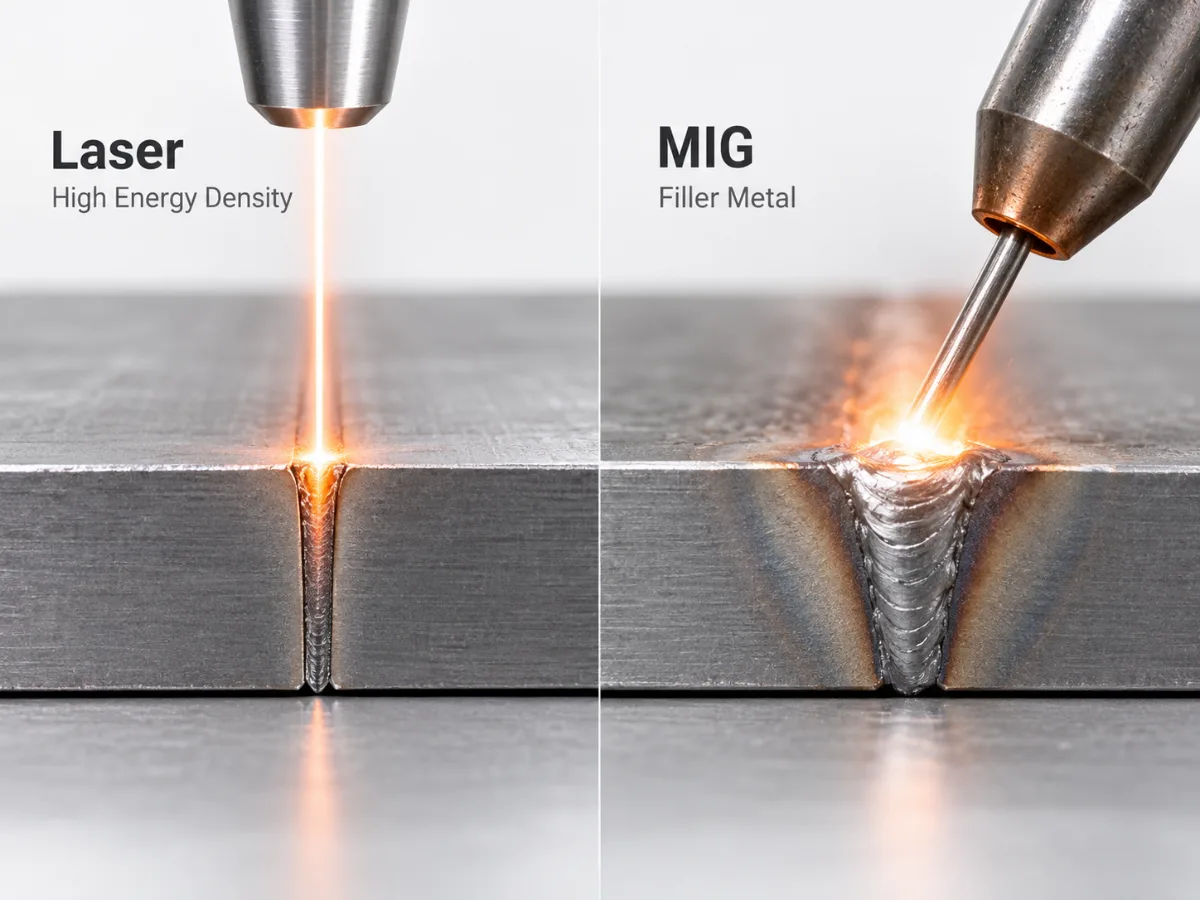
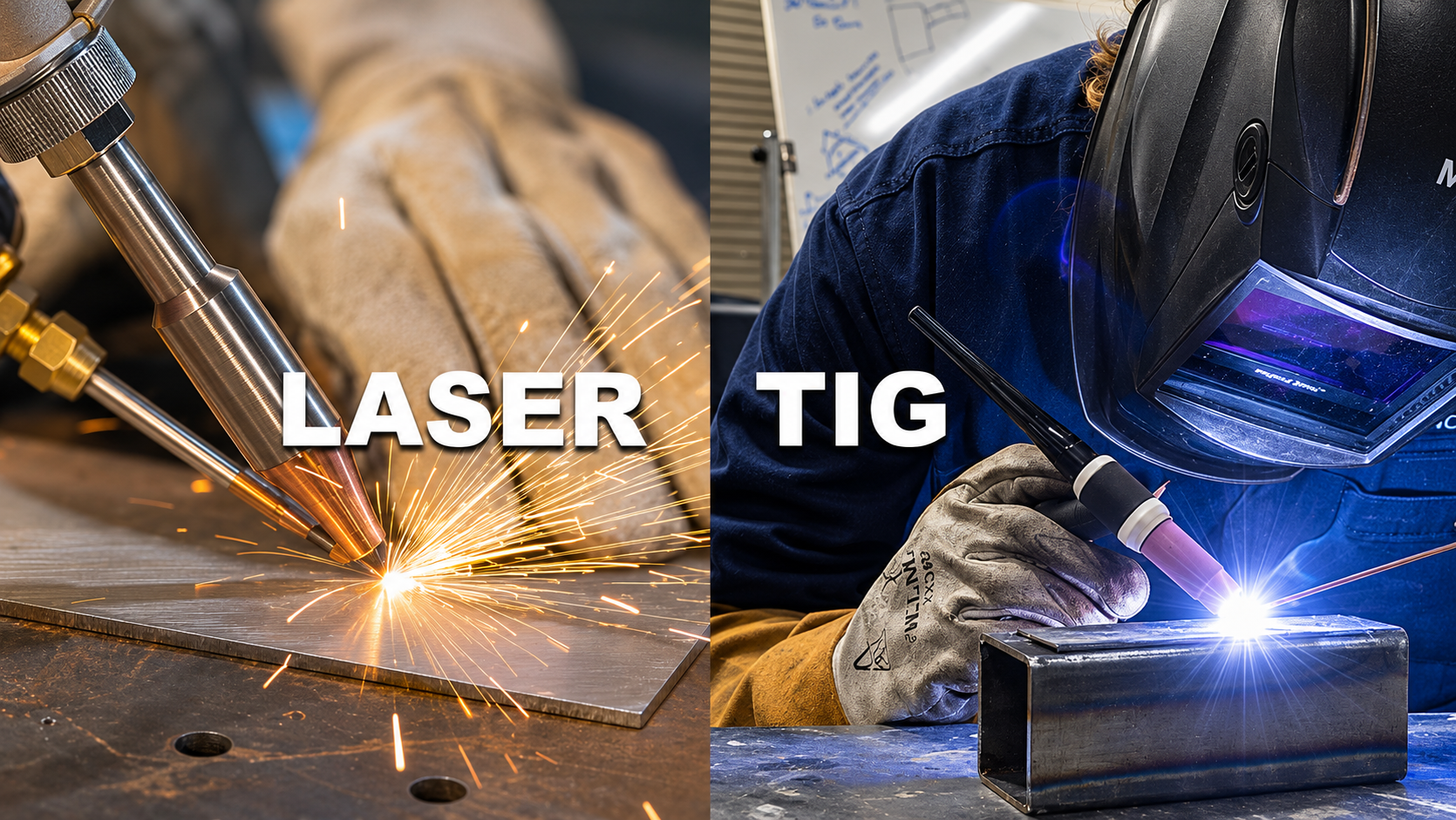
MIG and TIG use an electric arc to melt metal. Laser welding uses a concentrated beam of light to create the weld.
The different heat sources influence travel speed, distortion, weld appearance, and how precisely the joint must be prepared.
Side-by-Side Comparison
| Comparison Factor | MIG Welding | TIG Welding | Laser Welding |
|---|---|---|---|
| Heat input | Moderate; depends on transfer mode and settings | Precise control, but slower travel may increase total heat exposure | Concentrated heat source; often lower heat input on suitable joints |
| Welding speed | Generally fast for manual fabrication | Usually slower, especially with manual filler feeding | Potentially very fast on consistent, well-fitted joints |
| Distortion | Possible on thin panels | Possible because of longer heat exposure | Often lower due to a narrow heat-affected zone |
| Weld appearance | Good, but may require spatter removal or finishing | Excellent control of visible welds | Smooth, narrow seams when properly configured |
| Joint fit-up | Can accommodate some variation using filler wire | Skilled operators can adjust manually to variable joints | Usually requires more consistent fit-up; wire and beam oscillation may improve tolerance |
| Operator requirements | Relatively accessible for general fabrication | Demands strong torch and weld-pool control | Easier to learn some basic movements, but requires laser safety and process training |
| Initial investment | Generally lower | Low to moderate, depending on equipment | Higher when equipment and safety infrastructure are included |
| Typical applications | Repairs, brackets, frames, general fabrication | Custom stainless work, aluminum parts, visible joints | Repeated sheet metal assemblies, cabinets, enclosures, production seams |
These are general tendencies, not guaranteed rankings. Advanced pulsed MIG equipment, automated TIG systems, and different laser configurations can change the results.
What Do Real Welding Tests Show?
A useful example comes from Kemppi’s technical comparison of laser, MAG, and TIG welding.
The manufacturer compared fillet welds on 1 mm, 2 mm, and 3 mm steel plates. For the 2 mm test pieces, it reported:
| Process | Welding Speed | Heat Input |
|---|---|---|
| Laser | 85 cm/min | 0.048 kJ/mm |
| MAG | 57 cm/min | 0.189 kJ/mm |
| TIG | 11 cm/min | 0.287 kJ/mm |
Source: Kemppi’s published technical comparison. MAG welding uses active shielding gas and is commonly included in everyday discussions of MIG welding in the United States.
Under these particular test conditions, laser welding achieved higher travel speed and lower heat input.
However, Kemppi also notes that the tested welds had different throat thicknesses. The results should therefore not be treated as proof that every process produced mechanically equivalent joints.
They also do not mean that every laser welder will be faster than every MIG or TIG welder.
Actual results depend on joint design, material, welding position, equipment capability, and the required penetration.
Why Heat Input Matters for Thin Sheet Metal
When metal is heated during welding, the material around the joint expands. As the weld cools, it contracts.
On thin sheets, this contraction can cause visible warping, twisting, or changes in dimensions.
A larger heat-affected zone can increase the amount of surrounding material affected by the welding process.
Laser welding concentrates energy into a smaller area and may reduce this problem when welding speed and penetration are properly controlled.
However, lower heat input does not automatically mean a better weld.
The process must still achieve adequate fusion, penetration, and joint strength for the intended application.
For more detailed comparisons of individual processes, see our guides to laser welding vs TIG welding and laser welding vs MIG welding.
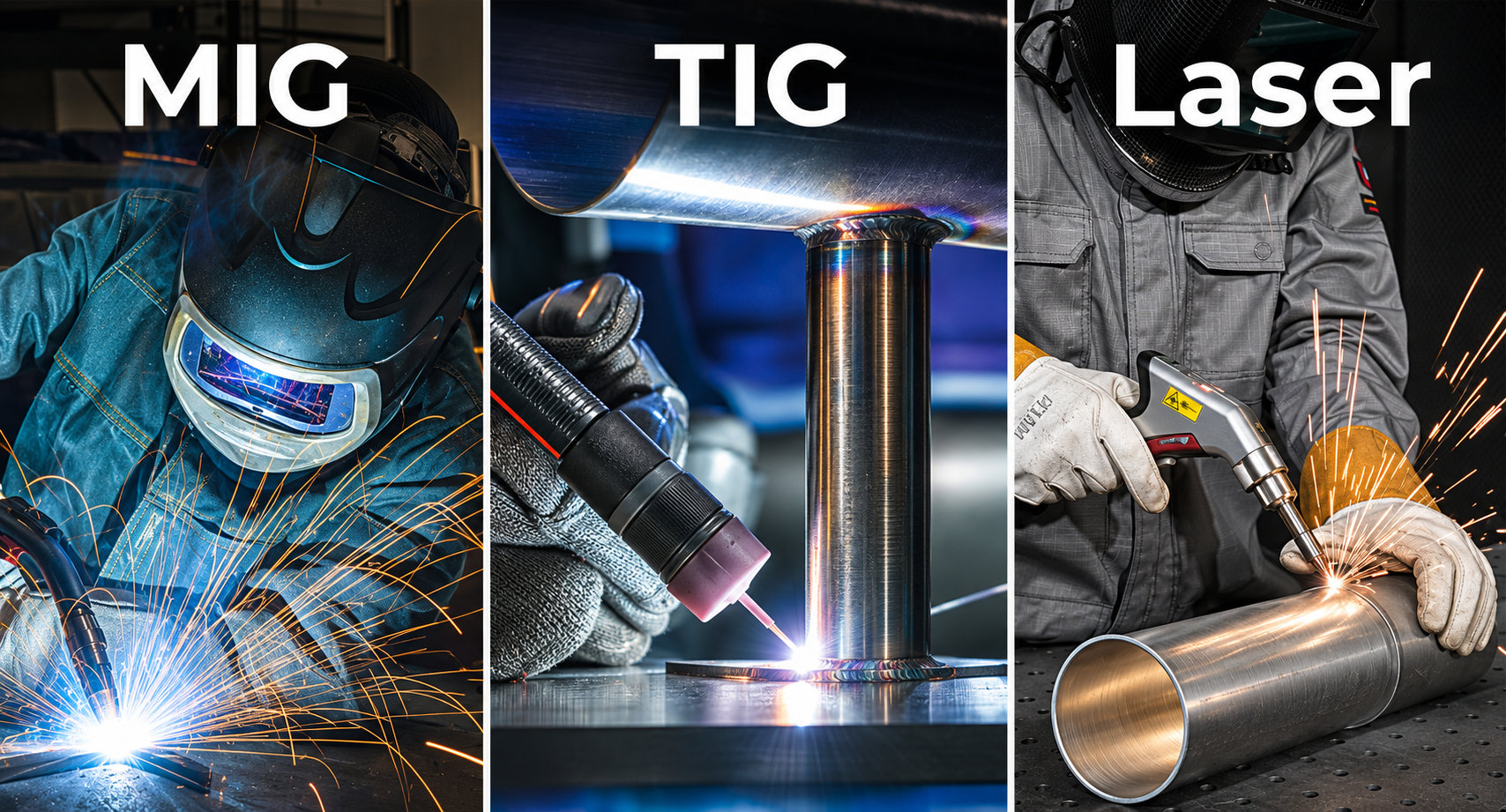
3. Best Sheet Metal Welding Method by Material and Thickness
Material and thickness are two of the most important considerations when selecting a sheet metal welding process.
However, thickness alone cannot determine the correct equipment.
A 2 mm aluminum sheet behaves differently from a 2 mm stainless steel sheet because the materials have different thermal conductivity, oxide characteristics, and welding requirements.
Joint design and production conditions also matter.
Carbon Steel Sheet Metal
MIG welding is often the most economical starting point for general carbon steel fabrication.
Short-circuit MIG can be particularly useful for light-gauge steel when suitable wire, shielding gas, and welding parameters are selected.
It works well for brackets, cabinets, equipment frames, and repair jobs where appearance is not the only priority.
TIG welding is useful when more precise manual control is required, especially for thin sections or small custom components.
Laser welding becomes attractive for repeated carbon steel assemblies where reducing distortion and post-weld straightening is valuable.
For example, a shop producing identical steel cabinets every day may benefit more from laser welding than a workshop repairing occasional damaged panels.
Stainless Steel Sheet Metal
Stainless steel is commonly used for kitchen equipment, decorative panels, enclosures, and commercial fixtures.
In these applications, appearance and distortion are often especially important.
TIG welding remains a strong choice for custom stainless steel fabrication because it provides precise control over the weld pool and filler material.
Laser welding is another option for well-fitted stainless steel parts. Its concentrated energy can reduce the width of heat discoloration and limit distortion when shielding gas and penetration are properly controlled.
MIG welding is useful when production speed, filler deposition, and cost are more important than achieving a narrow visible seam.
The best option depends on whether the finished part requires polishing, how visible the weld will be, and how consistently the components fit together.
Aluminum Sheet Metal
Aluminum requires additional attention because it conducts heat efficiently and develops a surface oxide layer.
AC TIG welding is widely used for thin aluminum components, custom assemblies, and applications requiring fine manual control.
MIG welding can be more productive for suitable aluminum fabrication, particularly when equipment is configured with an appropriate wire-feeding system and transfer mode.
Laser welding can also be effective, but the material’s reflectivity and thermal characteristics make correct laser configuration, preparation, and joint design important.
For thin aluminum panels, do not assume that higher laser power automatically produces better results. Excessive energy or unsuitable parameters can lead to defects, including burn-through or porosity.
Which Process Fits Each Thickness?
The following table is a practical selection guide, not a universal machine-capability chart.
| Sheet Thickness | MIG Welding | TIG Welding | Laser Welding |
|---|---|---|---|
| Below 0.8 mm | Possible with specialized thin-sheet settings, but burn-through risk is high | Often suitable with precise low-current or pulsed control | Possible with a properly configured system; very thin sheets require careful validation |
| 0.8–1.5 mm | Good option with controlled short-circuit or pulsed transfer | Strong choice for precision and visible seams | Attractive for repeated, closely fitted parts |
| 1.5–3 mm | Versatile and economical for many fabrication tasks | Suitable for detailed or lower-volume work | Strong candidate for consistent production joints |
| 3–6 mm | Often practical for stronger or heavier fabricated assemblies | Useful when precision justifies slower production | Depends heavily on laser power, joint design, penetration requirements, and equipment capability |
For U.S. readers, common approximate thicknesses for uncoated steel sheet include:
- 20 gauge: 0.91 mm
- 18 gauge: 1.21 mm
- 16 gauge: 1.52 mm
Gauge-to-thickness conversions vary by material and gauge system, so always confirm the actual measured thickness before selecting welding parameters.
The most important distinction is that a process being capable of welding a certain thickness does not mean it is automatically the most economical or reliable choice.
For thicker parts, increasing joint penetration requirements, bevel preparation, and the possibility of multiple welding passes can change the comparison significantly.
A machine’s rated laser power should never be used as the sole basis for determining whether it can produce a qualified weld.
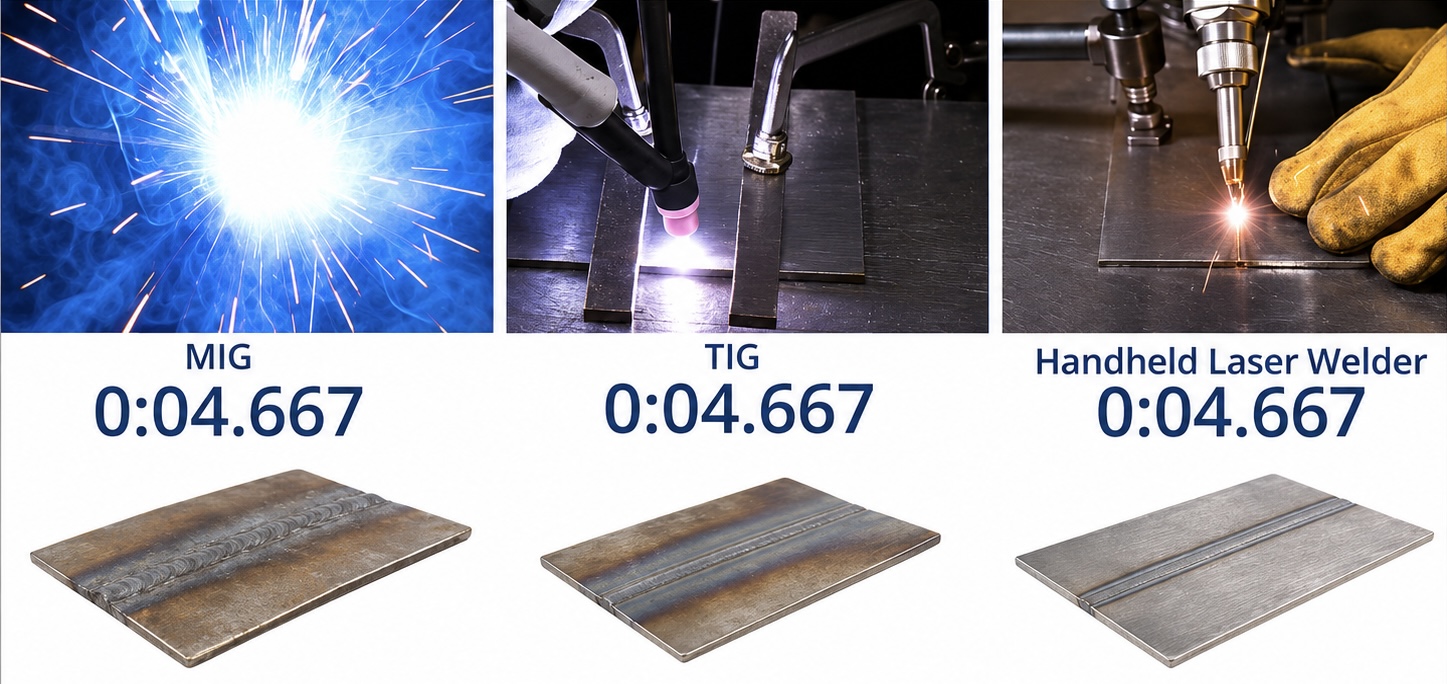
4. How to Prevent Warping and Burn-Through in Sheet Metal Welding
Warping and burn-through are among the most common problems in thin sheet metal welding.
Although MIG, TIG, and laser welding generate heat differently, all three require suitable preparation and controlled welding conditions.
The first step is understanding what causes the problem.
Warping occurs when heating and cooling create uneven expansion and contraction across the workpiece.
Burn-through occurs when the metal melts excessively and cannot support the weld pool.
These defects are influenced by heat input, sheet thickness, joint gaps, travel speed, and how the workpiece is supported.
Start With Proper Joint Preparation
Poor preparation can undermine the advantages of any welding process.
Before welding, the joint should be inspected for:
- Oil, grease, rust, paint, or other contamination.
- Gaps or misalignment that exceed the intended process tolerance.
- Uneven sheet thickness or damaged edges.
- Inadequate support or positioning.
Aluminum also requires appropriate oxide removal and preparation.
For coated or galvanized steel, the welding procedure must address coating-related fumes, contamination, and weld quality.
When possible, test the welding process on scrap material with the same thickness and surface condition as the production parts.
Preventing Warping With MIG Welding
For thin mild steel, short-circuit MIG welding is commonly used because it provides a more manageable weld pool than higher-heat transfer modes.
Smaller-diameter wire can also help improve control.
For example, Miller’s guidance on welding sheet metal discusses using approximately 0.023–0.024-inch wire for many light-gauge applications.
MIG operators can also reduce unnecessary heat buildup by using suitable travel speed, proper tack placement, and an appropriate welding sequence.
On long, thin panels, shorter weld segments may help distribute heat more evenly.
However, repeatedly stopping and starting can introduce other defects if the technique is not properly controlled.
The goal is to use a proven welding sequence that produces sufficient fusion without overheating the surrounding sheet.
Preventing Warping With TIG Welding
TIG welding offers precise control over welding current and the molten pool.
This makes it useful for thin materials and detailed work.
However, TIG can still distort thin sheet metal if the torch moves too slowly or repeatedly heats the same area.
Pulsed TIG, careful filler selection, suitable tungsten electrodes, and proper clamping can help control heat input.
Where appropriate, backing materials or heat sinks may provide additional support and help control local temperatures.
The operator must balance heat control with adequate penetration.
A visually attractive weld that lacks fusion is not an acceptable result.
Preventing Warping With Laser Welding
Laser welding can reduce distortion because energy is concentrated into a relatively narrow weld zone.
Nevertheless, successful laser welding depends on several variables:
Laser power, travel speed, focal position, beam oscillation settings, shielding gas coverage, and joint fit-up all influence the final result.
Among these factors, joint fit-up deserves particular attention.
According to TWI’s guidance on laser welding fit-up, proper clamping is especially important for autogenous laser welding of thin sheets.
Filler wire and suitable beam movement can improve tolerance to some joint variations, but they do not eliminate the need for consistent preparation.
For manufacturers considering laser welding, this creates an important trade-off:
Laser welding may reduce time spent correcting distortion, but it can require more disciplined cutting, positioning, and fixturing before welding begins.
A production trial should check both the finished weld and the time required to prepare each assembly.
5. Sheet Metal Welding Costs: MIG vs TIG vs Laser
The cheapest welding machine does not necessarily produce the lowest-cost finished part.
For sheet metal fabrication, a realistic cost comparison should include more than equipment price.
It should account for labor, consumables, preparation, welding time, finishing, inspection, and rework.
MIG Welding Costs
MIG welding generally has the lowest barrier to entry for a small fabrication shop.
Equipment is widely available, and the process handles many everyday fabrication tasks efficiently.
Typical operating costs include shielding gas, filler wire, contact tips, nozzles, electricity, and routine equipment maintenance.
MIG welding may also require grinding, spatter removal, or straightening, depending on material, joint design, and final appearance requirements.
For low-volume work with variable parts, its lower initial investment often makes it difficult to beat.
TIG Welding Costs
TIG equipment can also be relatively affordable, but labor often represents a larger part of the total welding cost.
Manual TIG welding requires experienced operators and may involve slower travel speeds.
Consumables include shielding gas, tungsten electrodes, filler metal when required, and torch components.
TIG can reduce some finishing work because it produces clean, precisely controlled welds.
However, a process that takes significantly longer per assembly may become expensive when production volume increases.
For custom fabrication, prototypes, and visible seams, that additional labor may be justified.
Laser Welding Costs
Laser welding generally requires higher initial investment.
In addition to the welding machine, the total installed cost should include suitable laser-safety infrastructure, shielding gas, replacement protective optics, training, maintenance, and any necessary fixtures.
The economic advantage comes from potential reductions in welding time, distortion, grinding, and rework.
However, these savings must be measured on actual parts.
A laser may produce a weld very quickly but deliver limited overall savings if the operator spends additional time aligning each component.
Conversely, when identical parts are welded repeatedly, even a small reduction in handling and finishing time may become significant.
A Simple Production-Cost Example
Consider a hypothetical fabrication shop producing 500 sheet metal assemblies per month.
Suppose a tested alternative process saves two minutes per assembly by reducing welding and finishing work.
That would represent:
500 assemblies × 2 minutes = 1,000 minutes saved per month.
This equals approximately 16.7 labor hours.
At an assumed loaded labor cost of $35 per hour, the potential labor saving would be approximately $583 per month.
This is an illustrative calculation, not a claim about any specific welding machine.
It does not yet account for the additional equipment investment, laser-safety infrastructure, financing, maintenance, scrap, or changes in production quality.
To evaluate payback, compare the total additional investment against verified net savings after all relevant costs.
For most businesses, the best metric is cost per acceptable finished assembly—not welding speed alone.
6. How to Choose the Right Welder for Your Sheet Metal Shop
The most suitable welding equipment depends on the type of work your shop performs every day.
A general repair workshop, a stainless steel fabrication business, and a manufacturer producing repeated sheet metal assemblies may reach very different conclusions.
When MIG Welding Makes More Sense
MIG is often the sensible choice for shops handling varied fabrication and repair work.
It is particularly useful when the business needs affordable equipment, works with different joint types, and does not produce large numbers of identical parts.
For workshops making brackets, frames, repair panels, or general steel assemblies, a properly selected MIG welder may provide the best balance of cost and flexibility.
A shop should not switch to laser simply because laser welding can be faster in a controlled demonstration.
The actual production process must justify the additional investment.
When TIG Welding Makes More Sense
TIG is valuable for lower-volume work requiring careful weld-pool control or a highly controlled visible finish.
Examples include custom stainless steel components, thin aluminum assemblies, prototypes, and complex small joints.
It is also useful when an experienced operator needs to respond to variations that would be difficult to accommodate with a tightly configured production process.
If a workshop produces only a handful of precision components each week, buying a laser welder may not deliver sufficient financial benefit.
When a Handheld Laser Welder Is Worth Considering
A handheld laser welder becomes worth evaluating when a shop repeatedly encounters problems such as:
- Thin panels warping during welding.
- Excessive grinding or straightening after welding.
- Slow production of similar sheet metal components.
- Difficulty maintaining consistent results across repeated jobs.
These problems are especially relevant to manufacturers of metal cabinets, stainless steel fixtures, enclosures, doors, and other fabricated sheet metal assemblies.
For this type of work, an air-cooled handheld laser welder may provide a practical alternative to conventional MIG or TIG welding.
MaxWave offers handheld laser welding configurations with different power options, including 1500W and 2000W models. The equipment is designed for applications involving materials such as stainless steel, carbon steel, and aluminum.
However, the correct configuration must be selected according to the actual material, thickness, joint type, required penetration, and working conditions.
For repeatable precision components requiring programmed weld paths rather than handheld operation, an automatic fiber laser welder may also deserve consideration.
Do Not Overlook Laser Safety
Laser welding introduces hazards that are different from conventional arc welding.
Industrial handheld fiber laser welders are generally Class 4 laser systems. Their direct, reflected, and scattered radiation can cause serious eye or skin injuries.
A suitable installation may require laser-rated barriers, controlled access, appropriate interlocks, wavelength-specific protective eyewear, operator training, and effective fume extraction.
Protective eyewear alone is not an adequate substitute for engineering controls.
OSHA’s laser safety guidance explains the hazards associated with high-power lasers and the need for appropriate control measures.
The cost and practicality of establishing a compliant working area should be part of the purchase decision.
Test Your Own Parts Before Buying
A manufacturer’s demonstration can show what a welding process is capable of, but it cannot replace testing your actual components.
Before purchasing a new welder, confirm:
- Material and thickness: Can the process produce adequate penetration without unacceptable distortion?
- Joint fit-up: Can it handle the gaps and dimensional variation present in your production?
- Weld requirements: Does the joint meet the required appearance, strength, and inspection criteria?
- Production efficiency: Does it reduce total handling, welding, and finishing time?
- Safety and support: Can your shop provide the required controls, training, and ongoing maintenance?
Where weld strength or service performance is critical, testing should follow the applicable engineering specifications and qualified welding procedures.
At TheLaserTool, customers can discuss their material, thickness, and joint requirements and request a sample welding test before selecting a suitable handheld laser welding configuration.
The purpose of a sample test is to establish whether laser welding is appropriate for the actual job—not simply to produce an attractive demonstration weld.
7. Sheet Metal Welding FAQs
What is the best welding method for thin sheet metal?
The best method depends on material, thickness, joint fit-up, production volume, and appearance requirements. TIG offers precise manual control, MIG is economical for many general fabrication tasks, and properly configured laser welding can reduce distortion on repeated, well-fitted thin-sheet joints. Sample testing is important before selecting a process.
Can you MIG weld 20-gauge sheet metal?
Yes. Mild steel around 20 gauge, approximately 0.91 mm thick, can be MIG welded with suitable equipment and technique. Controlled short-circuit transfer, appropriately sized wire, careful joint preparation, and proper heat management can help reduce burn-through. Settings should be verified using test pieces of matching material and thickness.
Is laser welding better than TIG for sheet metal?
Laser welding can be faster and produce less distortion on suitable, consistently prepared joints. TIG may be preferable for one-off parts, complex manual work, and applications requiring fine control over the weld pool. The better choice depends on the entire fabrication process, including setup, finishing, and inspection—not travel speed alone.
Is a handheld laser welder worth it for a small fabrication shop?
It may be worthwhile if the shop regularly welds similar metal parts and spends significant time on distortion correction, finishing, or repeated welding operations. For occasional repairs or poorly fitted components, MIG or TIG may remain more practical. Compare real sample results, total installed costs, safety requirements, and expected workload before purchasing.
Final Recommendation
There is no universal winner between MIG, TIG, and laser welding for sheet metal.
MIG remains a versatile, economical choice for general fabrication. TIG excels when precise manual control and weld appearance are priorities. Laser welding can offer major advantages for repeated, closely fitted sheet metal assemblies where reducing distortion and finishing work improves productivity.
The right decision is the process that consistently delivers acceptable weld quality at the lowest practical total cost for your specific parts.
If you are considering laser welding for your workshop, start with your material, thickness, joint design, and production volume. A representative welding test will tell you far more than a general speed or power claim.

0 Comments