
Choosing between laser welding and MIG welding is more than a technical call. It’s a financial decision, an operational one, and for many shops, it can make or break the business.
Get it right, and you’ll see faster production, cleaner welds, and a real edge over competitors still using older methods. Get it wrong, and you’re stuck with an expensive machine that doesn’t fit your workflow.
Both processes have their strengths. But they’re built for very different jobs.
This guide breaks down real costs, weld quality, material compatibility, and the specific scenarios where one process wins over the other — so you can make a decision you’ll stand behind with confidence.
Laser vs MIG Welding: Key Differences in Numbers

Two processes. Very different engineering logic behind each one.
Here’s a quick comparison to start:
| Aspect | Laser Welding | MIG Welding |
|---|---|---|
| Speed | 3–10x faster on thin materials | Steady, reliable on heavy fab |
| Heat-Affected Zone | Tight, minimal material damage | Larger, risks structural changes |
| Gap Tolerance | Demands tight fit-up | Forgiving of misalignment |
| Best Material Thickness | Under 4mm | Thicker, heavier sections |
| Equipment Cost | $3,500+ upfront | From ~$2,000 |
| Weld Quality | Near-zero spatter, less rework | More grinding, cleanup needed |
What the Same Workpiece Reveals
Run both processes on a 3mm stainless plate. The gap between them becomes clear fast.
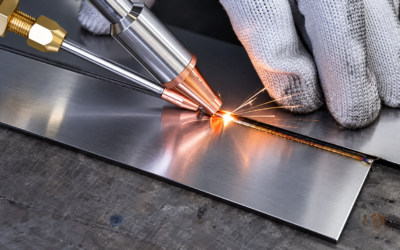
Laser welding cuts a deep, narrow fusion zone. You get full penetration in a single pass. Distortion stays under 0.1mm. Processing time runs around 10–30 seconds per meter. No filler wire needed. No grinding after.
MIG leaves a wider, shallower bead. Processing takes 1–3 minutes per meter. Distortion falls in the 0.2–0.5mm range. Some joints need more than one pass. Cleanup isn’t optional — it’s part of the job every time.
The Strength Question Most People Get Wrong
Here’s a common misconception worth clearing up: laser welds are not stronger than MIG welds by default.
Both processes — once dialed in — reach tensile strength close to the base material. On 3mm stainless, that puts you at around 500–600 MPa either way. Fillet break tests show similar failure loads across both methods.
So where does laser welding win? Not raw strength. It delivers better precision, lower distortion, and cleaner geometry. That matters a great deal in tight-tolerance work. MIG, on the other hand, holds up well on thick sections. Deeper heat input is a real benefit there, not a drawback.
The difference isn’t strong versus weak. It’s where each process hits its peak.
What Is Laser Welding and How Does It Work?

A focused beam of light — intense enough to drill through steel in milliseconds. That’s the core of laser welding.
Here’s the physics that matters: push power density above 10⁶–10⁷ W/cm², and the laser doesn’t just melt metal. It vaporizes it. That vapor opens a narrow cavity called a keyhole. Think of it as a self-sustaining channel — the beam drives straight down into the joint instead of skimming across the surface.
The result? Welds with a high depth-to-width ratio, minimal heat spread, and an HAZ under 0.5mm.
Three variables control everything:
– Laser power — drives penetration depth and travel speed
– Spot size — smaller diameter means higher density, deeper keyhole
– Welding speed — too slow and you bloat the heat zone; too fast and fusion fails
Modern fiber lasers lead industrial and SME applications. They run at 1–2 kW, hit weld rates of 5–50 m/min, and push single-pass penetration up to 10mm. Handheld units brought this technology into small shops too. They replace bulky setups with compact systems — and operators need little training to get started.
What Is MIG Welding and How Does It Work?
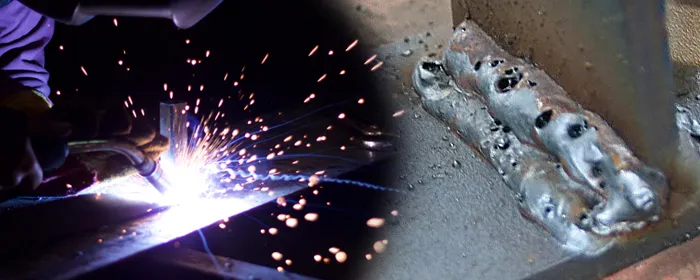
MIG welding — known by its official name, Gas Metal Arc Welding (GMAW) — has been the backbone of fabrication shops for decades. The reason is simple: it works on almost everything.
The process runs on three elements working together:
- A consumable wire electrode fed through the welding gun at a steady, controlled rate
- An electric arc that generates the heat to fuse wire and base metal into a single pool
- Shielding gas — argon, helium, or an argon/CO₂ mix — flowing at 20–25 cubic feet/hour to block atmospheric contamination
As the arc burns, the wire melts into the puddle. You move the gun, the pool solidifies behind you, and that’s your joint.
Gun angle matters more than most beginners expect. Keep your travel angle between 5–15°. Push past 20–25° and you’re asking for spatter and arc instability. Pull technique gives you deeper penetration and a narrower bead. Push technique flattens the profile and opens up visibility.
Transfer Modes: Where MIG Gets Flexible
Not all MIG welding runs the same way. Three transfer modes handle different jobs:
| Mode | Heat Input | Best For |
|---|---|---|
| Short-Circuit | Low | Thin sections, out-of-position work |
| Spray | High | Thick materials, deep penetration |
| Pulsed | Low-controlled | Thin materials, spatter-free results |
Pulsed MIG is worth a closer look. It gives you the control of short-circuit transfer, but with cleaner droplet placement. So on thin materials that would burn through under standard settings, Pulsed MIG becomes a serious option.
Cost Breakdown: Laser Welder vs MIG Welder — What’s the Real Price Difference?
The sticker price doesn’t tell the whole story. What really matters is the total cost over time—including consumables, labor, rework, and cleanup time. These hidden costs are often where the real difference shows.
Upfront Cost: The First Big Gap
The upfront gap is obvious. MIG welders usually cost $300 to $5,000+, making them easy to start with. In comparison, laser welding machines start around $3,500 and can go beyond $200,000 for industrial systems. MIG is cheaper at the beginning—but that’s only part of the picture.
Ongoing Costs: Where MIG Gets Expensive
MIG welding comes with constant ongoing costs, including filler wire, gas, and replaceable parts. As production increases, these costs rise quickly. At the same time, spatter creates extra cleanup work, which means more labor and higher cost per part. Over time, this adds up fast.
Laser Welding: Faster and Cleaner
Laser welding machine has fewer ongoing costs, mainly electricity. It doesn’t rely on wire and uses much less gas. More importantly, it’s 4–10× faster than MIG welding, which means higher output, less labor, and almost no post-processing. The workflow is simpler and more efficient.
What the Difference Really Means
In simple terms, MIG welding is cheaper to buy but more expensive to run, especially as production grows. Laser welding costs more upfront but saves money over time thanks to speed, efficiency, and reduced labor.
When Does Laser Start to Win?
For small jobs, MIG is the better choice. But once you scale up, the numbers change quickly. At around 1,000 parts per month, the time and labor saved by laser welding can already cover the price difference. And that’s before counting savings from less waste and almost zero finishing work.
Final Takeaway
If you’re doing low-volume work or have a tight budget, MIG is enough. But if your goal is higher efficiency, stable quality, and scalable production, then laser welding becomes the smarter long-term investment.
Laser Welding vs MIG Welding: Material & Application Compatibility
Material dictates everything. Pick the wrong process, and no amount of skill or fine-tuning saves you.
Here’s how the two processes split across the materials you’re most likely working with:
Stainless Steel: Laser handles 300-series stainless very well. You get low distortion, narrow welds, and minimal HAZ. MIG works on thicker stainless sections. But the larger heat-affected zone becomes a real problem on anything under 4mm.
Aluminum: Laser wins here. Fiber and disk lasers handle aluminum’s reflectivity without burn-through risk. MIG can run aluminum too. The wider heat spread causes problems though — particularly on dissimilar metal joins where aluminum meets steel.
Carbon Steel: Flip the script. MIG is the natural choice for thick carbon steel. You get deeper penetration and strong filler-based fusion. Laser welding handles thin-to-medium carbon steel with tight distortion control. Clean results, less rework.
Copper Alloys: Laser performs well with the right wavelength settings. MIG is versatile but loses precision on reflective, non-ferrous surfaces.
Where the Thickness Boundary Falls
Two numbers are worth keeping in mind: 3mm and 6mm.
- Under 3mm: Laser runs 5–10x faster. HAZ stays minimal. Precision is hard to beat.
- 3mm–6mm: Either process works. Hybrid laser-MIG is worth a look in this range.
- Over 6mm: MIG is the standard choice. It bridges gaps, handles structural loads, and drives deeper penetration. Laser multi-pass simply can’t compete at that thickness without major cost increases.
Industry Fit at a Glance
| Industry | Recommended Process | Reason |
|---|---|---|
| Automotive | Laser (thin/dissimilar), MIG (structural) | Weight savings, Al-steel joins |
| Jewelry | Laser | Precision on delicate, thin pieces |
| Electronics | Laser | Heat-sensitive components, tight tolerances |
| Structural Steel | MIG | Thick sections, large-scale fabrication |
The pattern is clear. Laser welding owns the thin, precise, and heat-sensitive end of the spectrum. MIG holds the structural, thick, and high-volume fabrication side. Figure out which side your work falls on — the right process becomes obvious from there.
Decision Guide: How to Choose Between Laser and MIG Welding
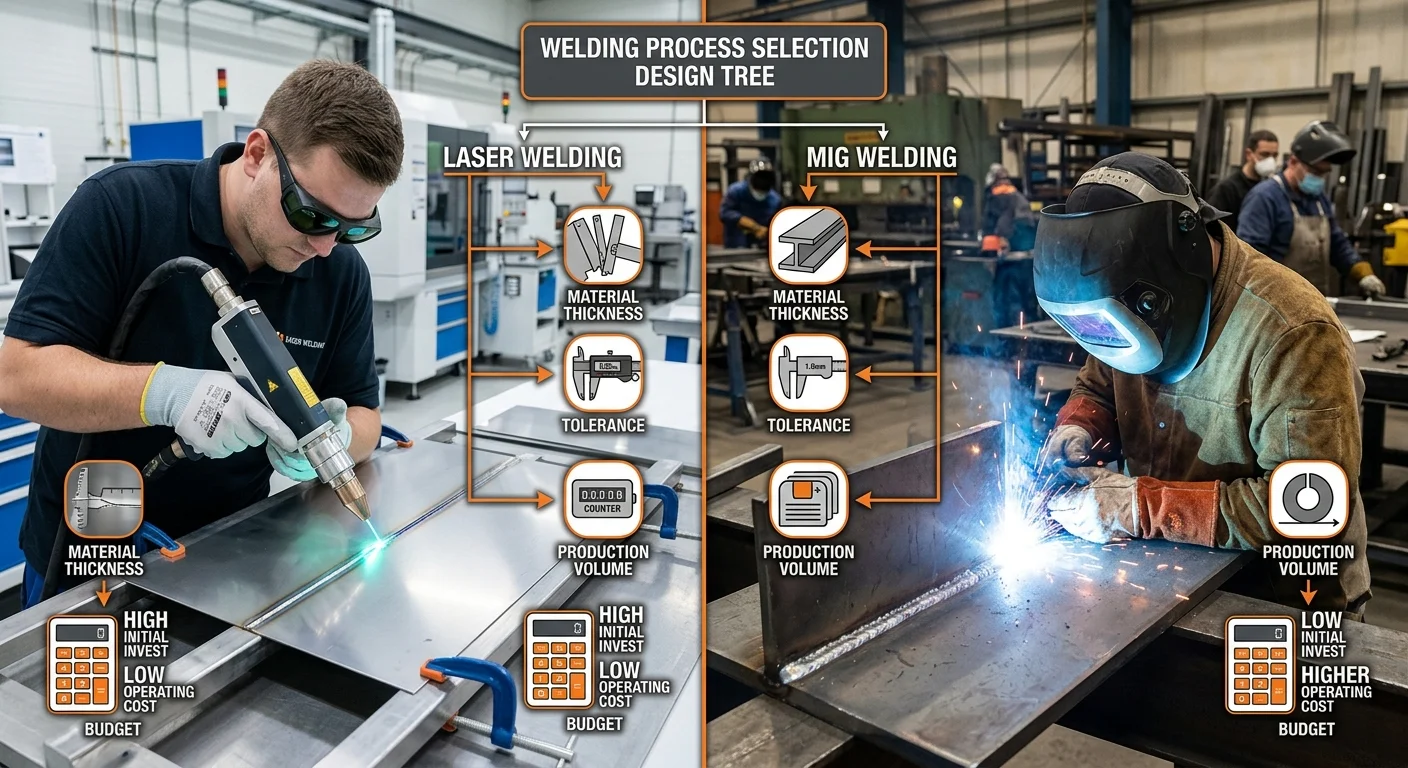
Four questions will settle this. What thickness are you welding? How tight are your tolerances? What’s your volume each day? And what’s your real budget — not the number you wish it were, but the one your accountant will approve.
Work through those four questions and the answer becomes clear on its own.
The Quick Decision Framework
| Your Situation | Go With |
|---|---|
| Material under 3mm, precision matters | Laser |
| Material over 6mm, strength is the priority | MIG |
| High volume, automation-ready, budget over $20K | Laser |
| Small shop, mixed jobs, tight capital | MIG |
Five Shops, Five Answers
- Startup factory: MIG. $2K gets you running. The learning curve won’t stall production.
- Scale manufacturer: Laser. The 3–10x speed advantage builds up fast at volume.
- Auto parts shop: Laser. Thin aluminum and steel under 4mm, tight joints, no distortion tolerance.
- Jewelry workshop: Laser — no debate. Material under 1mm, complex shapes, zero spatter.
- Structural steel: MIG. Over 10mm, nothing else competes on strength and reliability.
Conclusion
Both processes have their place, but not in the same jobs. MIG welding remains the go-to for thick materials and heavy fabrication, where cost and deposition speed matter most. Laser welding delivers cleaner seams, faster production, and minimal distortion, making it a better fit for modern manufacturing. The real question isn’t which is better—it’s which is better for your future.
If you’re working with thin metals, stainless steel, or aluminum at scale, hidden costs like grinding and rework can quietly reduce your margins. As manufacturing shifts toward higher efficiency and precision, laser welding is quickly becoming the smarter long-term choice. The right weld today should still make sense tomorrow.
Explore MaxWave’s laser welding solutions and find the right setup for your production.

0 Comments