
The four basic welding positions are flat, horizontal, vertical, and overhead. Each position affects how molten metal behaves, how the operator accesses the joint, and how welding parameters must be controlled.
For metal fabrication shops, welding position matters when working on stainless steel cabinets, metal frames, enclosures, railings, and other assemblies that cannot always be repositioned. When comparing a handheld laser welder supplier, also check which metals and thicknesses each power level can handle.
A joint that is easy to weld from above may become more challenging when it is vertical or located underneath a workpiece.
Handheld laser welding offers greater flexibility in accessing different joints, but can the same machine handle all four welding positions?
The answer depends on the material, joint geometry, machine configuration, operator skill, and required weld quality.
This guide explains the four welding positions, how they affect handheld laser welding, and what to consider when evaluating equipment for out-of-position welding.
1. What Are the Four Welding Positions?
Welding positions describe the orientation of a joint relative to gravity.
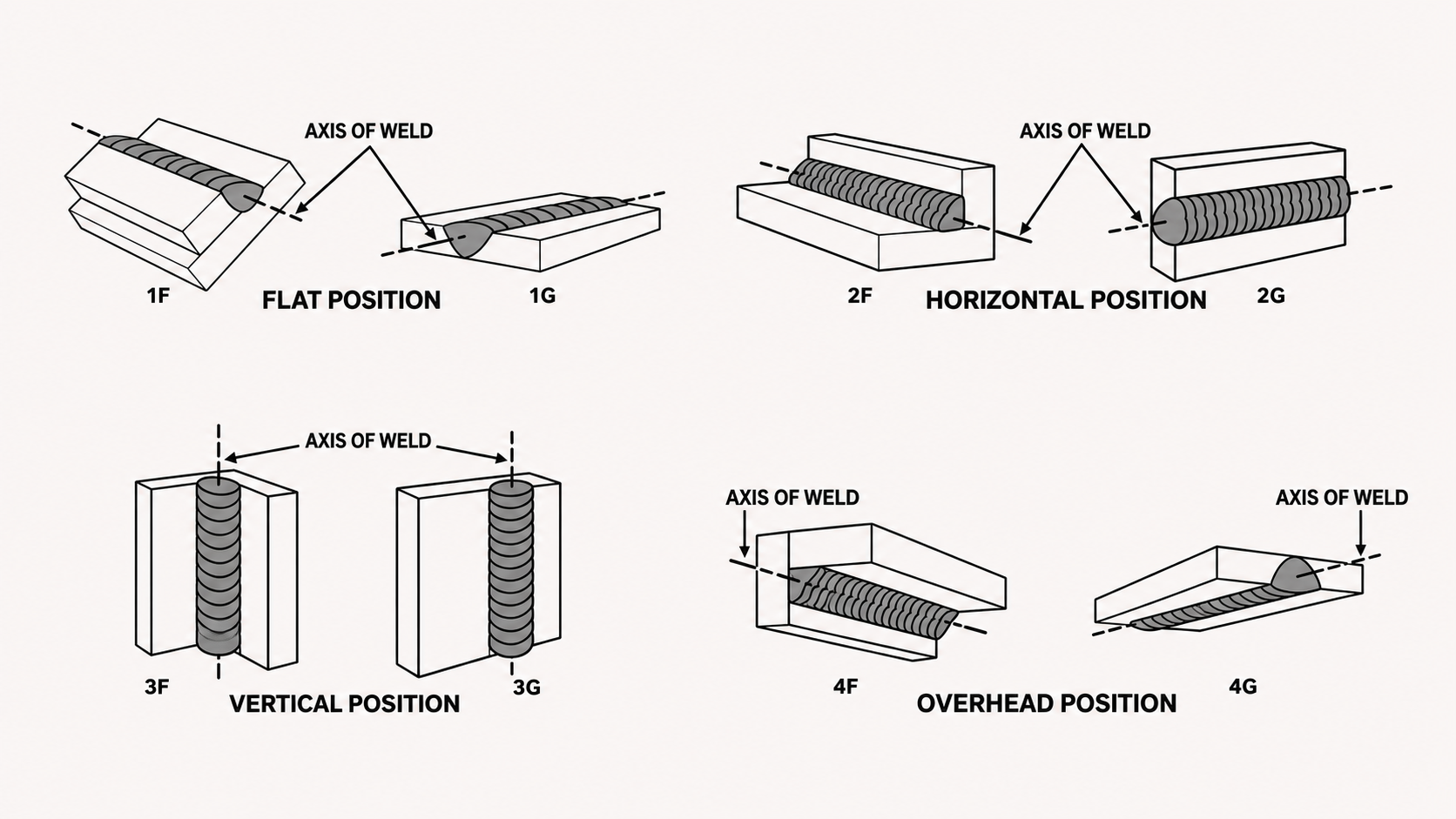
In AWS welding terminology, four basic positions are used for plate welding: flat, horizontal, vertical, and overhead.
The corresponding codes use numbers 1 through 4. The letter G identifies groove welds, while F identifies fillet welds.
Four Welding Positions Compared
| Welding Position | AWS Codes | Description | Main Challenge |
|---|---|---|---|
| Flat | 1G / 1F | Welding from above the joint | Maintaining consistent travel and fusion |
| Horizontal | 2G / 2F | Welding along a horizontal joint | Preventing downward weld-pool movement |
| Vertical | 3G / 3F | Welding along an upright joint | Controlling molten metal against gravity |
| Overhead | 4G / 4F | Welding from beneath the joint | Maintaining weld-pool stability and safe access |
Flat Welding Position
Flat welding is generally the easiest position because the operator works from above the joint.
Gravity helps retain molten metal in the weld area, making it easier to observe and control the process.
This position is common in workshop fabrication, where metal plates, frames, and other components can be placed on a workbench.
For handheld laser welding, flat-position trials are often useful when developing an initial procedure for a particular material and joint.
However, successful flat-position welding does not automatically establish acceptable performance in other positions.
Horizontal Welding Position
In horizontal welding, the weld progresses horizontally while gravity acts on the molten pool.
This can cause uneven bead formation or insufficient fusion if the process is not properly controlled.
Horizontal joints are common in metal enclosures, frames, tanks, and assemblies containing vertical panels.
Consistent welding head alignment and controlled filler-wire delivery are particularly important.
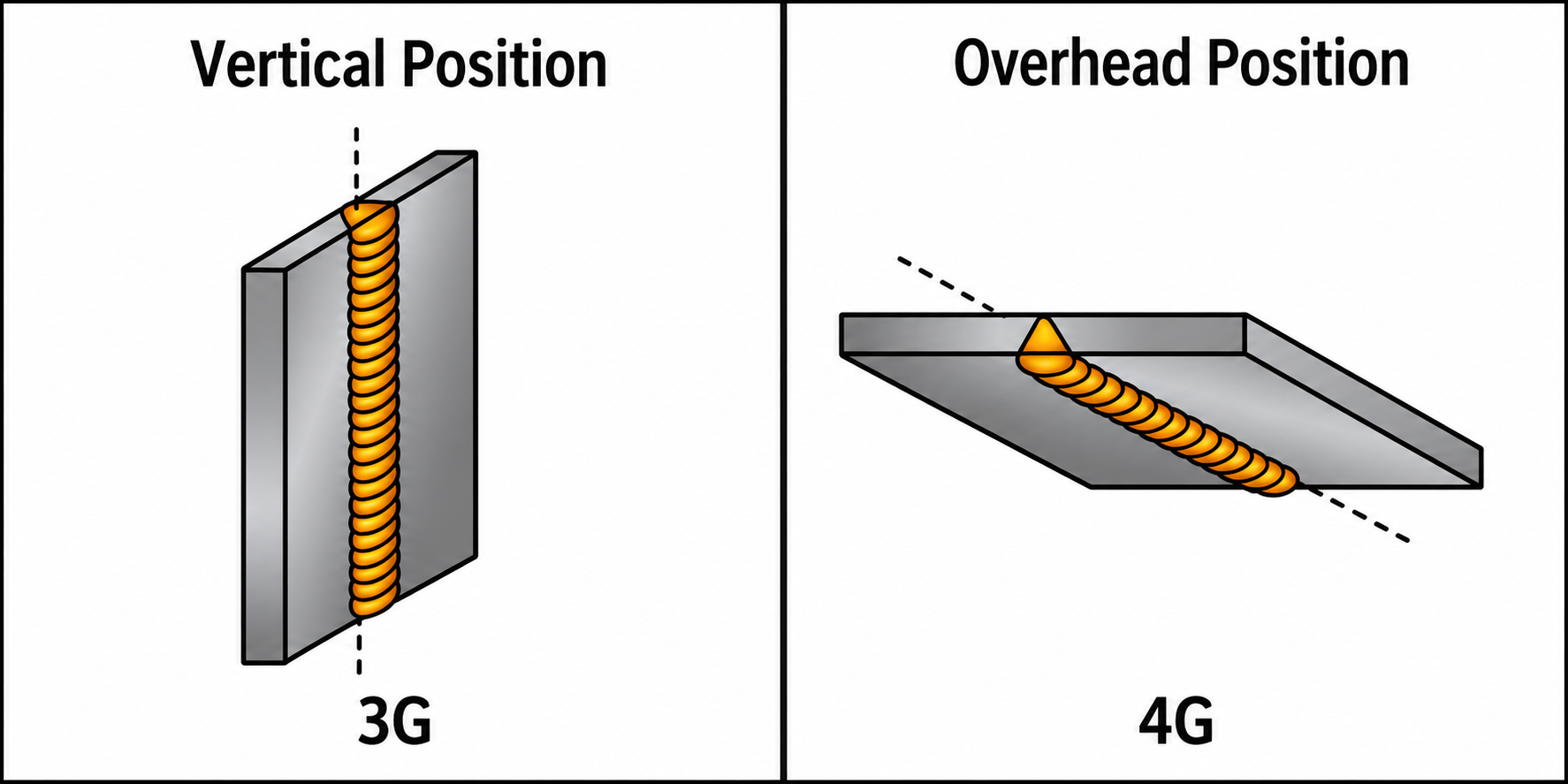
Vertical Welding Position
Vertical welding is performed along an upright joint.
Depending on the material, joint design, and welding procedure, the operator may weld upward or downward.
Gravity can influence molten metal flow and make it more difficult to maintain a stable weld pool.
Vertical welding is often encountered in large metal assemblies, cabinets, and frames that cannot easily be rotated.
Overhead Welding Position
Overhead welding is performed from beneath the joint.
This is usually one of the more challenging positions because molten metal is affected by gravity, while working access and visibility may be limited.
Overhead welding also introduces additional safety concerns involving falling hot material and the direction of direct or reflected laser radiation.
Whenever practical, repositioning the workpiece into a more accessible welding position can simplify the process.https://www.youtube.com/embed/OEzYZHUG_g0
2. Can a Handheld Laser Welder Work in All Four Positions?
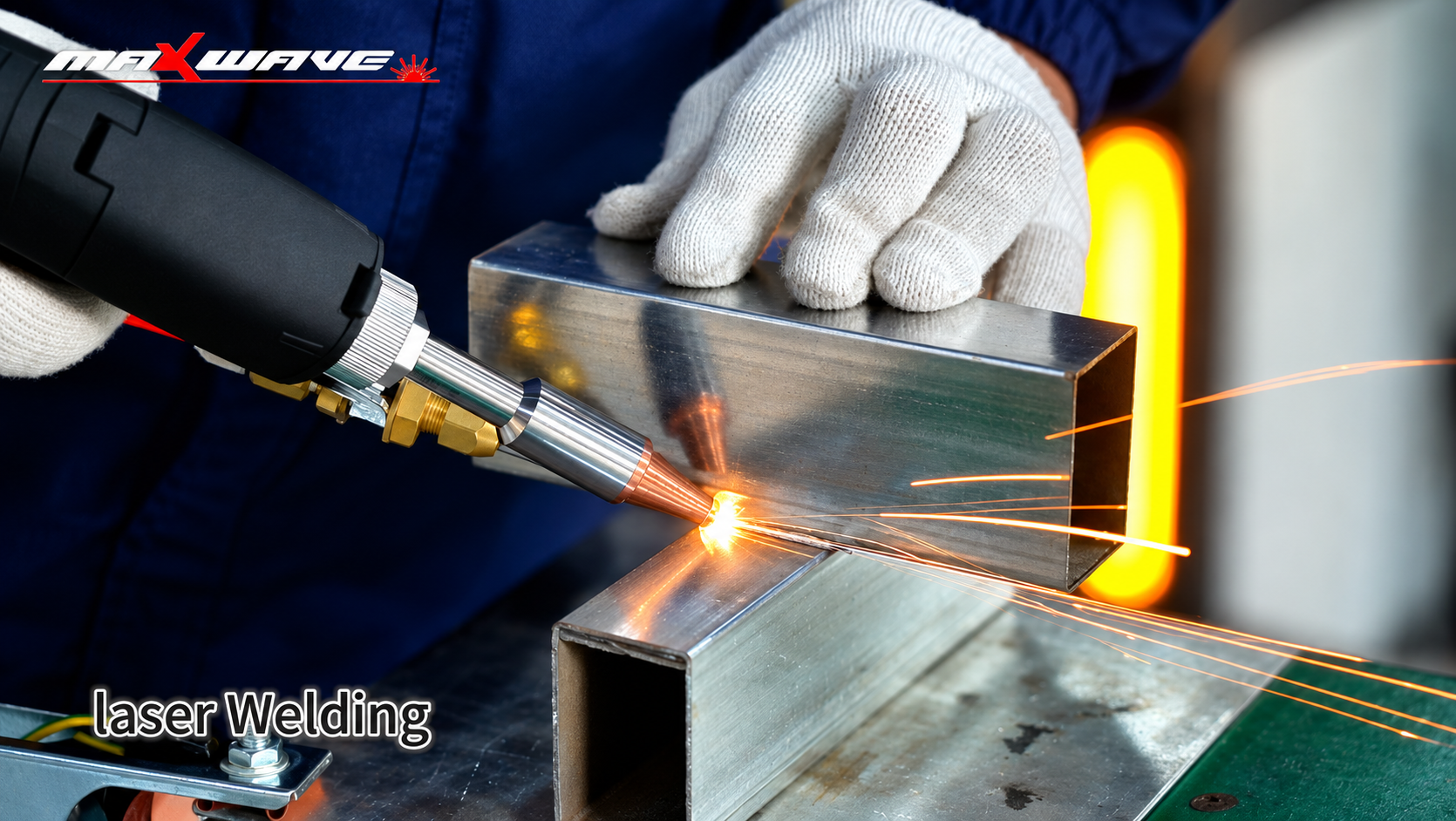
Handheld laser welding can be performed in different orientations, including horizontal and vertical positions. Overhead welding may also be feasible for suitable applications, but it requires additional process and safety verification.
Unlike a fixed welding workstation, a handheld laser welder allows the operator to move the welding head around a workpiece.
This flexibility can be useful when welding large assemblies or components with joints in different locations.
However, reaching a joint does not automatically mean the machine can produce a weld that meets the required quality standards.
How Welding Position Affects Laser Welding
| Position | General Feasibility | Main Consideration |
|---|---|---|
| Flat | Commonly suitable | Consistent penetration and welding speed |
| Horizontal | Suitable for many applications | Bead shape and molten-metal control |
| Vertical | Possible with validated settings | Travel direction and weld-pool stability |
| Overhead | More application-dependent | Fusion quality, access, and safety |
Laser welding uses concentrated energy to form a relatively small molten pool.
This can help limit heat input, but gravity still influences the behavior of molten metal.
For example, a thin stainless steel fillet weld may respond differently from a thicker carbon steel groove weld when performed vertically.
The welding position also changes how the operator holds the head and introduces filler wire.
For this reason, settings developed for flat welding should not automatically be used for vertical or overhead welding.
Which Fabrication Projects Benefit from Position Flexibility?
Position flexibility can be useful for workshops producing metal cabinets, doors, frames, railings, and fabricated enclosures.
These products may contain joints in several orientations, especially after the components have been assembled.
A handheld laser welder allows operators to approach suitable seams without relying entirely on a fixed welding station.
However, for repeated production, rotating the workpiece or using a positioner may still produce a more consistent and accessible welding arrangement.
The best approach depends on whether the component can be safely repositioned and whether the welding process has been validated for the required orientation.
3. What Changes During Vertical and Overhead Laser Welding?
The main challenge in out-of-position welding is controlling the interaction between laser energy, molten metal, and the joint.
There is no universal adjustment that makes every flat-position welding procedure suitable for vertical or overhead work.
Instead, several variables must be evaluated together.
Joint Preparation and Alignment
Proper joint preparation is essential.
Laser welding generally performs best when the workpieces have consistent alignment and controlled gaps.
If the parts shift during welding, achieving complete fusion becomes more difficult.
This problem can become more significant when the welding head is being operated in an awkward position.
Before welding, remove relevant contamination and secure the components with suitable fixtures or clamps.
If the assembly can be positioned for flat welding, doing so may reduce unnecessary complexity.
Laser Energy and Travel Speed
Welding power and travel speed influence the energy delivered to a joint.
Too much local heating can produce excessive melting, irregular bead formation, or burn-through.
Too little energy may result in incomplete fusion.
For vertical and overhead welding, the process may require different power, travel-speed, or beam-movement settings from those used in the flat position.
However, simply reducing power by a fixed percentage is not a reliable method for every application.
Settings should be developed using representative workpieces and verified through inspection or testing.
Beam Oscillation and Wire Feeding
Some handheld fiber laser welders offer adjustable beam oscillation.
This allows the beam to move across a controlled pattern rather than remaining at one fixed point.
Oscillation can influence weld width, energy distribution, and molten-pool behavior.
However, wider oscillation does not automatically improve out-of-position welding. Excessive movement can create defects if it is not matched to the joint and material.
Filler-wire delivery is another important consideration.
When welding vertically or overhead, maintaining consistent wire placement may require more careful coordination.
The selected filler wire, feeding angle, and feed rate should match the material and welding procedure. A handheld laser wire feeder supplier can advise on setup.
Shielding Gas and Weld Quality
Shielding gas helps protect the molten weld area from atmospheric contamination.
When the welding head is tilted or repositioned, nozzle orientation and surrounding airflow can affect shielding coverage.
Insufficient shielding can contribute to oxidation or porosity. A handheld laser welding equipment supplier can explain how to diagnose and fix these defects.
After changing welding positions, inspect the weld for incomplete fusion, undercut, excessive reinforcement, cracks, and other relevant defects.
For production applications, the procedure should be tested using the actual material thickness, joint type, and welding orientation.
4. Which Handheld Laser Welder Features Matter for Different Positions?
Not all handheld laser welding machines offer the same operating flexibility.
When evaluating a machine for fabrication tasks involving different joint orientations, focus on features that affect handling, weld control, and consistent operation.
Features Worth Evaluating
| Equipment Feature | Why It Matters |
|---|---|
| Welding Head Design | Influences accessibility and operator handling |
| Adjustable Beam Oscillation | Allows control over beam movement and weld coverage |
| Wire Feeding Compatibility | Supports joints requiring additional filler metal |
| Parameter Adjustment | Helps develop settings for different materials and positions |
| Fiber Cable Length | Affects working reach around large components |
| Cooling and Duty Cycle | Must support the expected workload |
| Safety Interlocks | Help prevent unintended laser emission |
Welding Head Accessibility
A compact welding head can make it easier to reach joints on frames, cabinets, and other fabricated assemblies.
However, head weight is not the only factor.
Cable routing, operator posture, nozzle clearance, and the ability to maintain a consistent working distance also affect usability.
For large assemblies, check whether the welding head can reach the required seams without creating uncomfortable or unsafe operating positions.
Adjustable Welding Parameters
Handheld laser welding machines may provide adjustable laser power, beam oscillation, shielding-gas controls, and wire-feeding options.
These functions are relevant when developing welding procedures for different joint types and orientations.
For example, when comparing a stainless steel laser welder supplier, note that MaxWave’s air-cooled handheld system provides adjustable oscillation patterns, compatible wire-feeding options, and controls designed for varied metal fabrication tasks.
These capabilities are worth evaluating when working with different seam geometries, but they do not by themselves guarantee qualified welds in all four positions.
When comparing handheld fiber laser welding machines, ask for demonstrations using the actual positions and materials required by your workshop.
Portability and Production Requirements
An air-cooled handheld laser welder can simplify equipment setup by eliminating the need for a separate external water chiller.
This may be useful for workshops where equipment space and mobility matter.
However, portability should not be confused with unrestricted operation.
High-power handheld laser welding requires suitable beam containment, controlled access, interlocks, protective equipment, and fume extraction.
For repeated welding of identical parts, a fixed-position or automated system may also be more appropriate than manual operation.
The correct machine depends on the workpiece, expected production volume, and required weld quality.
5. What Should You Verify Before Out-of-Position Laser Welding?
Before using handheld laser welding for vertical or overhead production, confirm that the machine and procedure can meet the actual application requirements.
A supplier demonstration on a flat stainless steel plate is not sufficient evidence for a different welding position.
Test the Required Welding Position
Ask for representative welding trials using the same material, thickness, joint geometry, and orientation as your production work.
If overhead welding is important, request an overhead welding demonstration rather than relying on flat or vertical samples.
Evaluate the finished weld using appropriate inspection methods.
For critical applications, this may include cross-section examination, mechanical testing, or other procedure qualification requirements.
Evaluate Operator Access and Safety
High-power handheld laser welding systems are generally Class 4 lasers.
Direct and reflected radiation can cause severe injury.
The welding position changes where the beam may travel and where reflected radiation could be directed.
Overhead work can introduce additional risks from falling hot material and restricted operator movement.
An appropriate operating arrangement should include a properly designed laser-controlled area, suitable protective barriers, access controls, trained operators, and effective fume extraction.
Protective eyewear alone is not a substitute for beam containment.
The operator should never stand in the direct or reflected beam path, and no person should be positioned behind a joint where laser radiation could emerge.
Confirm the Machine and Supplier Support
When choosing equipment for varied welding positions, review the machine specifications and ask whether the laser machine manufacturer has demonstrated comparable applications.
Useful information includes welding-head accessibility, wire-feeding options, parameter controls, safety features, and technical assistance.
Most importantly, request samples that represent your actual production conditions.
For workshops handling large frames, fixed metal assemblies, or complex joint locations, a suitable laser welding machine for metal fabrication may improve operating flexibility.
However, equipment selection should be based on verified weld quality and safe working conditions rather than broad claims of all-position capability.
Conclusion
The four basic welding positions are flat, horizontal, vertical, and overhead. Handheld laser welding can provide flexibility across different joint orientations, but each position creates its own welding and safety considerations.
Flat welding is generally the easiest position to control, while horizontal and vertical welding introduce additional challenges involving gravity and molten-metal behavior.
Overhead welding is more demanding and should be evaluated carefully before production.
For metal fabrication shops, handheld laser welding can be useful when working on frames, cabinets, enclosures, and assemblies containing joints in different positions.
The most important factors are suitable machine controls, consistent joint preparation, operator training, and verified welding procedures.
Before purchasing equipment for out-of-position welding, request sample welds using your actual materials and joint orientations.
You can also review handheld laser welder configurations Learn about the MaxWave laser welder manufacturer to understand the available welding controls, wire-feeding options, and equipment requirements for your fabrication projects.

0 Comments