
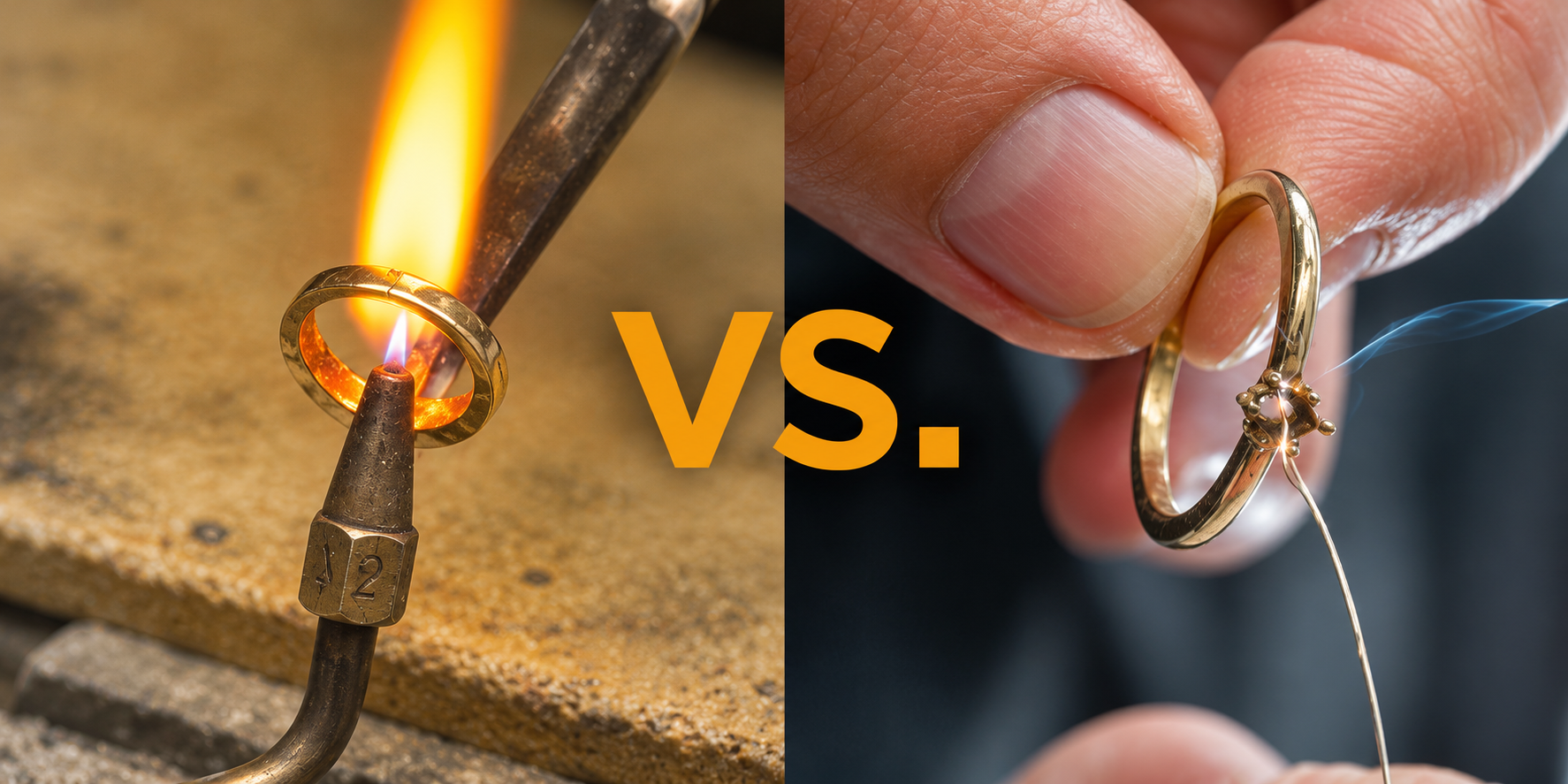
Laser welding is generally better for precision jewelry repairs, delicate components, and work near mounted gemstones. Traditional torch soldering remains a practical and economical choice for many routine repairs and fabrication tasks.
The main difference is how each method joins metal and distributes heat. Laser welding concentrates energy in a small area, while torch soldering heats a larger section of the jewelry to melt a separate joining alloy.
For professional jewelers, choosing the right method can affect repair quality, labor time, gemstone safety, and the amount of finishing required.
Whether you are considering a jewelry laser welder or looking to improve your existing repair process, understanding the strengths and limitations of both methods is essential.
1. What Is the Difference Between Laser Welding and Soldering?
Laser welding uses concentrated laser energy to melt and fuse the metal at the joint. Depending on the repair, the jeweler can join the existing metal directly or add compatible filler wire to rebuild damaged areas.
Traditional jewelry soldering uses a separate, lower-melting alloy to connect metal components without melting the parent metal. Most traditional precious-metal torch soldering is technically classified as brazing, although jewelers commonly call it soldering.
Laser Welding vs Soldering Comparison
| Factor | Laser Welding | Traditional Torch Soldering |
|---|---|---|
| Joining Method | Localized fusion of the base metal | Melting a separate solder alloy |
| Heat Distribution | Concentrated around the weld | Broader heating around the joint |
| Joint Strength | Potentially excellent with sufficient fusion | Reliable when properly designed and soldered |
| Gemstone Protection | Reduced heat exposure in suitable repairs | Often requires additional protection or stone removal |
| Seam Appearance | Can produce less visible joints | May leave a visible solder line |
| Filler Material | Optional or required depending on the repair | Required |
| Finishing Work | Often more localized | May require more cleaning and refinishing |
| Equipment Investment | Higher | Generally lower |
| Best Applications | Precision repairs and localized metal buildup | Routine assembly and suitable larger joints |
The most important distinction is not simply which technology is newer.
Laser welding offers greater control over where energy is delivered, while soldering provides an economical way to join properly fitted components through solder flow.
2. Is Laser Welding Stronger, Cleaner, and Safer Near Gemstones?
These are three of the most important considerations when choosing a jewelry repair method.
Is Laser Welding Stronger Than Soldering?
A properly executed laser weld can achieve strength comparable to the parent metal because the joint is formed through direct fusion.
However, this does not mean every laser weld is stronger than a soldered joint.
A laser weld that only melts the surface may appear complete but fail during filing, polishing, or normal wear.
Traditional soldering can produce a strong and durable connection when the joint is properly designed, the solder is compatible, and sufficient bonding area is achieved.
Laser weld strength depends on:
- Adequate fusion and penetration.
- Clean, properly fitted joint surfaces.
- Compatible base metals and filler wire.
- Appropriate laser settings and operator technique.
For structural repairs such as ring sizing, the quality of the joint matters more than whether it was made using a laser or a torch.
Which Method Produces a Cleaner Finish?
Laser welding can reduce the amount of surrounding metal that requires refinishing.
Because the energy is concentrated at the joint, nearby engraving, decorative details, and polished surfaces may remain relatively undisturbed.
Many laser welding repairs also require little or no flux, reducing the need for flux-related cleanup.
Compatible filler wire can help preserve the original metal color and reduce visible seam differences.
However, laser welding does not eliminate finishing work. Excessive energy, unsuitable filler, or poor technique can still create craters, porosity, discoloration, and uneven welds.
A well-executed soldered joint can also produce an excellent cosmetic finish.
Can You Laser Weld Jewelry Without Removing Gemstones?
In suitable cases, yes.
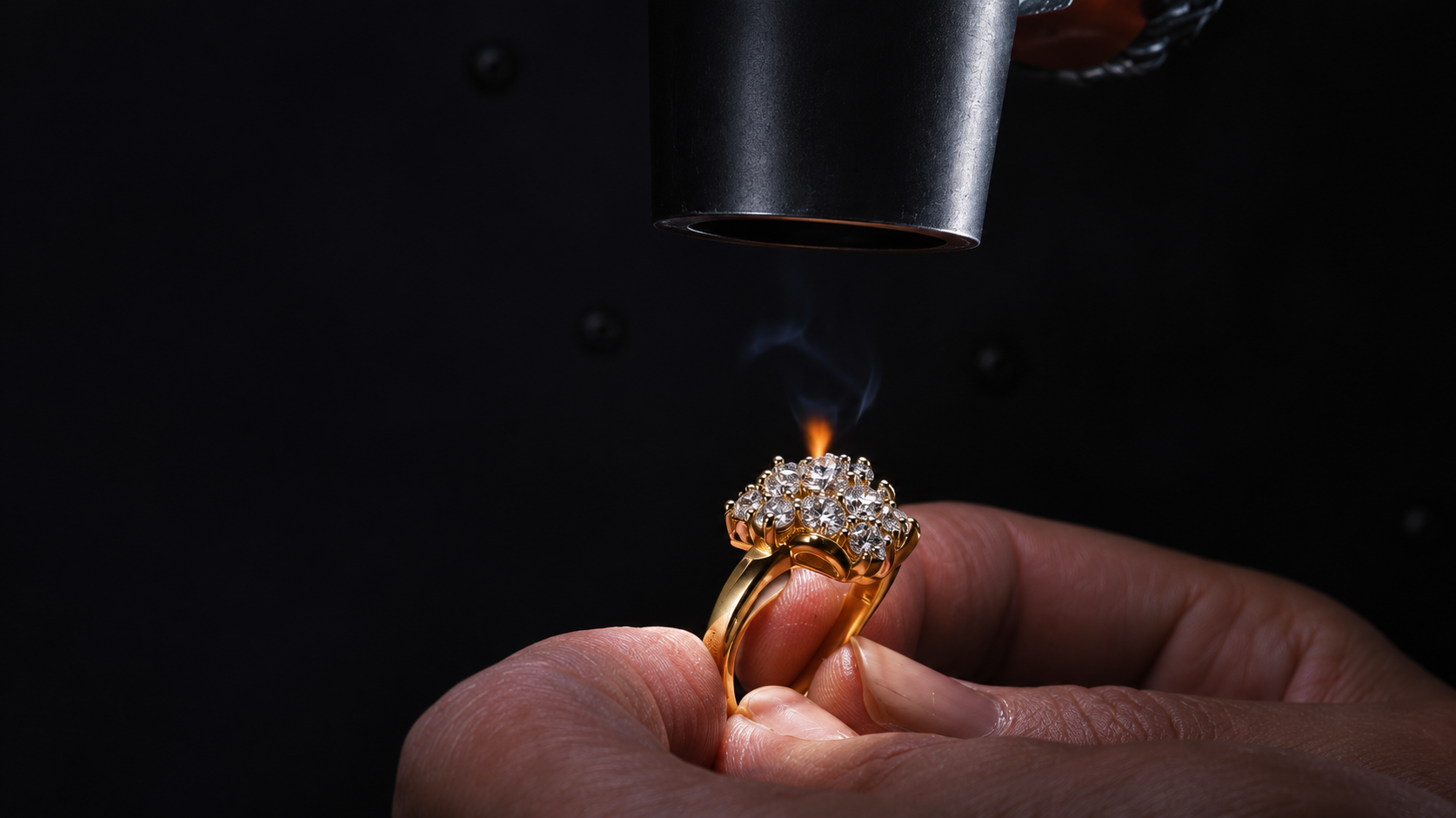
One of the main advantages of laser welding jewelry is its ability to limit heat exposure outside the immediate repair area.
This can make certain prong repairs, ring-sizing jobs, and small setting repairs possible without removing every nearby gemstone.
Traditional torch soldering generally heats a larger area, which may increase the need for stone removal and thermal protection.
However, laser welding does not guarantee gemstone safety.
Opals, pearls, emeralds, fracture-filled stones, and other heat-sensitive or treated gemstones may still require removal before repair.
Direct laser exposure, reflections, spatter, and heat conducted through the metal can all cause damage.
Even diamonds should not be deliberately exposed to the laser beam.
Before repairing a stone-set piece, identify the gemstone, inspect its condition and treatments, and determine whether the repair can be performed safely with the stone in place.
Laser welding reduces certain thermal risks, but it does not eliminate them.
3. Which Method Is Better for Gold, Silver, and Platinum?
Gold, silver, and platinum respond differently to laser energy and torch heating. If you work with silver often, a sterling silver laser welding machine supplier can help you match settings to its reflective, heat-conductive surface.
The best repair method depends on the alloy, joint dimensions, surrounding details, and the condition of the jewelry.
| Jewelry Metal | Laser Welding Advantages | When Soldering Remains Practical |
|---|---|---|
| Yellow Gold | Localized repairs, fine chains, prongs, and finished jewelry | Routine sizing, assembly, and accessible seams |
| White Gold | Precise repairs with compatible filler and reduced surrounding heat | Conventional assembly and suitable alloy-specific repairs |
| Rose Gold | Controlled joining and localized metal buildup | Routine fabrication with color-compatible solder |
| Sterling Silver | Reduced heating around delicate components | General fabrication and larger, accessible joints |
| Platinum | Precision fusion, prong rebuilding, and stone-set ring repairs | Selected joints using appropriate platinum solder and techniques |
Gold Jewelry
Both laser welding and soldering are widely used for gold jewelry repair.
Laser welding is particularly useful when repairing fine details, worn prongs, damaged settings, or finished pieces where broad heating would be undesirable.
For routine repairs on plain gold rings or accessible components, traditional soldering can remain an efficient choice.
White gold requires additional attention because certain alloy compositions and previous solder repairs can increase the risk of porosity or cracking.
Rose gold also requires suitable filler selection and controlled energy delivery to achieve an acceptable color match and joint quality.
Sterling Silver Jewelry
Silver presents a particular challenge for laser welding because of its high reflectivity and rapid heat conduction.
A suitable laser system from a sterling silver laser welder supplier can successfully repair sterling silver chains, rings, and small components, but its settings must be carefully matched to the joint.
Laser welding may help reduce firescale, distortion, and unnecessary heating around delicate areas.
Traditional silver soldering remains valuable for larger fabrication joints and routine assemblies where broader heating is acceptable.
Platinum Jewelry
Laser welding is especially useful for many platinum jewelry repairs because it allows localized fusion and controlled metal buildup.
For example, the Gemological Institute of America (GIA) demonstrates laser welding as a method for resizing platinum-cobalt rings containing channel-set diamonds.
This is a practical example of how laser welding can support precision repairs on valuable jewelry.
However, platinum’s high melting temperature and differences between alloy compositions still require suitable equipment, joint preparation, and welding parameters.
Workshops regularly handling these three metals should evaluate a laser welder for jewelry using representative samples rather than assuming one setting works for every alloy.
4. Which Method Should You Use for Common Jewelry Repairs?
The repair itself is often the best guide when choosing between laser welding and soldering.
Jewelry Repair Method Selection Chart
| Repair Application | Recommended Approach | Main Consideration |
|---|---|---|
| Fine Chain Repair | Laser welding often preferred | Limit damage to surrounding links |
| Plain Gold Ring Resizing | Either method | Joint strength, labor, and equipment availability |
| Platinum Ring Resizing | Laser welding often preferred | Fusion depth and filler compatibility |
| Diamond Prong Retipping | Laser welding often preferred | Precise metal placement and gemstone protection |
| Cracked Bezels | Laser welding often preferred | Preserve the surrounding setting |
| Clasp and Bail Repairs | Either method | Joint geometry and required bonding area |
| Hollow Jewelry | Case-by-case assessment | High risk of burn-through or collapse |
| Antique Jewelry Restoration | Laser welding often worth considering | Preserve original details and assess old solder |
| Filling Small Pores and Worn Areas | Laser welding with compatible filler | Remove defective material and rebuild sound metal |
| Routine Metal Assembly | Soldering often practical | Economical joining of accessible components |
These recommendations are starting points. The exact repair method should be based on the condition and construction of the piece. If you plan to bring this work in-house, compare a jewelry repair laser welding supplier first.
Example 1: Retipping a Diamond Ring Prong
A worn prong may require additional metal to restore its shape and secure the gemstone.
Laser welding allows the jeweler to place small amounts of compatible filler material directly onto the damaged area.
This can reduce unnecessary heating around the setting and limit the area that requires finishing.
However, a severely worn prong may need replacement rather than rebuilding.
The finished prong must provide adequate strength and securely hold the gemstone.
Example 2: Resizing a Plain Gold Ring
If a plain gold ring contains no gemstones or heat-sensitive decorations, either method may be appropriate.
An experienced jeweler may complete the repair efficiently using traditional soldering.
Laser welding is another option, particularly when localized heat control, color matching, or minimal surrounding refinishing is important.
In both cases, the joint must have sufficient strength to withstand normal use.
Example 3: Repairing a Fine Gold Chain
When repairing a small chain link, excessive heat can accidentally join neighboring links or damage delicate sections.
Laser welding offers more precise energy placement, which can be valuable when the surrounding links must remain flexible.
However, extremely thin or hollow links can still melt through if the pulse settings are unsuitable.
The repair should preserve both the strength and movement of the chain. Workshops that handle fine chains often source equipment from a permanent jewelry welder supplier offering adjustable YAG settings.
5. Which Method Is More Cost-Effective for Jewelry Repair Shops?
Traditional soldering generally requires less initial investment.
A torch, gas supply, solder, flux, and standard bench tools can support a wide range of everyday jewelry repairs.
Laser welding requires a higher equipment investment, but it may reduce labor and preparation requirements for certain precision jobs. Before buying, small shops can compare outsourcing costs with quotes from a laser welder supplier for repair shops.
Compare the Complete Repair Time
The cost of a repair includes more than the time spent joining metal.
For soldering, the complete process may involve gemstone removal, joint preparation, heating, flux removal, pickling, refinishing, and resetting.
Laser welding may reduce some of these steps when the repair can be completed locally without extensive disassembly.
However, simple torch repairs may still be faster and more economical than rebuilding a joint pulse by pulse.
The better comparison is the total cost and time required to deliver an acceptable finished repair.
What Equipment Features Matter for Precision Repairs?
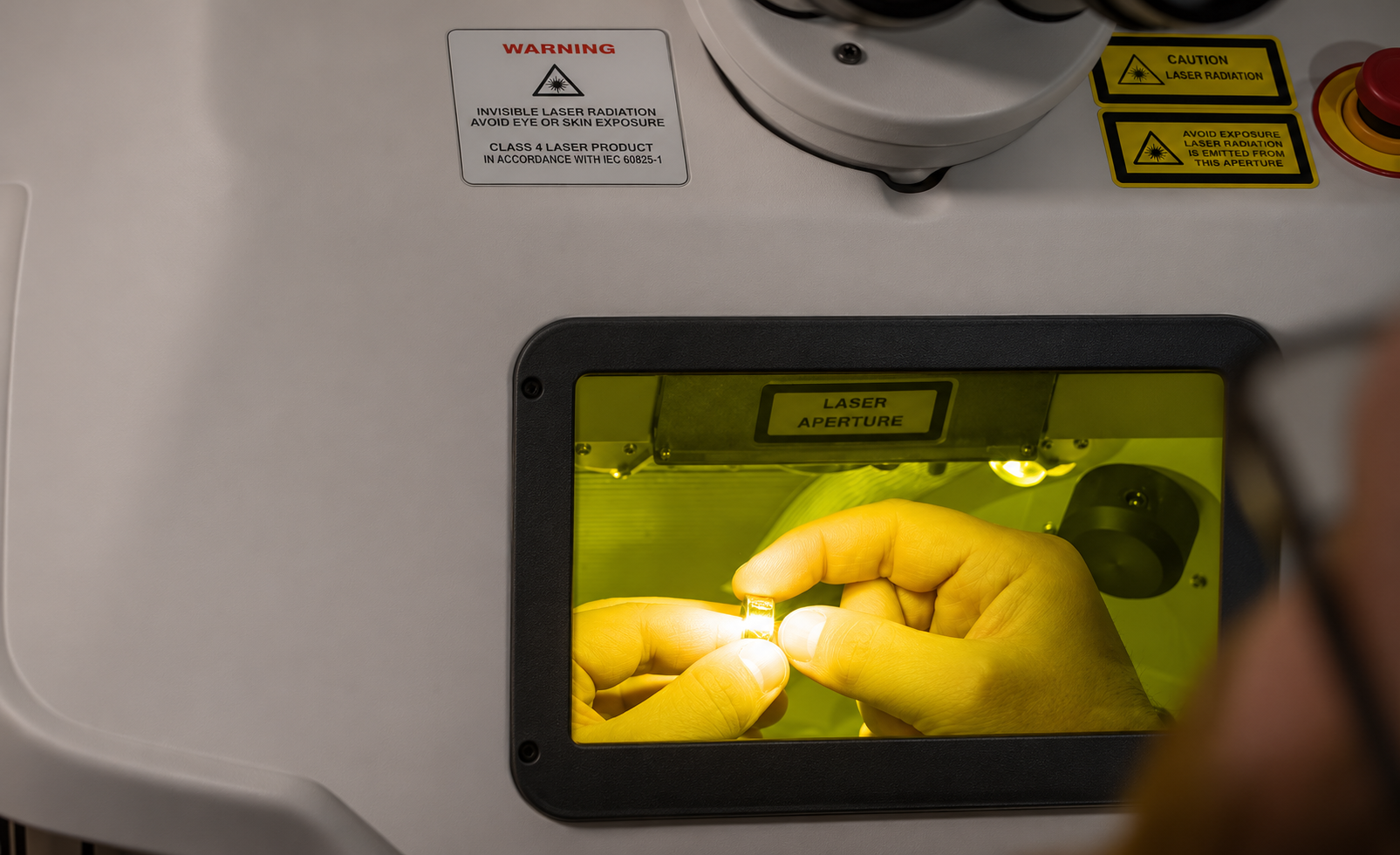
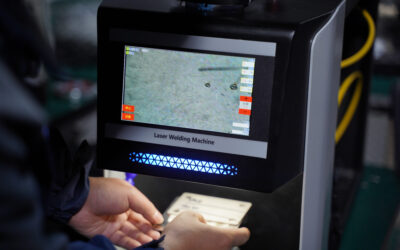
When evaluating a jewelry welding machine, consider its ability to place small welds accurately and deliver controlled energy to different jewelry metals.
For example, MaxWave, a laser machine manufacturer, offers an air-cooled QCW jewelry laser welding series with 60W, 150W, and 200W configurations and a 7-inch, 8-megapixel CCD viewing system.
The enlarged view helps operators position fine chain links, prongs, and small joints more accurately, while pulsed energy delivery supports localized welding.
Higher power may be useful for more demanding joints, but delicate repairs also require stable low-energy control.
Before purchasing, request test welds on the alloys and components your workshop repairs most frequently. Evaluate actual fusion, surface quality, and finishing requirements.
Operators must also follow appropriate laser radiation protection, ventilation, and equipment safety procedures.
Does Laser Welding Replace Traditional Soldering?
No. Many professional jewelry workshops benefit from having both technologies available.
Laser welding can handle precision work and localized rebuilding, while soldering remains useful for economical assembly and suitable larger joints.
For workshops with occasional precision repairs, outsourcing laser welding may also be a practical option before you choose a laser welding equipment supplier.
For businesses that regularly repair stone-set jewelry, fine chains, platinum rings, and damaged prongs, bringing laser welding in-house may reduce certain repair limitations.
The decision should reflect the shop’s actual workload rather than equipment specifications alone.
Conclusion
Laser welding is often the better choice for delicate jewelry repairs, localized metal rebuilding, and work where surrounding heat must be minimized. Traditional soldering remains effective for routine assembly, accessible joints, and workshops with limited equipment budgets.
Neither process guarantees a stronger or cleaner repair without appropriate joint preparation and skilled operation.
For professional jewelers, the greatest value of a jewelry laser welding machine is its ability to expand the range of precision repairs they can perform and reduce unnecessary heat exposure during suitable jobs.
Rather than replacing every traditional soldering procedure, laser welding provides an additional repair method for situations where precision, appearance, and heat control matter most.

0 Comments