
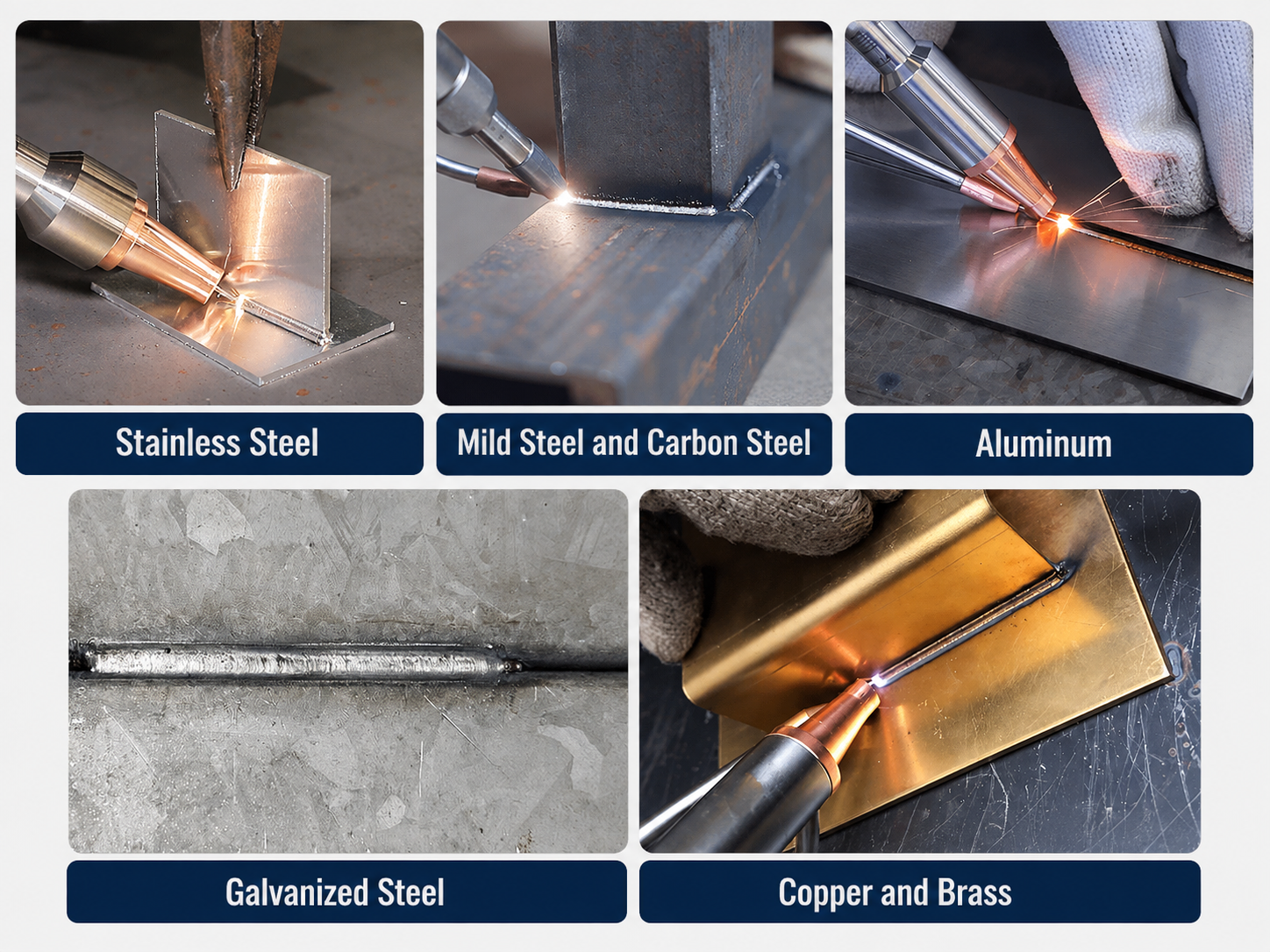
A handheld laser welder can weld most of the metals commonly used in sheet-metal fabrication, including stainless steel, mild steel, carbon steel, galvanized steel and aluminum. With the right machine and settings, it can also weld copper, brass, titanium and some specialty alloys.
But this is what most buyers really want to know:
Can it weld my material?
Can it weld my thickness?
Do I need 1500W or 2000W?
Will aluminum need more power than stainless steel?
Is the “maximum thickness” on the specification sheet realistic for daily production?
Those questions matter much more than whether a machine simply claims to “weld multiple metals.”
For most fabrication shops, a handheld laser welder is best suited to thin and medium sheet metal. Stainless and mild steel are usually the easiest applications, while aluminum, galvanized steel, copper and brass require more attention to power, fit-up and welding conditions.
One rule is especially important:
Maximum weldable thickness is not the same as recommended production thickness.
A supplier may demonstrate a machine welding a thick plate slowly under ideal conditions. That does not mean you should run that thickness all day at normal production speed.
1. How Thick Can a Handheld Laser Welder Weld?
Use this table as a practical starting point when comparing power levels.
Actual results depend on the machine, material grade, joint type, gap, welding speed, filler wire and required penetration.
|
Material |
1500W Practical Range |
2000W Practical Range |
3000W Practical Range |
|---|---|---|---|
|
Stainless steel |
About 0.5–3 mm |
About 1–5 mm |
About 3–8 mm |
|
Mild / carbon steel |
About 1–4 mm |
About 2–6 mm |
About 4–8 mm |
|
Aluminum |
About 0.5–2 mm |
About 1–4 mm |
About 3–6 mm |
|
Galvanized steel |
About 1–3 mm |
About 2–4 mm |
About 3–6 mm |
|
Copper / brass |
Mainly thin sections |
About 1–2 mm |
About 2–3 mm, depending on alloy |
These should be treated as working ranges, not guaranteed limits.
The original material makes the same important distinction: a machine may reach a higher maximum thickness, but the practical “sweet spot” for consistent welding is usually lower.
For example, if a 1500W machine is advertised to weld 4 mm stainless steel, that does not automatically mean 4 mm should be your normal production thickness.
If most of your paid work is 1–3 mm stainless, 1500W may be an excellent match.
If you regularly weld 4–5 mm stainless or carbon steel, a 2000W laser welder gives you more margin for penetration and speed.
Stainless Steel: Usually the Easiest Starting Point
Stainless steel is one of the most common applications for handheld laser welding.
Typical jobs include:
Kitchen equipment.
Cabinets.
Electrical enclosures.
Metal furniture.
Doors and frames.
Tanks.
Sanitary equipment.
Automotive components.
Both 304 and 316 stainless can be welded with handheld systems.
For a shop mainly working with 1–3 mm stainless sheet, 1500W is usually a practical power level.
When 3–5 mm stainless becomes a regular part of the workload, 2000W is more comfortable because the machine does not need to operate as close to its upper limit.
If you are choosing a laser welder for stainless steel, do not ask only:
“What is the maximum stainless thickness?”
Ask:
“What stainless thickness can I weld repeatedly at a normal production speed?”
That answer is much more useful.
Mild Steel and Carbon Steel
Mild steel is also very suitable for handheld laser welding.
For common frames, brackets, cabinets and fabricated components, a 1500W system can cover a large portion of normal 1–3 mm work.
Moving toward 4–6 mm steel makes 2000W increasingly useful.
A higher-power machine may also weld thinner steel faster, so production volume matters in addition to material thickness.
Surface condition matters as well.
Heavy rust, mill scale, paint, grease or oil around the joint can contribute to inconsistent welds and porosity.
For repeatable production, clean the weld area rather than expecting the laser to compensate for poor surface preparation.
Aluminum: Yes, but It Usually Needs More Power Margin
One of the most common buyer questions is:
Can a handheld laser welder weld aluminum?
Yes.
But aluminum is generally more demanding than stainless or mild steel because it reflects more laser energy and conducts heat away quickly.
That means the same thickness of aluminum may require more power margin than steel.
A shop working mainly with 1–2 mm aluminum can consider 1500W.
For 2–4 mm aluminum, 2000W is usually the more practical choice.
If thicker aluminum is a regular production requirement, higher power becomes increasingly useful.
This is why buyers looking for a laser welder for aluminum should always send the supplier the actual alloy and thickness.
“Aluminum” alone is not enough information.
Different aluminum grades can behave differently during welding.
If aluminum makes up a large part of your business, ask for a sample weld on the exact material you use before ordering the machine.
Galvanized Steel
Galvanized steel can also be welded with a handheld laser system.
The main issue is the zinc coating.
During welding, zinc can vaporize and contribute to fumes, porosity and spatter, particularly when the vapor becomes trapped inside a lap joint.
For occasional galvanized work, this is manageable with correct joint preparation and process control.
If galvanized sheet is one of your main production materials, ask the supplier to test:
Your actual coating.
Your actual thickness.
Your actual joint type.
Do not accept a stainless-steel demonstration as proof that galvanized production will behave exactly the same way.
Copper and Brass
Copper and brass are possible, but they are more difficult than ordinary steel.
Copper reflects laser energy strongly and moves heat away from the weld zone quickly.
Brass also contains zinc, introducing additional fume and porosity concerns.
For this reason, practical thickness is generally lower than stainless or carbon steel at the same power.
If copper or brass is central to your business, a generic “supports copper” statement is not enough.
Request a real weld sample.
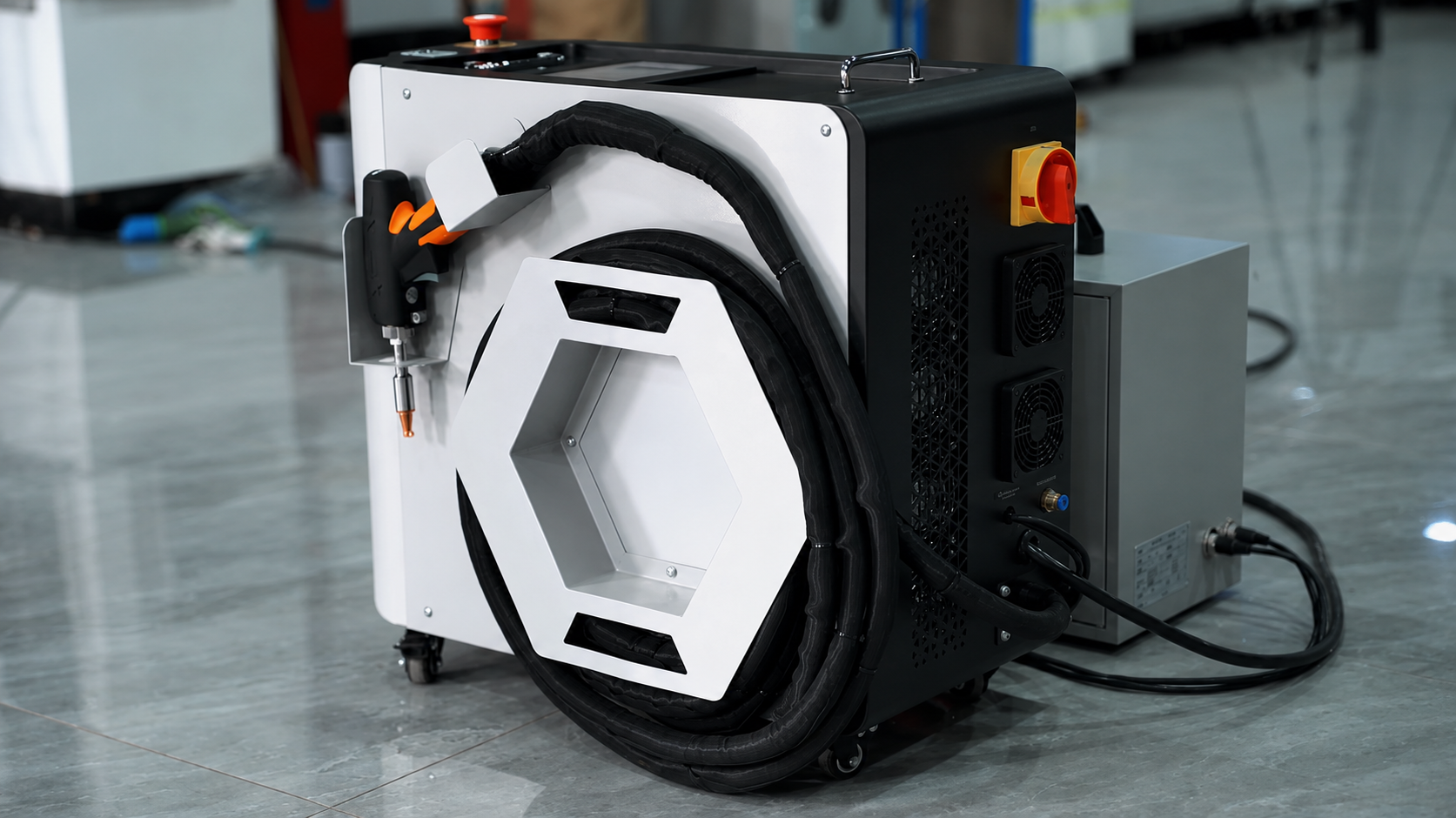
2. Should You Buy a 1500W, 2000W or 3000W Handheld Laser Welder?
For most buyers, this is the real purchasing question.
Do not choose power based on the thickest material your shop might weld once a year.
Choose based on the thickness that makes up most of your daily work.
Choose 1500W If Most of Your Work Is Thin Sheet
A 1500W laser welder is a good starting point for shops working mainly with:
1–3 mm stainless steel.
1–3 mm mild steel.
Thin galvanized sheet.
Approximately 1–2 mm aluminum.
Cabinets.
Kitchen equipment.
Metal furniture.
Doors and frames.
Automotive sheet metal.
Repair and custom fabrication.
For a small fabrication shop, repair business or owner-operator, 1500W can provide enough capability without paying for power that is rarely used.
If your typical question is:
“Can I weld 2 mm or 3 mm stainless?”
1500W is normally the first power class worth considering.
Choose 2000W If Your Workload Is Mixed
For many commercial fabrication shops, 2000W is the more flexible middle ground.
It is especially useful when your daily jobs include:
3–5 mm stainless.
3–6 mm carbon steel.
2–4 mm aluminum.
Different materials on the same production floor.
Higher daily welding volume.
Jobs where speed matters as much as penetration.
A 2000W machine is not valuable only because it can weld thicker metal.
It can also give you more speed and process margin when welding material that a 1500W machine could technically handle.
If your shop regularly switches between stainless steel, carbon steel and aluminum, a handheld laser welding machine around 2000W is often easier to justify.
Choose 3000W When Thick Material Is Normal, Not Occasional
3000W makes more sense when thicker work is a regular part of production.
Examples include:
5 mm+ steel.
Heavier frames.
Machinery components.
Industrial fabrication.
Higher-throughput production.
But more power is not automatically better.
If most of your work is 1 mm stainless sheet, a 3000W machine may give you capacity you rarely need while requiring tighter control to avoid excessive heat input.
Buy 3000W because your normal work requires it, not because the number looks better on the quotation.
Quick Power Selection Guide
|
Your Main Work |
Best Starting Point |
|---|---|
|
1–3 mm stainless / mild steel |
1500W |
|
3–5 mm stainless |
2000W |
|
3–6 mm mild / carbon steel |
2000W |
|
1–2 mm aluminum |
1500W |
|
2–4 mm aluminum |
2000W |
|
Regular 5 mm+ steel |
Consider 3000W |
|
Copper / brass |
Sample test before choosing |
|
Mixed fabrication shop |
2000W is often the safest middle ground |
This is the table most buyers actually need.
3. What Else Determines How Thick You Can Weld?
Wattage is important, but it does not tell the whole story.
This is why two 1500W machines can have different published thickness limits.
Joint Gap
Handheld laser welding prefers good fit-up.
If the gap between parts is small, creating a stable weld is easier.
As the gap increases, maintaining penetration and bead appearance becomes more difficult.
Wire feeding can help bridge a gap, but it does not completely compensate for poor fabrication tolerances.
If your current parts have large or inconsistent gaps, include those gaps in your sample welding test.
Do not send the supplier perfectly machined samples if your real factory parts are not perfectly fitted.
Do You Need Filler Wire?
Another common buyer question is:
Do I need filler wire for handheld laser welding?
Not always.
Well-fitted joints can often be welded without filler.
Filler wire becomes more useful when:
There is a joint gap.
You need to add material.
The joint requires a wider bead.
You need to improve appearance or reinforcement.
If your production parts regularly have gaps, choose a system with a suitable wire feeder rather than assuming autogenous welding will cover everything.
Joint Type
Butt, lap, corner and fillet joints do not have exactly the same thickness capability.
A supplier quoting “6 mm welding capacity” should be able to tell you:
Which material?
Which joint?
With or without filler?
At what travel speed?
One or multiple passes?
Without those details, the thickness number does not tell you enough.
Welding Speed
Slowing down can increase penetration, but it also increases heat input.
That may improve a thick weld while increasing distortion or burn-through on thinner material.
For a paying fabrication shop, the goal is not simply:
“Can the machine eventually weld this plate?”
The goal is:
“Can it weld this plate repeatedly at a speed that makes money?”
This is why production thickness matters more than maximum thickness.
Material Grade
304 stainless and 316 stainless are related, but not identical.
Neither are all aluminum alloys.
Neither are all carbon steels.
If the weld is important to your production, tell the supplier the actual material grade.
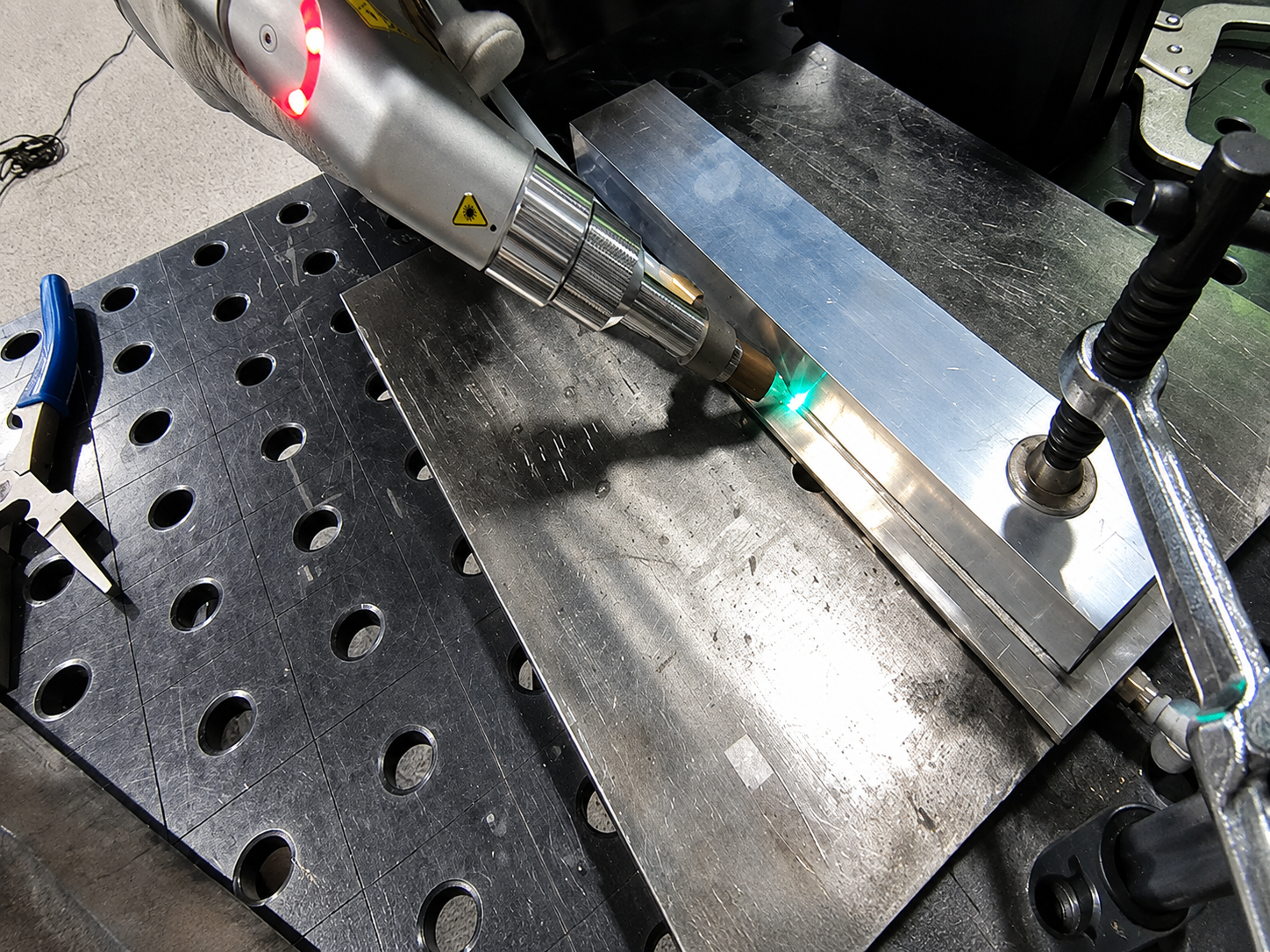
How Should You Test a Machine Before Buying?
Before choosing a fiber laser welder, send the supplier a simple application sheet:
Material: 304 stainless / mild steel / 6061 aluminum / galvanized steel
Thickness: 1 mm / 3 mm / 5 mm
Joint: butt / lap / fillet / corner
Typical gap: actual production gap
Filler: yes or no
Daily workload: parts per day or welding hours
Required result: cosmetic, structural, airtight, etc.
Then ask for a welding video showing:
The actual machine.
The actual sample.
The welding process.
Front weld appearance.
Back penetration where relevant.
Whether filler wire was used.
This is much more useful than watching another generic demonstration on 1 mm stainless sheet.
Conclusion
So, what metals can a handheld laser welder weld?
For most fabrication businesses, the main materials are:
Stainless steel.
Mild and carbon steel.
Galvanized steel.
Aluminum.
Copper, brass, titanium and specialty alloys can also be possible, but they deserve more application-specific testing.
For power selection, keep the decision simple:
Mostly 1–3 mm steel → start with 1500W.
Regular 3–5 mm steel or 2–4 mm aluminum → 2000W gives more useful headroom.
Regular 5 mm+ material → evaluate 3000W or another higher-power solution.
And never choose a machine from the maximum-thickness number alone.
The best laser welder for metal is not the one that produces the thickest demonstration weld.
It is the one that can repeatedly weld your normal material, your normal thickness and your normal joint at a speed and quality your customers will pay for.
Before choosing a machine, send TheLaserTool your material type, grade, thickness, joint, gap, daily volume and a photo of the workpiece.
A real sample weld will tell you whether you need 1500W, 2000W or more far more accurately than a maximum-thickness number on a product page.

0 Comments