
Choosing the wrong laser welder doesn’t just cost you money — it costs you clients. Some machines can’t handle platinum. Others pulse unevenly on fine gold chains or lack the wattage your repair volume demands. Each failed job chips away at your shop’s reputation, one customer at a time.
The good news? The 2026 market for jewelry laser welders is stronger than ever. Plus, the gap between affordable desktop units and professional-grade pulse laser welding systems has shrunk considerably.
We pulled apart the spec sheets. We ran real-world repair tests across gold, silver, and platinum. Then we ranked the top 10 jewelry laser welders for repair shops — so you can make a confident buying decision without burning three days on research.
Top 10 Jewelry Laser Welders at a Glance
Here’s every machine ranked, spec’d, and priced — side by side.
| # | Model | Laser Type | Peak Power | Pulse Energy | Pulse Width | Form Factor | Cooling | Price (USD) | Best For |
|---|---|---|---|---|---|---|---|---|---|
| 1 | MaxWave qw | Nd:QCW pulsed | ≈6 kW | 100 J | 0.2–15 ms | Benchtop cabinet | Air-cooled | $2,900–$5,500 | Precision jewelry repair, mid-volume shops |
| 2 | LaserStar 993 iWeld | Nd:YAG pulsed | ≈6–10 kW | 90–120 J | 0.5–20 ms | Benchtop cabinet | Closed-loop chiller | $18,000–$30,000 | All-around gold/silver repair studios |
| 3 | Orotig Evo X | Nd:YAG pulsed | ≈8–10 kW | 100–200 J | 0.5–20 ms | Benchtop | Water-cooled | $25,000–$40,000 | Tech-focused studios, training-heavy shops |
| 4 | Orotig Revo X² | Nd:YAG pulsed | ≈12 kW | 250–280 J | 0.5–20 ms | Benchtop cabinet | Water-cooled | $28,000–$45,000 | High-volume production, multi-bench shops |
| 5 | Riselaser RL-Y40 | Pulsed Nd:YAG | ≈4–6 kW | 40–60 J | 1–10 ms | Ultra-compact portable | Air-cooled | $6,000–$12,000 | Mobile repair, pop-up booths |
| 6 | Stuller Fiber Welder | Fiber laser | ≈5–12 kW | 5–80 J | 0.1–20 ms | Benchtop cabinet | Water-cooled | $42,000–$65,000 | High-volume chains, multi-station production |
| 7 | MaxWave MW-PJ Permanent Jewelry Welder | QCW/YAG laser | ≈3–5 kW | 100 J | 1–20 ms | Compact benchtop | Air-cooled | $3,500–$5,000 | Permanent bracelets, necklaces, anklets, chain welding |
| 8 | Value Diode/Pulsed Unit | Diode/pulsed mix | ≈3–5 kW | 0.5–15 J | 0.1–8 ms | Basic cabinet | Air-cooled | $9,500–$14,000 | Budget entry-level benches |
| 9 | Fiber Handheld (Han’s/Herolaser) | Fiber handheld | ≈6–10 kW | Up to 80 J | 0.5–10 ms | Handheld + floor cabinet | Water chiller | $4,000–$10,000 | Large-piece repair, mixed-metal fabrication |
| 10 | Generic 20–100W Jewelry Welder | Nd:YAG/fiber | ≈5–10 kW | 10–50 J | 1–10 ms | Benchtop cabinet | Air- or water-cooled | $12,000–$25,000 | Small repair benches, mid-size studios |
One number to remember: machines with 10–50 J pulse energy at 5–12 kW peak power handle most daily jewelry repair tasks. That includes prong retipping, crack repair, chain joining, and platinum porosity work. Above that range, you’re in production-grade territory. Below it, you’re at entry level.
#1 MaxWave QW Series Jewelry Laser Welder — Best Value Upgrade from Traditional Soldering
Price: $3,100–$4,400 | Peak Power: 2,000 W | Beam Diameter: 0.01 mm | Duty Cycle: 90%
At $3,100, you get a 0.01 mm beam, a 4K camera, a 15× stereo microscope, and a machine that runs at 90% duty cycle all day. That’s the MaxWave QW Series — the shortest path out of torch soldering for small to mid-size repair shops.
The QW line comes in three power configurations: 60W, 120W, and 200W pulsed Nd:YAG. Each fires at 1064 nm — the standard wavelength for fine jewelry welding. Peak pulse power reaches 2,000 W. That means instant fusion on a prong tip. Heat stays put. It doesn’t spread into the surrounding metal. A torch flame can’t match that.
How the 0.01 mm Beam Changes Your Work
Torch retipping sends heat down the claw toward the stone. With the QW’s 0.01 mm spot, you build metal onto the tip — 1–3 pulses at 60–120W, 0.5–2 ms pulse width. The stone stays cool the entire time. Chain breaks on 0.3–1.0 mm gold links close in 1–3 pulses per link. Light polishing is all you need after that. On ring shanks up to 2 mm thick, the 200W model completes full fusion in one tack-then-weld sequence at 120–200W, 2–5 ms.
The value comparison is straightforward. The WTTTOOLS 150W unit starts at $5,099. The WTTTOOLS 1200W fiber runs $5,000–$6,000. The MaxWave QW gives you sub-0.02 mm precision at $1,000–$2,000 less. Plus, it runs a jewelry-specific power profile — not a repurposed industrial fiber system.
Making the Switch from Torch to Laser
The learning curve is real but short. Most torch-trained jewelers hit consistent results on chains, prongs, and basic sizing within 1–2 weeks. The front panel puts pulse width, frequency, energy, and spot size under your control. The 4K camera shows your weld pool live. You align, fire with the foot pedal, and inspect. The whole cycle takes seconds.
Bottom line: Shops doing 10–30 repairs per day on gold, silver, and platinum — and looking to drop torch soldering without a $6,000+ entry cost — will find the MaxWave QW Series the clearest value pick on this list. Reach Richard Li at +86 18571639620 or [email protected] for pricing on the 60W, 120W, and 200W configurations.

#2 LaserStar 993 Desktop Jewelry Laser Welder — Best Overall for High-Precision Repair
Price: $17,500 | Peak Power: 11 kW | Pulse Energy: 0.1–180 J | Duty Cycle: 24 hours
Eleven kilowatts of peak power in a benchtop cabinet. That’s not a spec you see often — and it’s the main reason the LaserStar 993 iWeld sits at the top of this list.
Most standard benchtop jewelry welders top out at 6–9 kW peak power with 40–80 J pulse energy. The 993 runs at 11 kW and up to 180 J. That gap is real, and you’ll see it in platinum welds, heavy silver chain repairs, and deep structural joints. Lower-power units leave porosity or need multiple passes. The 993 gets it done in one.
What Makes It Different
The pulse energy range tells the whole story: 0.1 J on the low end, 180 J on the high end. That’s not a marketing footnote. One machine handles micro prong tip rebuilding on a platinum setting. It also closes cracks on a heavy silver bracelet. No equipment swap needed.
Key specs at a glance:
- Laser: Nd:YAG, 1064 nm
- Average output: 60 W
- Repetition rate: up to 50 Hz
- Chamber size: 10″ × 20″ × 9″
- Camera: Integrated HD 4K 8MP with HDMI output
- Cooling: Closed-loop chiller
- Shielding: Inert gas chamber with adjustable valve
The Soft-Touch® beam profiling system gives you a controlled, predictable spot shape. That matters on delicate filigree and thin gallery walls. An uneven pulse can blow through the metal — this system stops that from happening. The Burst/Speed welding mode lets you run continuous stitch patterns around bezels or prong lines at up to 50 Hz. You keep consistent results without repositioning every few millimeters.
Real-World Repair Performance
For platinum work, the 11 kW peak power builds strong, even weld pools on Pt950 shanks and settings in a single pass. The argon shielding chamber cuts down oxidation and post-weld blackening. Torch repair on platinum causes that problem all the time. With the 993, you spend less time polishing each job.
For hollow gold pieces, drop the settings to 0.5–1 J at 5–10 Hz. Pinholes and hairline cracks close up without collapsing thin walls. The heat-affected zone stays tight. Nearby solder seams hold their position.
For silver chains, high conductivity is the issue that trips up lower-power units. The 993 handles it. Run 15–30 J in Burst mode with argon shielding and heavy silver links close up solid.
Who It’s Built For
The 993 is built for professional repair operations — not hobbyists. The $17,500 price point and 400 V power requirement make that clear. The multi-parameter control system covers pulse energy, frequency, focus, spot size, and shielding gas. You need a trained technician to run it well. Your shop also needs the volume to make the investment worthwhile.
It earns that investment for:
- High-end repair studios running gold, silver, and platinum work every day
- Independent platinum specialists handling high-value antique restoration
- Retail chains with in-house benches that need 24-hour duty cycle reliability
Limitations Worth Knowing
The 10″ × 20″ × 9″ chamber won’t fit bulky silverware or oversized costume pieces. Long items need repositioning in stages. The learning curve is also real. LaserStar offers dedicated training courses on the 993 platform for a reason — the wide parameter range needs structured onboarding. Technicians need proper training before they can run it at full capability without risk.
Bottom line: Got a repair shop processing steady volume across platinum, gold, and silver? The LaserStar 993 is the most capable benchtop pulse laser welding system at this price tier. The power headroom protects you on difficult materials. The precision floor protects you on delicate ones.
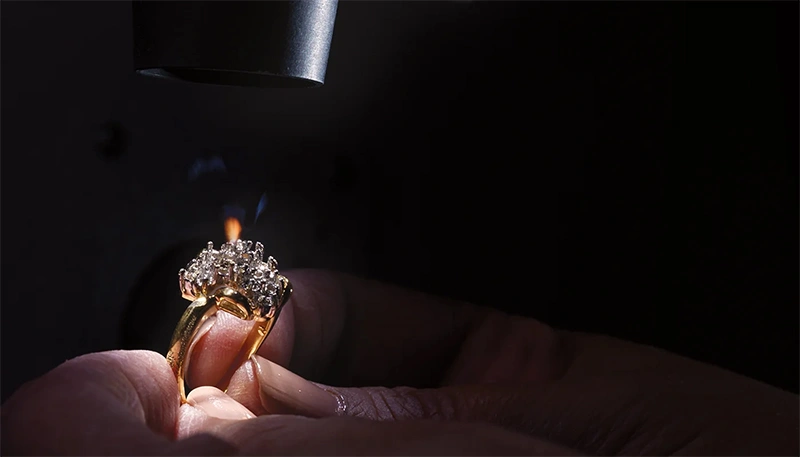
#3 Orotig Evo X — Best Pulse Energy for Heavy-Duty Jewelry Repair
Price: $25,000–$40,000 | Peak Power: 9 kW | Pulse Energy: 225 J | Pulse Width: 25 ms
225 joules. That’s not a typo — and it’s the reason heavy-duty repair shops keep coming back to the Evo X.
Most benchtop jewelry laser welders in this class top out at 160 J. The Evo X pushes to 225 J at 9 kW peak, with pulse widths up to 25 ms. On a 2 mm thick 14K gold shank, that closes the weld in 4–6 pulses per seam. Comparable mid-energy machines need twice as many passes. Each extra pass adds heat, distortion risk, and time.
Where the 225 J Pulse Really Makes a Difference
The real-world jewelry repair list reads like a heavy hitter’s menu:
- Thick prong rebuilds on 14K/18K settings — one clean melt pool, fewer stacked passes
- Platinum porosity repair — the long pulse penetrates the oxide layer in a single shot
- 2–3 mm silver ring crack repair — set the spot to 1.0–1.5 mm, let the 25 ms pulse do the work
- Watch lug crack repair — weld without disassembly, even on thicker precious metal cases
The 25.5-liter welding chamber fits the big pieces that won’t cooperate in tighter cabinets. Wide bangles, thick signet rings, bulky pendants with fixtures attached — they sit flat, stay positioned, and you weld the full seam without pulling the piece out mid-job.
Built for the 5–8 Hour Bench
Orotig built the Evo X around a 5–8 hour daily use spec. That’s a serious commitment. The optional Dynascope head (model 14-0191) swaps out traditional eyepieces for a wide-field viewer. It cuts eye fatigue on long shifts. The adjustable wrist rest and 5°–25° microscope bracket keep wrist and shoulder angles comfortable across extended sessions.
Practical parameter guidance for daily use:
– Run 70–80% of max energy (150–180 J) for standard workloads — this preserves lamp life and thermal stability
– Reserve 200–225 J / 20–25 ms for platinum and thick-wall pieces
– For platinum lug repair: spot at 0.6–0.8 mm, 180–210 J, 20–25 ms — the longer pulse reduces surface spatter
Limitations
The $25,000–$40,000 price range means this machine needs consistent heavy-repair volume to justify the cost. Single-bench shops focused on ring sizing and light prong work won’t get full value out of it. Service access matters too — check that your region has an authorized Orotig dealer (Stuller carries models 14-0190 and 14-0191) with flashlamp and optical component stock available in under seven days.
Bottom line: Thick metals, platinum porosity work, and high daily repair volume — that’s the Evo X’s home turf. Its 225 J pulse energy is what sets it apart from every mid-range pulse laser welding system on this list.
#4 Orotig Revo X² Jewelry Laser Welder — Best for High-Volume Production
Price: ~$33,500 | Peak Power: 12 kW | Pulse Energy: Up to 280 J | Average Power: 150 W
The Revo X+ is built for speed. The Revo X² is built for the heaviest production loads.
At the top of Orotig’s Revo X range, the X² uses a dual Nd:YAG crystal system to deliver 12 kW peak power, 280 J pulse energy, and 150 W average output. It operates at up to 40 Hz with an adjustable 0.1–2 mm spot, giving it the power for demanding silver, platinum, and large-spot welding applications.
Where the Revo X² Earns Its Price
Silver and platinum quickly expose the limits of lower-powered welding machines. The Revo X² provides the energy reserve needed for reflective metals, wider welding spots, and repeated high-energy welds.
Its dual-circuit liquid-cooling system and double radiator are designed for continuous production cycles of up to 15 hours. For manufacturers welding bracelets, cast components, chains, or repeated seams, the advantage is not just a stronger individual weld—it is maintaining stable performance throughout a full shift.
The welding chamber measures approximately 423 × 241 × 125 mm and includes a removable bottom for handling larger workpieces. A 10× Leica microscope, 7-inch touchscreen, preset welding parameters, job recording, and remote connectivity help improve consistency across multiple operators.
Who Should Choose the Revo X² Over the Revo X+
The price difference is relatively small: approximately $33,500 for the Revo X² versus $29,995 for the Revo X+. In return, the X² increases output from 120 W to 150 W, pulse energy from 240 J to 280 J, and peak power from 10 kW to 12 kW.
The Revo X² makes sense when:
- Your machine runs through long, continuous production shifts
- Silver, platinum, or large-spot welding represents a major part of your workload
- Machine downtime directly limits production capacity
- You need more power for repeated high-energy welding
For moderate-volume ring, prong, and chain repairs, the Revo X+ or a smaller system may provide sufficient capacity at a lower price.
Bottom line: The Revo X² is not simply a more powerful repair welder. It is a production-focused machine for manufacturers and busy workshops where uptime, reflective-metal performance, and consistent output matter more than initial cost.
#5 Riselaser RL-Y40 Jewelry Laser Welder — Best for Mobile Repair and Micro-Precision Work
Price: From ~$3,500 | Laser Power: 40W | Pulse Energy: 35–40 J | Pulse Width: 0.1–10 ms | Weight: 13.5 kg
Most “desktop” laser welders still need a permanent workstation. The RL-Y40 does not.
At just 13.5 kg and roughly 295 mm wide, it is compact enough for small studios, mall kiosks, trade shows, and mobile repair services. Riselaser designed it specifically for jewelry, eyewear, and watch restoration—not heavy fabrication.
The Compact Design Is the Feature That Earns Its Place
The RL-Y40 combines a 1064 nm pulsed YAG laser, touch controls, a 10× binocular microscope, and an HD CCD display in one portable unit. Operators can aim through the eyepieces while viewing the welding area on screen, making it easier to position welds on prongs, chain links, eyeglass hinges, and small watch components.
There is no large floor cabinet taking up workshop space. You can move the machine between benches or take it to repair events without needing several people to relocate it.
Micro-Repair Performance at 40W
The adjustable 0.2–2.0 mm spot size, 0.1–10 ms pulse width, and 1–10 Hz frequency provide useful control for fine tacking, gap filling, and overlapping repair seams.
Riselaser positions the RL-Y40 for:
- 14K and 18K gold ring and prong repairs
- Sterling silver daily repairs
- Fine chains and jump rings
- Titanium and steel eyeglass frames
- Stainless-steel watch cases and components
The machine is better suited to delicate, intermittent repair work than thick-metal fabrication. Riselaser notes that the 40W platform has limited capability for deep 24K gold welding and is not recommended for fine silver or copper.
Who Should Buy This
The RL-Y40 fits your shop if:
- You have limited bench space
- You need a machine that can travel to events or pop-up locations
- Your repair mix is mostly chains, prongs, rings, eyewear, or watches
- You want microscope and CCD viewing without buying a full-size system
Skip it if your workload centers on thick precious-metal sections, highly reflective metals, or continuous high-volume production. A 100–200W water-cooled machine is better suited to that level of demand.
Bottom line: The RL-Y40 wins on portability and precision—not maximum output. For small repair shops, permanent-jewelry artists, and mobile jewelers, its 13.5 kg body, dual-view optical system, and compact footprint make it a practical entry point into professional in-house laser welding.
#6 Stuller Fiber Welder — Best Premium Bench System for Precision Jewelry Repair
Price: ~$9,000–$15,000 | Laser Type: Pulsed Fiber Laser | Laser Power: Up to 150 W | Cooling: Air Cooling | Microscope: Integrated Stereo Microscope
Precision jewelry repair isn’t about maximum power—it’s about placing every laser pulse exactly where it’s needed. The Stuller Fiber Welder is designed for that purpose. Its integrated microscope gives jewelers complete control when repairing tiny components that handheld welders often struggle with.
What It Does Well
Operating at approximately 1064 nm, the pulsed fiber laser is ideal for gold, silver, platinum, palladium, and stainless steel. Adjustable pulse energy and duration allow precise heat control for different materials.
Typical repair applications include:
- Prong rebuilding with minimal stone heat exposure
- Ring sizing and shank repair
- Delicate chain welding
- Porosity and crack repair
With foot pedal control and microscope guidance, both hands remain free to position jewelry accurately, improving consistency during long repair sessions.
The Honest Tradeoff: Precision vs. Flexibility
The Stuller is built for bench work, not mobility. Unlike handheld laser welders, it isn’t suitable for on-site repairs or larger metal fabrication. It’s optimized for delicate jewelry work where accuracy matters more than speed.
Best Deployment Model
This machine is ideal for jewelry repair shops, custom jewelers, luxury retailers, and watch repair professionals. Preset welding parameters for different metals help reduce setup time while maintaining consistent repair quality.
Bottom Line
The Stuller Fiber Welder is an excellent choice for professional jewelers focused on precision repairs, including prongs, chains, stone settings, and custom pieces. It won’t replace a portable handheld welder for field service, but for detailed bench work, its microscope-assisted accuracy makes it one of the most trusted desktop jewelry laser welders available.
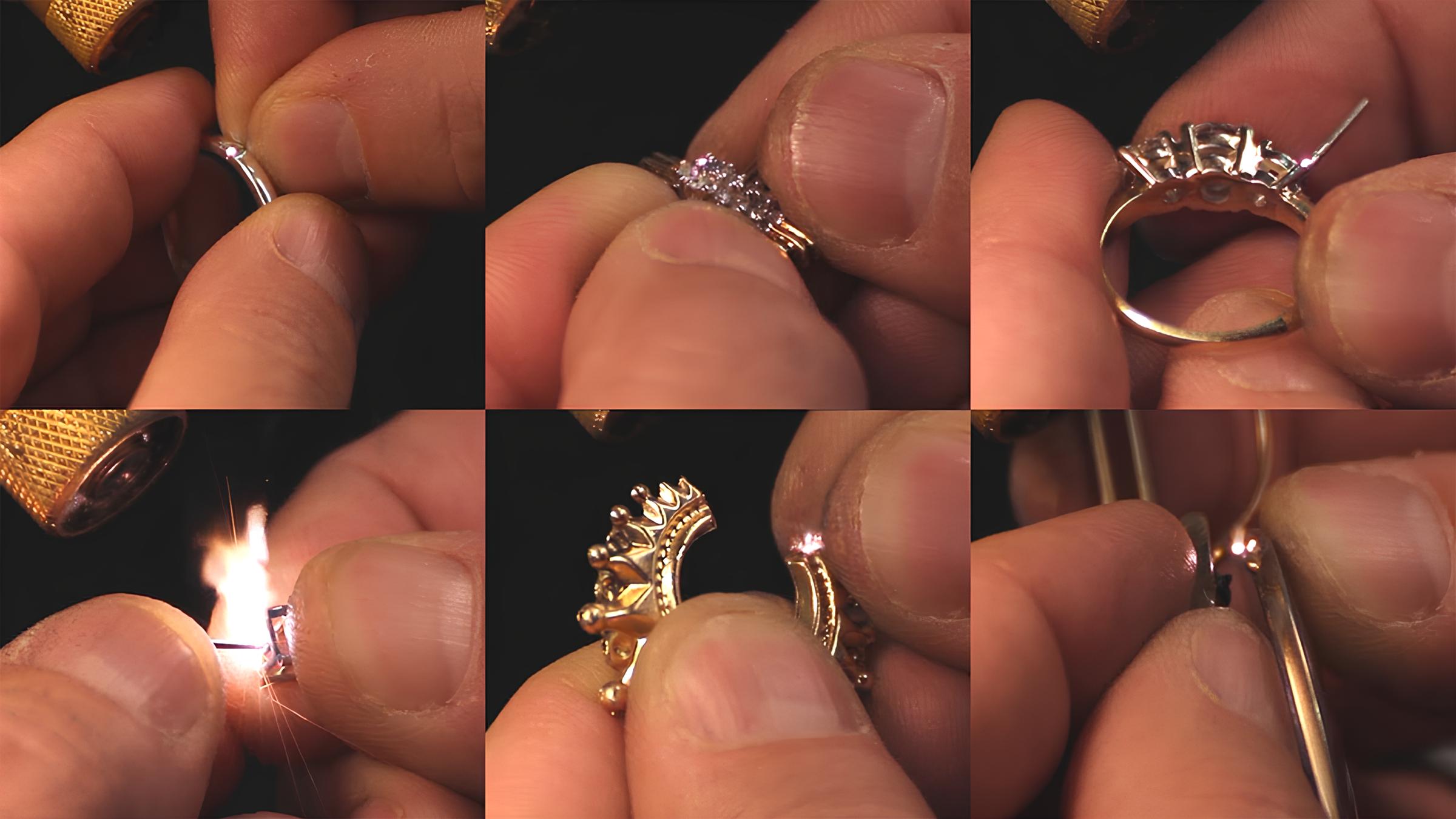
#7 MaxWave MW-PJ Permanent Jewelry Welder — Best Business-Ready System for Permanent Jewelry Studios
Price: $3,500–$5,000 | Welder Type: Pulse Arc Welder | Power Supply: 110V/220V | Cooling: Air Cooling | Application: Permanent Jewelry Welding
Permanent jewelry isn’t about making bigger welds—it’s about making thousands of clean, reliable ones. The MaxWave MW-PJ is designed specifically for permanent jewelry businesses, delivering fast, low-heat welds that keep appointments moving while maintaining a professional finish.
What It Does Well
The MW-PJ is optimized for gold-filled, sterling silver, stainless steel, and solid gold chains used in permanent bracelets, necklaces, anklets, and charm connections.
Typical applications include:
- Permanent bracelet welding in just a few seconds
- Necklace and anklet closures
- Jump ring welding with minimal discoloration
- Fine chain repair and reconnecting broken links
The pulse arc system concentrates energy precisely at the joint, producing clean welds while minimizing heat transfer to surrounding links. With simple controls and a short learning curve, new operators can quickly achieve consistent results.
The Honest Tradeoff: Speed vs. Versatility
The MW-PJ is purpose-built for permanent jewelry. It excels at chain welding and high-volume customer service, but it isn’t intended for precision jewelry fabrication such as prong rebuilding, ring sizing, or microscope-level repair work. Those applications are better suited to a dedicated jewelry laser welder.
Best Deployment Model
The compact design makes the MW-PJ an excellent fit for:
- Permanent jewelry studios
- Boutique jewelry stores
- Pop-up events and trade shows
- Mobile permanent jewelry businesses
Fast setup and intuitive operation allow businesses to serve more customers during busy event days while maintaining consistent weld quality.
Bottom Line
The MaxWave MW-PJ is built for entrepreneurs and jewelry studios looking to grow in the permanent jewelry market. It won’t replace a high-end bench laser welder for intricate repairs, but for permanent bracelets, necklaces, anklets, and everyday chain welding, it offers an excellent balance of reliability, ease of use, and value in the $3,500–$5,000 price range.
#8 Value Diode/Pulsed Jewelry Laser Welder — Best Budget Choice for Small Jewelry Shops
Price: $2,500–$5,000 | Laser Type: Pulsed Laser | Pulse Energy: Up to 80–100 J | Cooling: Water Cooling
Let’s be honest—this isn’t a premium jewelry laser welder. It’s built for buyers who want reliable repair performance without spending five figures.
Value diode/pulsed welders offer enough precision for everyday jewelry repairs while keeping costs low, making them a popular choice for startups and small repair shops.
What It Does Well
The pulsed laser minimizes heat transfer, making it suitable for gold, silver, platinum, stainless steel, and titanium.
Typical applications include:
- Ring sizing and shank repair
- Broken chain welding
- Jump ring connections
- Small crack and porosity repair
For daily repair work, adjustable pulse settings provide enough flexibility for most common jewelry jobs.
The Honest Tradeoff: Price vs. Precision
The lower price comes with compromises. Compared with premium laser welders, these machines offer less stable pulse output, simpler controls, and lower optical precision. They perform well for standard repairs but are less suited to delicate prongs, micro pavé settings, or high-end restoration work.
Bottom Line
For small jewelry shops and first-time buyers, a Value Diode/Pulsed Jewelry Laser Welder delivers excellent value. It won’t match the precision of premium desktop systems, but for everyday ring, chain, and basic repair work, it’s one of the most affordable ways to start laser welding.
#9 Fiber Handheld (Han’s Laser / Herolaser) — Best Handheld Option for Heavy Jewelry & Metal Repair
Price: $4,000–$8,000 | Laser Type: Continuous Fiber | Power Range: 1000–2000W | Cooling: Water Cooling | Handheld Welding Head
Let’s be clear—this isn’t a traditional jewelry laser welder. It’s a handheld fiber welding system built for jobs where strength and speed matter more than microscopic precision.
For workshops that handle both jewelry and light metal fabrication, it offers far more versatility than a desktop bench welder.
What It Does Well
Operating at 1070 nm, the continuous fiber laser easily welds stainless steel, titanium, silver, brass, and thicker gold components.
Typical applications include:
- Heavy ring and bracelet repairs
- Stainless steel jewelry fabrication
- Watch cases and metal accessories
- Light metal fabrication and custom hardware
The handheld welding head allows operators to reach larger or awkward-shaped workpieces that are difficult to position under a microscope.
The Honest Tradeoff: Power vs. Precision
Continuous fiber output delivers fast, deep welds, but it isn’t designed for delicate jewelry repairs. Fine prongs, pavé settings, thin chains, and stone-adjacent welding still require a pulsed desktop jewelry laser welder with microscope guidance.
If your work focuses on intricate restoration, this machine simply provides more heat than necessary.
Bottom Line
The Han’s Laser and Herolaser handheld fiber welders are excellent choices for workshops that repair both jewelry and metal products. They won’t replace a precision bench welder for fine jewelry work, but for heavy rings, bracelets, watch components, and mixed-metal fabrication, they deliver fast, reliable performance with far greater flexibility than traditional desktop systems.
#10 Generic 20–100W Jewelry Laser Welder — Best Budget Desktop System for Everyday Jewelry Repairs
Price: $2,000–$6,000 | Laser Power: 20–100W | Laser Type: Pulsed Nd:YAG | Cooling: Water Cooling
Not every jewelry shop needs a premium laser welder. If your business focuses on everyday repairs rather than high-end restoration, a generic 20–100W jewelry laser welder can handle most common jobs at a much lower cost.
These machines have become a popular entry point for independent jewelers, repair shops, and small manufacturers.
What It Does Well
With adjustable pulse settings, a 20–100W pulsed laser is suitable for gold, silver, platinum, stainless steel, and titanium.
Typical applications include:
- Ring sizing and shank repair
- Chain welding
- Jump ring and clasp repair
- Small crack and porosity repair
For most daily repair work, the available power range provides enough flexibility while keeping heat input under control.
The Honest Tradeoff: Cost vs. Performance
The biggest advantage is affordability, but consistency varies between manufacturers. Compared with premium brands, generic machines often have simpler software, lower optical quality, and fewer parameter controls. They’re well suited for standard repairs but less ideal for precision prong work, micro pavé settings, or continuous high-volume production.
Bottom Line
A Generic 20–100W Jewelry Laser Welder is an excellent choice for startups, small repair shops, and budget-conscious buyers. It won’t match the stability or precision of premium systems, but for everyday ring, chain, and basic jewelry repairs, it offers dependable performance at an accessible price.
Nd:YAG vs QCW Laser Welder: Which Technology Is Right for Your Jewelry Repair Shop?
Two pulsed technologies. One bench. The difference is how they generate and control the laser pulse.
Traditional Nd:YAG welders use a flashlamp-pumped crystal to deliver short, adjustable bursts of energy. They are proven and forgiving for ring sizing, prong re-tipping, chain repair, crack filling, and work near set stones. The trade-off is a larger machine, water cooling, higher energy consumption, and periodic flashlamp maintenance.
QCW fiber welders also use controlled pulses—not continuous heat—but generate them through a fiber laser source. The beam is typically finer and more stable, with faster startup and lower maintenance. Many QCW systems are compact and air-cooled, making them well suited to fine chains, filigree, pavé settings, platinum prongs, watch components, and precision repairs.
The Decision Comes Down to What’s on Your Bench
Choose Nd:YAG if:
- Your operators already have extensive YAG experience
- Most jobs involve traditional ring, prong, and stone-set repairs
- You prefer a wider, more forgiving welding spot
- Water cooling and routine maintenance are not concerns
Choose QCW if:
- You need a finer spot for chains, small prongs, and detailed work
- You want a compact, air-cooled machine with fast startup
- Lower power consumption and minimal maintenance matter
- You need consistent results across repeated daily repairs
One important distinction: QCW is not the same as conventional continuous-wave fiber welding. It still delivers energy in controlled pulses, helping limit the heat-affected area. Stone safety ultimately depends on pulse settings, spot size, material, stone type, and operator technique.
Bottom line: Nd:YAG remains a proven jewelry-repair platform. QCW provides similar pulse-based control in a smaller, more efficient, and lower-maintenance system. For shops replacing an older YAG machine or adding more repair capacity, QCW—such as the MaxWave QW Series—can be the more practical long-term choice.
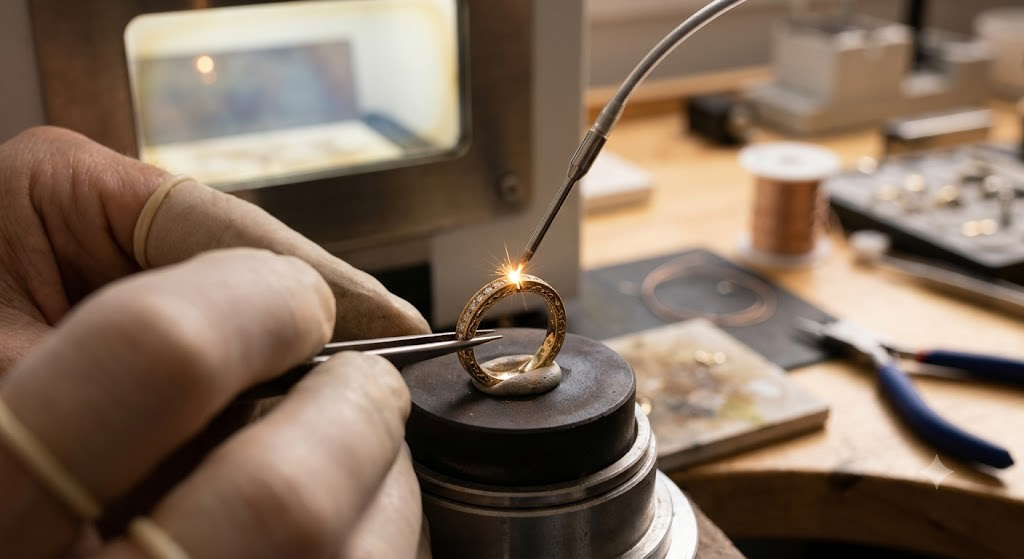
How to Choose a Jewelry Laser Welder for Your Repair Shop: 6 Key Buying Factors
Six numbers separate a smart purchase from an expensive mistake. Here’s what they are.
1. Match Wattage to Your Actual Work — Not Your Ambitions
Most jewelry repair shops need 60–150W pulsed Nd:YAG. That range covers ring sizing, prong retipping, chain repair, and platinum porosity work on pieces up to 1.5 mm thick.
The selection formula is simple:
- Gold, silver, platinum ≤1.5 mm thick → 60–120W Nd:YAG
- Frequent 1.5–3 mm heavy stock + occasional stainless watch cases → 120–200W with a fine-pulse mode
- Regular steel fabrication >2 mm → then, and only then, consider ≥1 kW fiber
Don’t chase wattage. A 200W machine with poor beam quality will crater a thin gold gallery wall. A well-tuned 80W unit handles the same job without damage. Pulse controllability beats raw output on a jewelry bench every time.
2. Run the ROI Numbers Before You Sign Anything
A 100W benchtop jewelry spot welder runs around $3,500. Laser repair brings in $20–50 more per job than traditional soldering. You get fewer stone removals, less rework, and cleaner results.
At 5 jobs per day and $30 average margin gain, that’s $150 per day. Your $3,500 machine pays for itself in about 23–30 working days.
Step up to a $12,000 professional unit. Run 15 jobs per day at the same margin, and you’re looking at 27 working weeks to break even. Higher-end machines earn that back through lower failure rates and stronger resale value — 40–60% of original price for name brands. Plus, they let you take on platinum and multi-stone work your current bench can’t handle.
3. Check the Work Chamber Before the Spec Sheet
Chamber size decides whether your day runs well or turns into a geometry puzzle.
High-end benchtop systems run 20–30 liters of interior volume. The gap between a cramped 15L cavity and a 27L chamber shows up fast. Try working a wide bangle or a brooch with a pin fixture attached — the larger chamber lets you fit the piece flat, rotate it, and weld the full seam. The smaller one forces you to pull it out, reposition, and start again.
Look for these ergonomic specifics:
- Adjustable wrist rest — eight hours of fine weld work without one will wear out your technicians
- Integrated high-brightness LED cold lighting — dim illumination alone can slow complex repairs by 20–30% and push error rates up 30–50%
- CCD camera sync with external monitor — essential for training new technicians and catching weld pool issues in real time
4. Know What Power Circuit You’re Walking Into
Most desktop jewelry laser welders run on single-phase 110–230V at 1–2 kW draw. Standard shop wiring handles that without upgrades.
Industrial handheld fiber systems at 1.5–2 kW are a different story. They pull harder. They also need external water chillers, which add cost, maintenance, and floor space. Before buying anything above 200W, confirm your shop has a ≥20A dedicated circuit. Also check that you have space for a chiller unit if one is required.
Cooling type affects daily operating costs too:
- Integrated air-cooled or small closed-loop water systems: annual maintenance stays in the low tens of dollars — filter cleans, occasional coolant top-off
- External water chillers: annual maintenance can reach several hundred dollars once you add up deionized water, coolant additives, pump checks, and line inspections
5. Factor in Consumables From Day One
The laser lamp inside a pulsed Nd:YAG pulse laser welding system survives several million to tens of millions of pulses. At moderate shop use, that works out to one to three years before replacement.
Protective window glass is a different story. Under heavy use — flux residue or silver oxidation in the chamber — windows can cloud in weeks to months. Price out replacement windows, protective glass, and shielding gas before committing to any machine. A $3,500 unit with $800 in annual consumable costs can lose its price edge over a $5,500 unit that runs cleaner and goes longer between service intervals.
6. Treat After-Sales Support as a Hard Requirement
A jewelry laser soldering machine is a precision optical instrument. The beam drifts. The lamp dims. The cooling circuit throws a fault code mid-shift. The real question isn’t whether your supplier can help — it’s how fast they do it.
Good after-sales support looks like this:
- Structured onboarding training covering parameter setup for gold, silver, and platinum, plus common fault diagnosis
- Consumable lead times under seven days for lamps, windows, and optical components
- Live technical support during business hours — not just an email ticket queue
Brands like LaserStar and Orotig have dealer networks with parts in stock. Newer entrants like MaxWave offer direct technical access — reach Richard Li at +86 18571639620 or [email protected] — which cuts response time for shops outside major metro areas.
A machine that takes three weeks to ship a replacement lamp will cost you more in lost revenue than the price gap between it and a better-supported competitor.
Conclusion
Picking the right jewelry laser welder goes beyond just buying a machine. It shapes the quality of every piece that leaves your bench.
Solo goldsmith or high-volume repair shop — it doesn’t matter. The right welder makes a real difference. The LaserStar 993 delivers top-tier precision. The MaxWave QW Series offers strong value for shops switching from traditional soldering. The Force Solder keeps up with heavy production loads without missing a beat.
Here’s the bottom line: in 2026, shops still using conventional torch soldering are falling behind. Not just working harder — actually losing ground.

0 Comments