
Should you buy a 1000W, 1500W, 2000W or 3000W handheld laser welder?
For most buyers, the answer depends on three things:
The material you weld most often.
The thickness that makes up most of your daily work.
How much production speed you actually need.
A higher-power machine can provide more penetration and allow faster welding on thicker material, but more wattage is not automatically better.
If most of your shop works with 1–2 mm stainless sheet, buying a 3000W machine may add cost and infrastructure without creating enough extra value.
If 4 mm steel appears on almost every order, a 1000W machine may technically weld some jobs but force you to work near its limits.
For buyers comparing a handheld laser welder, this is the most useful starting point:
| Power | Common Workload Range | Best Starting Fit | Typical Buyer |
|---|---|---|---|
| 1000W | Mostly 1–2 mm | Thin sheet and lighter work | Repair and low-volume fabrication |
| 1500W | Mostly 1–3 mm | General fabrication | Small and medium shops |
| 2000W | Regular 2–4 mm | Mixed thickness and daily production | Commercial fabricators |
| 3000W | Regular 4 mm+ steel | Thicker work and high throughput | Heavy-production users |
These ranges are starting points, not guaranteed maximum welding thicknesses. Actual capability depends on material, joint design, fit-up, welding speed, filler wire and machine configuration.
If 80% of your work is 2 mm stainless steel and you only see 6 mm plate a few times a year, buying a 3000W machine for those occasional jobs may not make financial sense. Choose around the thickness you weld most often, not the thickest part you may encounter.https://www.youtube.com/embed/j-UZUVB4KWA
1. What Changes From 1000W to 3000W?
Laser power mainly changes how much energy the system can deliver continuously into the weld.
As wattage increases, the machine generally gains more ability to:
Weld thicker material.
Maintain penetration at higher travel speeds.
Handle demanding materials with more headroom.
Maintain production speed under heavier workloads.
But that does not mean weld quality automatically improves.
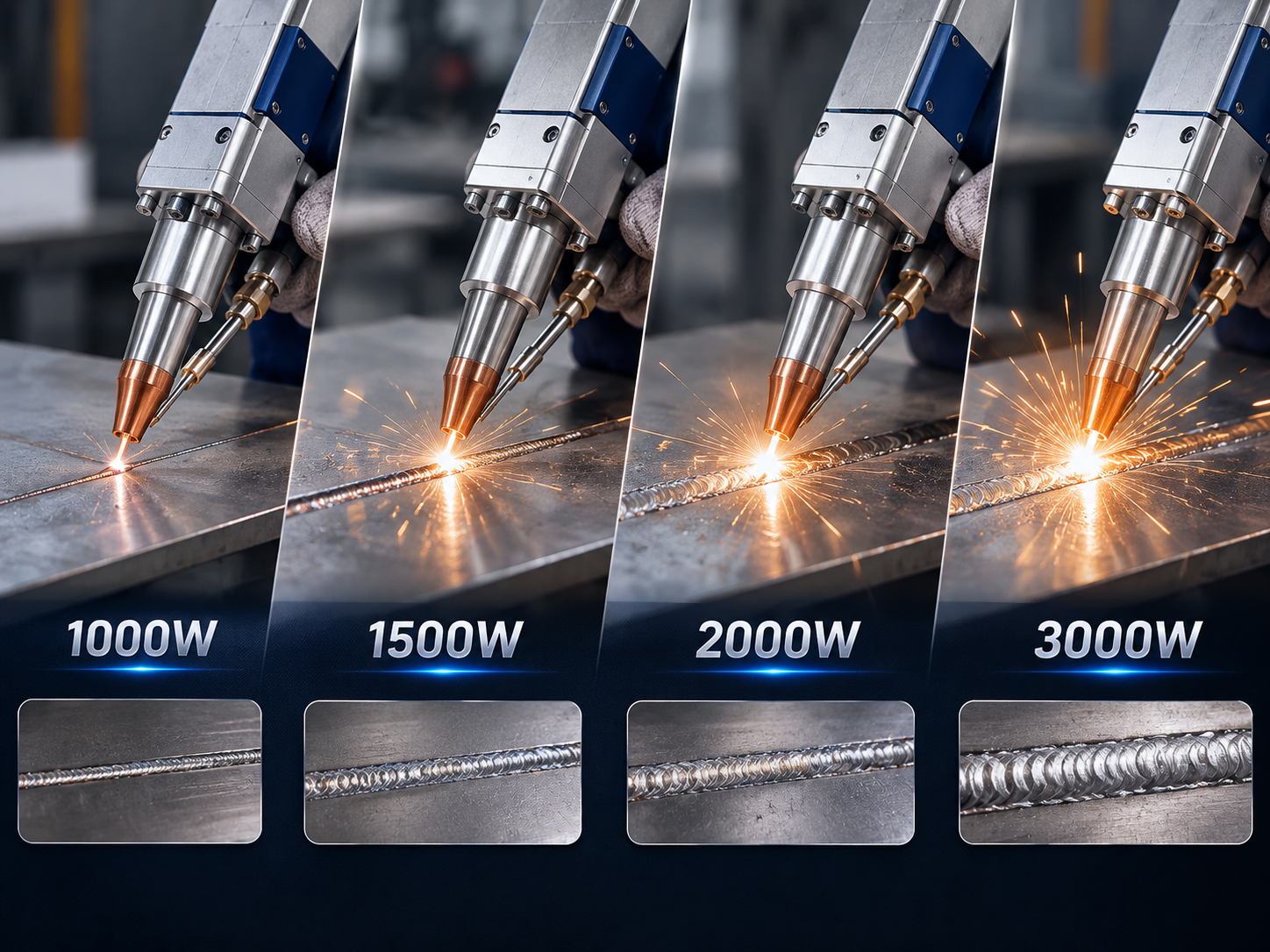
1000W: Thin-Sheet and Light Work
A 1000W fiber laser welder is most attractive when the majority of your work is thin stainless or mild steel.
A useful buying range is roughly:
1–2 mm stainless or mild steel
with occasional work beyond that depending on joint design and machine setup.
This class can make sense for:
Sheet-metal repair.
Small custom fabrication.
Thin tubing.
Light stainless products.
For occasional or lower-volume work, it can provide enough capability without paying for production capacity that stays unused.
The limitation appears when thicker steel or aluminum becomes normal rather than occasional.
Then operators may need slower travel speeds and a narrower process window.
1500W: General Fabrication
For many small and medium fabrication shops, 1500W is the first power class worth comparing seriously.
TheLaserTool’s current material-selection guide positions 1500W around 1–3 mm stainless and mild steel, with approximately 1–2 mm aluminum as a common starting range.
That makes it useful for jobs such as:
Kitchen equipment.
Cabinets and enclosures.
Doors and frames.
Metal furniture.
Automotive sheet metal.
This is why 1500W is often considered the balanced option.
It gives more thickness and speed headroom than 1000W without moving immediately into a higher-power production machine.
2000W: More Production Headroom
A 2000W laser welding machine becomes more attractive when your workload moves beyond mostly thin sheet.
Think of it less as:
“2000W can weld exactly X millimeters.”
and more as:
“2000W gives me a wider process window on medium-thickness work.”
It is particularly useful when your daily workload mixes:
1–2 mm sheet.
3 mm components.
Occasional 4 mm work.
Steel and aluminum.
TheLaserTool’s current product guidance similarly positions 2000W as the flexible middle ground for commercial fabrication rather than simply a thicker version of 1500W.
If 1500W can complete a job but requires slow travel near its upper working range, 2000W can make more sense because production time matters.
3000W: Thicker and Faster Work
3000W is aimed more toward shops where thicker work and throughput are regular requirements.
It makes more sense when your order book includes larger steel components and medium-to-heavy fabrication frequently enough to justify the additional capacity.
Current TheLaserTool pricing guidance places the 2500–3000W class around thicker plate and heavier commercial workloads, with 6–8 mm sometimes quoted as the upper application class for suitable configurations.
Treat that as an application category—not a guaranteed single-pass promise.
A 3000W machine welding:
6 mm carbon steel
is not equivalent to:
6 mm aluminum.
The material still matters.
2. Which Power Fits Your Material Thickness?
Thickness is usually the first specification buyers look at, but it should always be considered together with material.
Use Your Normal Thickness
Choose power based on the thickness you weld most often—not the thickest plate you may see once or twice a year.
If most of your work is 1–2 mm stainless steel, there is little reason to buy a 3000W machine only for an occasional 6 mm job. But if 3–4 mm material appears every day, you need enough power headroom to maintain stable penetration and practical welding speed.
A simple rule is:
Choose for your normal workload, with reasonable room for thicker regular jobs.
Stainless and Mild Steel Are Easier
Stainless steel and mild/carbon steel are among the most common applications for handheld laser welding.
For these metals, the power progression is relatively straightforward:
Thin sheet → lower wattage
Thicker production work → more power
That is why 1500W and 2000W are often the most relevant classes for general fabrication shops.
Aluminum Needs More Headroom
Aluminum deserves separate consideration.
Its reflectivity and thermal behavior make it less forgiving than normal stainless or mild steel.
Do not assume:
“My machine welds 4 mm stainless, therefore it welds 4 mm aluminum equally well.”
It may not.
For an aluminum-heavy business, stepping up one power class can create a wider production window.
But alloy, joint design and surface condition still need to be tested.
Thickness Is Not the Only Limit
A larger machine cannot compensate for:
Poor joint fit.
Contaminated metal.
Incorrect shielding.
Bad focus.
Unsuitable weld-head settings.
This matters particularly with handheld laser welding because tight fit-up generally produces more consistent results than trying to bridge large gaps with more power.
Higher wattage gives you more capability.
It does not remove the need for a good welding process.

3. When Is More Power Worth the Money?
Power becomes valuable when it improves the jobs you perform every day.
Not when it only increases the maximum number on the brochure.
Choose 1000W for Occasional Thin Work
1000W makes sense when your business is mainly doing light fabrication, repair or custom jobs on thin steel.
If the machine is not part of a continuous production line, you may never recover the additional cost of moving several power tiers higher.
Choose 1500W for General Shop Work
1500W is often the logical choice when your business handles normal sheet-metal fabrication and most work stays around 1–3 mm.
For an owner-operator or small fabrication shop, this can provide a useful balance between capability and investment.
TheLaserTool’s current buying content likewise identifies 1500W as a strong starting class for shops working mainly with thin sheet.
Choose 2000W for Daily Mixed Production
2000W becomes easier to justify when the welder is used every day and job thickness varies.
The benefit is not only maximum penetration.
It is also:
More speed and more process headroom on the work you already do.
If your 1500W option is constantly operating near its practical limit, upgrading makes sense.
Choose 3000W for Heavy Workload
A 3000W handheld fiber laser welder should normally be purchased because your existing workload demands it.
Not because:
“We may need thicker welding someday.”
Higher-power systems can also change:
Cooling requirements.
Electrical requirements.
Machine size.
Purchase price.
These depend on the exact system, so confirm them from the quotation rather than assuming every 3000W machine requires identical infrastructure.
4. How Should You Choose Before Buying?
The best buying decision does not come from a thickness table alone.
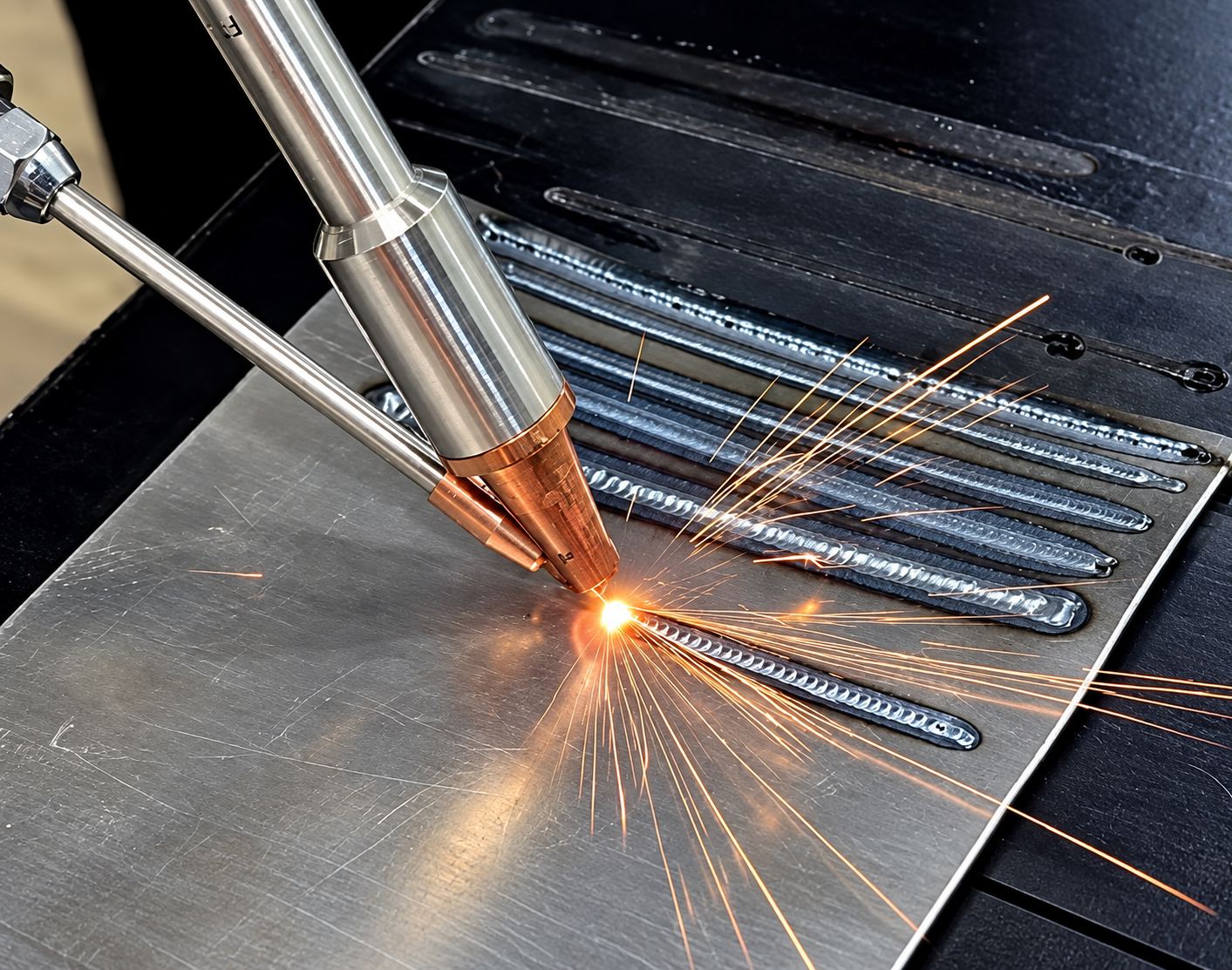
Use your own parts.
Start With Four Questions
Before asking for a quotation, write down:
- What metals make up most of your work?
- What thickness represents most orders?
- What is the thickest regular job?
- How many welding hours do you run daily?
Those answers should determine the power shortlist.
Not the supplier’s highest-wattage model.
Compare Two Adjacent Power Classes
If you think you need 1500W, test both 1500W and 2000W.
If you think you need 2000W, compare it with 3000W.
This shows whether the upgrade creates a meaningful improvement in:
Welding speed.
Penetration.
Finished weld quality.
Process stability.
If the higher-power machine produces almost no practical advantage on your real parts, you have no reason to pay for it.
Test the Same Material
Ask the supplier to weld the same part using each shortlisted machine.
Keep the comparison consistent:
Same material.
Same thickness.
Same joint.
Same finish requirement.
A supplier welding 1 mm stainless with one machine and 5 mm carbon steel with another does not give you a meaningful comparison.
Ask for Production Speed
Do not ask only:
“What maximum thickness can it weld?”
Ask:
“How fast can it weld my normal thickness with acceptable penetration and finish?”
This is often the more important B2B question.
A machine may technically complete the job but be too slow to make sense in production.
Confirm the Complete Configuration
Before ordering a laser welder for metal, compare the complete machine—not wattage alone.
Confirm the laser source, cooling design, weld head, wire feeder and after-sales support.
Two machines labeled “2000W” can offer very different ownership experiences.
Conclusion
1000W vs 1500W vs 2000W vs 3000W handheld laser welder—which power do you need?
For most buyers:
1000W is best suited to thinner sheet and lighter workloads.
1500W is a strong general-purpose choice for common thin-to-medium fabrication.
2000W provides more flexibility for mixed materials, medium thickness and regular production.
3000W makes the most sense when thicker steel and higher throughput are already part of your daily workload.
Do not buy power based on one maximum-thickness number.
Choose according to:
Material + Normal Thickness + Production Volume + Required Speed
TheLaserTool’s current guidance follows the same principle: select wattage around the thickness you weld most often, rather than the thickest possible job you may see occasionally.
The team can recommend the appropriate power class and arrange sample welding so you can compare actual penetration, welding speed and finished quality before choosing between 1000W, 1500W, 2000W or 3000W.

0 Comments