
Buying a jewelry laser welder is one of the biggest equipment decisions a repair shop will make — and the price range is wide. You’re looking at anywhere from $2,500 for a bare-bones entry model to well north of $25,000 for a professional-grade system that handles platinum without strain. Been quoted a number and not sure if it’s fair? Or building a budget from zero? This guide is for you. This 2026 price guide breaks down what drives the cost of a jewelry laser welder, what you’ll spend beyond the sticker price, and how fast a well-chosen machine pays for itself in a working repair shop.
What Is a Jewelry Laser Welder and Why Do Repair Shops Need One in 2026?
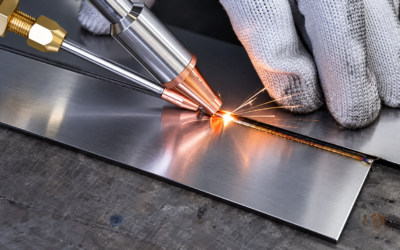
A jewelry laser welder does one thing no torch can: it puts intense heat where you want it, and nowhere else.
Most repair shops run on the pulsed Nd:YAG laser welder. It’s a solid-state system that fires at 1064 nm and hits ~5 kW peak power in a single pulse. Each pulse lasts just 0.5–10 milliseconds. That burst melts a pinpoint area no wider than 0.1–0.6 mm. Everything around it stays cold. The heat-affected zone holds under 0.5 mm. A torch flame, by contrast, spreads 3–8 mm wide. The numbers tell the whole story.
That precision gap turns straight into money for repair shops.
- No-stone-removal repairs: Laser lets you complete 80–90% of prong repairs on set stones without destoning. That alone saves 30–50% of your time per job.
- Job time cut in half: A standard torch repair cycle — remove stone, clean, solder, reset — takes 30–60 minutes. Laser brings that down to 5–15 minutes.
- Less cleanup: Smaller heat zones produce less oxidation and less distortion. You spend less time at the polishing wheel. Finishing time drops 30–50%.
Fiber laser welders are also out there, but they target a different need — high-volume production, automated fixtures, batch chain repair. For hands-on work with irregular vintage pieces and heat-sensitive stones, pulsed Nd:YAG is still the industry standard.
2026 makes this more urgent. Jewelry trends are moving toward titanium-gold combinations, Stainless steel bands, and complex multi-metal custom builds. Flame torches struggle with these materials. Laser handles them with no issues. Repair volume is rising too. Shops running 100+ welding jobs per month without a laser machine lose hours every single week — and that adds up fast.
2026 Jewelry Laser Welder Price Ranges at a Glance
Three tiers. That’s the whole map.
| Tier | Power | 2026 Price Band | Best For |
|---|---|---|---|
| Entry | 60–120 W | $2,500–$5,000 | Solo bench, start-up shops |
| Mid | 150–200 W | $5,000–$12,000 | Established repair shops |
| Professional | 200–300 W+ | $12,000–$25,000+ | Studios, small factories |
Entry tier ($2,500–$5,000) covers basic pulse welding — ring sizing, prong re-tipping, chain repair. A branded 100 W unit like the GWEIKE runs at $3,500. Generic Chinese factory builds land at $2,500–$3,000. These machines are air-cooled, compact, and run on single-phase power. weld speeds sit around 20–25 mm/s. They get the job done. Just don’t expect them to handle everything.
Mid tier ($5,000–$12,000) is where most working shops end up. You step up to 150–200 W, water cooling, a built-in CCD microscope, and weld speeds reaching 30 mm/s. A solid cluster of well-specced machines sits between $5,800–$6,800. You get stable results on platinum and thick gold settings — the jobs that bring in real money.
Professional tier ($12,000–$25,000+) is built for volume. These machines come with large enclosed chambers, closed-loop cooling, detailed parameter libraries, and training packages included. European-branded models push past $20,000 with delivery factored in.
One number to keep in mind: add 8–25% on top of any FOB quote. Freight, duties, and taxes all stack up depending on your region. The sticker price is never the final price.
Entry-Level Jewelry Laser Welders ($2,500–$5,000): Who Should Buy These?
The entry tier is where most first-time buyers land — and where most buying mistakes happen.
Machines in this band run 60–150W Nd:YAG, air- or water-cooled, desktop format, and most weigh under 60 kg. The sweet spot is a 100–150W unit with water cooling and a 10× microscope, priced around $3,500–$4,500. Go below that, and you’re looking at 60–80W air-cooled builds. Those struggle under a full shop load day after day.
What these machines handle well:
– Chain repairs and jump rings up to ~3 mm link thickness
– Prong re-tipping and earring post reattachment
– Porosity filling on cast gold and silver
– Thin sheet joins (0.3–0.8 mm)
Push them past 1.5–2 mm platinum sections, or run them for hours straight — you’ll hit the limit fast. Expect thermal overload, messy build-up, and slower throughput.
Four buyers who make this work:
- A small startup can complete 50–200 jobs per month and generate around $8,000 in monthly revenue, with each laser repair job bringing in $20–$50. After labor, marketing, consumables, and other expenses, a $3,500–$4,000 machine can typically pay for itself within 3–4 months. Actual ROI varies by local pricing, order volume, and operating costs.
- Part-time goldsmiths working evenings. A $2,500–$3,500 air-cooled 60–100W desktop laser welder handles light gold and silver repairs. No outsourcing needed.
- Budget-constrained custom shops not yet ready for a $10K+ system. Look for a 120–150W unit around $4,000–$5,000 with CCD viewing and a water chiller.
- Mobile jewelers at markets or pop-ups. A compact 40–60W portable — some under 14 kg — handles on-the-spot chain fixes without hassle.
Who should skip this tier: Shops focused on thick platinum bridal work, heavy men’s bands, or large silver cuffs. This tier won’t keep up. Also skip it if you need certified training or same-day local service. Most sub-$4,000 imports offer remote support and nothing else. That’s a real operational risk, not just an inconvenience.
One QC point worth flagging: ask for “imported ceramic condensing cavity” confirmation before buying. Also request test videos showing penetration on 1–2 mm platinum samples. Cheap optics and undersized water chillers are the two most common failure points in this price range.
Mid-Range Jewelry Laser Welders ($5,000–$12,000): The Sweet Spot for Most Repair Shops
For established jewelry repair shops, the $5,000–$12,000 range offers the best balance of precision, reliability, and return on investment. A strong option in this category is the MaxWave QW Series 300W Jewelry Laser Welder, priced at only US$5,500.
Unlike bulky water-cooled YAG systems, the QW Series uses air cooling, so it requires no water tank or external chiller. Its compact, open workstation takes up minimal space while accommodating jewelry and workpieces of different sizes. The modular design also makes the laser source and welding head easier to service or replace.
Key advantages include:
- Ultra-fine welding spot: approximately 50% smaller than conventional YAG systems, ideal for prongs, thin chains, filigree, pavé settings, and precision parts
- HD CCD viewing system: provides clear positioning and better control over detailed repairs
- Stable QCW beam quality: voltage-regulated control helps deliver consistent welding results
- Low operating cost: no routine consumables and no cooling-water maintenance
- Long service life: laser source designed for more than 100,000 hours
- Lower shipping cost: lighter than many machines with comparable power
- Multilingual interface: English included, with a customizable second language
The ROI is straightforward. Saving just three labor hours per week at US$50 per hour recovers approximately US$150 per week, allowing a US$5,500 machine to reach simple payback in about 37 weeks. That does not include the additional revenue from platinum, gold, and precision repairs that would otherwise be outsourced or turned away.
For shops seeking finer welds, simpler maintenance, and professional performance at an accessible price, the MaxWave QW Series is a highly competitive choice.
Professional-Grade Jewelry Laser Welders ($12,000–$25,000+): Does the Investment Pay Off?
At $12,000–$25,000+, this tier isn’t for every shop — and it shouldn’t be. These jewelry welders are built around one assumption: your laser runs hard, all day, every day.
What separates them from mid-range isn’t just wattage. It’s pulse energy — 85–120J per pulse versus 40–60J on lower tiers. That extra headroom keeps welds stable on thick platinum shanks and heavy multi-pass structural repairs. The machine never hits its ceiling. It runs at 70% capacity, with plenty of room to spare.
You’re also paying for:
– Closed-loop industrial cooling systems that hold up through full workday cycles
– Preset parameter libraries for each metal and task — gold, platinum, palladium, titanium
– 10–15× stereo microscopes with crosshair alignment and CCD output
– Multi-year service contracts, on-site installation, and documented warranty coverage on the laser source
The ROI Threshold Is Simpler Than You’d Expect
Put $15,000 into one of these machines. Generate just $100/day in added gross profit — that’s 3–5 extra repairs. The machine pays for itself in 3 months.
Shops sending out 10+ laser jobs per week at ~$20 margin each are giving up $10,000+ per year. That’s a 1–2 year payback on a professional system, and nothing else has to change.
This tier fits your shop when:
– You run 10–30 weld-related jobs per day
– Platinum and titanium work show up on your bench on a consistent basis
– Every hour of machine downtime costs you billable revenue
– Multiple jewelers share one laser station
Payback stretching past 36 months at realistic volume? Step back to mid-range. The math doesn’t lie.
7 Key Factors That Determine Jewelry Laser Welder Price
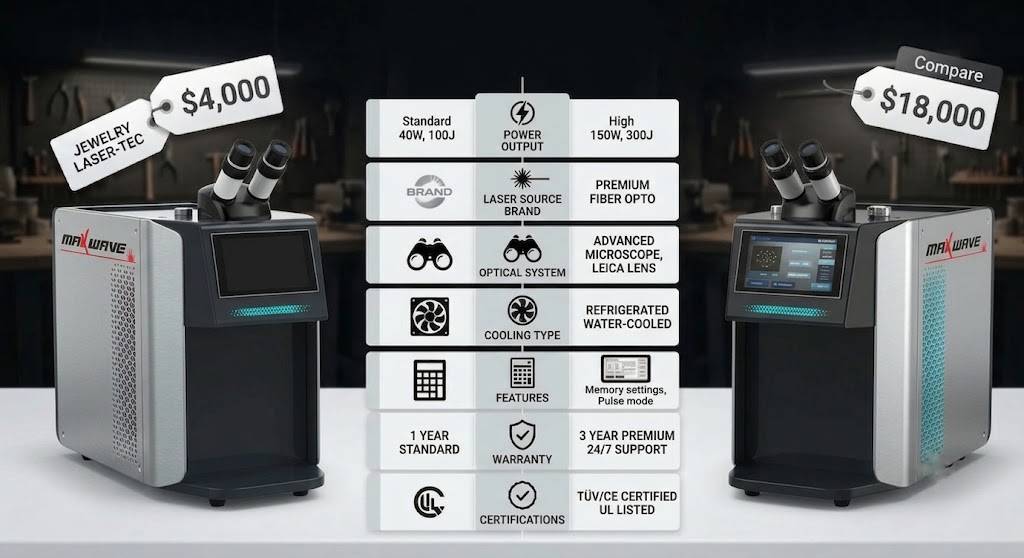
Two machines. Same wattage on the spec sheet. One costs $4,000. The other costs $18,000. That gap isn’t random — and it isn’t marketing noise. Every dollar separating them traces back to one of seven specific variables. Know these, and you stop guessing at quotes.
1. Laser Type and Power Output
Power is the biggest single price driver. The working range for jewelry repair runs 60 W to 200 W, and the price curve follows that range closely.
- 60–80 W air-cooled desktop: $3,500–$5,000. Good for light gold and silver repairs, thin sheet, and chain work.
- 100–150 W water-cooled: $8,000–$18,000. This is the professional studio range — platinum prongs, thick bands, back-to-back volume.
- 200 W+: $20,000–$30,000+. Built for production-level output, high-reflectivity metals, and complex multi-layer structures.
Key components — laser source, weld head, control system — make up 60–70% of total machine cost. Higher wattage pulls that number up fast.
2. Laser Source Brand and Origin
The laser source is where brand premiums hit hardest.
An imported source (IPG, Trumpf) runs 2–3× the cost of a domestic Chinese equivalent (Raycus, MAX). At the 100–200 W jewelry range, that means a 20–30% difference in total machine price.
The control system adds another layer. A Siemens or FANUC-based CNC workstation runs around $30,000. A basic PLC setup? Around $3,000. That one component decision spans a 10× price gap.
Brand service packages — training, warranty, ongoing technical support — add another 10–30% on top of like-for-like specs. That cost is real, even if it’s not on the sticker.
3. Optical System Quality
Most buyers overlook this. They shouldn’t.
A high-precision imported weld head (Precitec, Soudax — with auto-focus and spot adjustment) costs around $8,000 on its own. A standard domestic head runs about $2,000. That $6,000 gap feeds straight into the machine price. It can account for a 15–25% premium on your final quote.
For jewelry work — tight filigree, pavé settings, fine channel work — optics quality isn’t optional. It determines whether the weld lands where you aimed it.
Two specs matter more than raw wattage for precision metals:
– Peak power ≥ 9 kW — the practical threshold for welding high-reflectivity silver
– Pulse energy 180 J+ — needed for deep-penetration work on thick platinum and structural repairs
4. Cooling System
Cooling method separates a full-day shop machine from an occasional-use machine.
Air-cooled systems work fine at 60–100 W for light daily loads. They keep costs down — total units land in the $3,500–$5,000 range. But run one through a full shop day and thermal drift becomes a real problem.
Water-cooled systems add $500–$2,000 to the bill, pushing overall price up 5–15%. At 150–200 W with continuous repairs all day, water cooling isn’t a luxury. It’s what keeps weld consistency tight from the first job to the last.
5. Feature Configuration — Real vs. Packaged
Not every feature on the spec sheet earns its price. Here’s the honest split:
Features with proven performance value:
– Wobble welding — wider bead, better fill on thin decorative metals. Typical price premium: 5–10%
– Auto wire feed — essential for metal fill and shell thickening work. Similar 5–10% uplift
– High-end auto-focus weld head with precision optics — worth the ~$6,000 premium for production jewelry shops
Features worth a closer look:
– Decorative enclosures, color panels, styled housings — zero effect on weld quality, but these can inflate quotes by 5–10%
– Vague “smart modes” or “preset artistic programs” — no closed-loop monitoring behind them means they’re software packaging, not real engineering
– High average-wattage claims without matching peak power or pulse energy — for jewelry welding, joules (J) and peak kW matter more than the W rating alone
6. After-Sales Support and Warranty
Warranty length and service structure have real dollar values. They’re just buried in the quote.
- 2–3 year laser source warranty from a branded manufacturer adds 10–20% over short-warranty or no-warranty options
- On-site installation and training packages for overseas buyers run $1,000–$3,000. These get bundled into mid-to-high-tier pricing at 5–10% of machine cost
- Initial spare parts kits (focusing lens sets, protective glass, flash lamps) cost $300–$1,000 upfront — about 2–5% of machine price — and hit your real first-year total cost harder than most buyers expect
So always ask what’s in the box beyond the machine itself. The answer tells you a lot.
7. Certifications and Compliance
Compliance costs money. That’s not a complaint — it’s a budget line.
Machines carrying CE, FDA, or ISO certifications build testing and regulatory development costs into their price. Expect to pay 10–15% more than equivalent uncertified models. For shops in regulated markets, that premium is simply the cost of operating legally.
Full industrial-grade safety enclosures, interlocking systems, and laser safety classification markings push machines into the $17,000–$30,000 range. That’s the same tier where professional-grade optics and cooling systems live. These costs cluster together because machines at that level are built to a different standard — one that covers safety, consistency, and long-term reliability.
The bottom line: Two jewelry welders look the same on paper but sit $10,000 apart in price. The gap lives in these seven factors. Go through each one against your actual shop needs — daily volume, metal types, service expectations — and the right price tier becomes clear.
Total Cost of Ownership (TCO): Beyond the Sticker Price
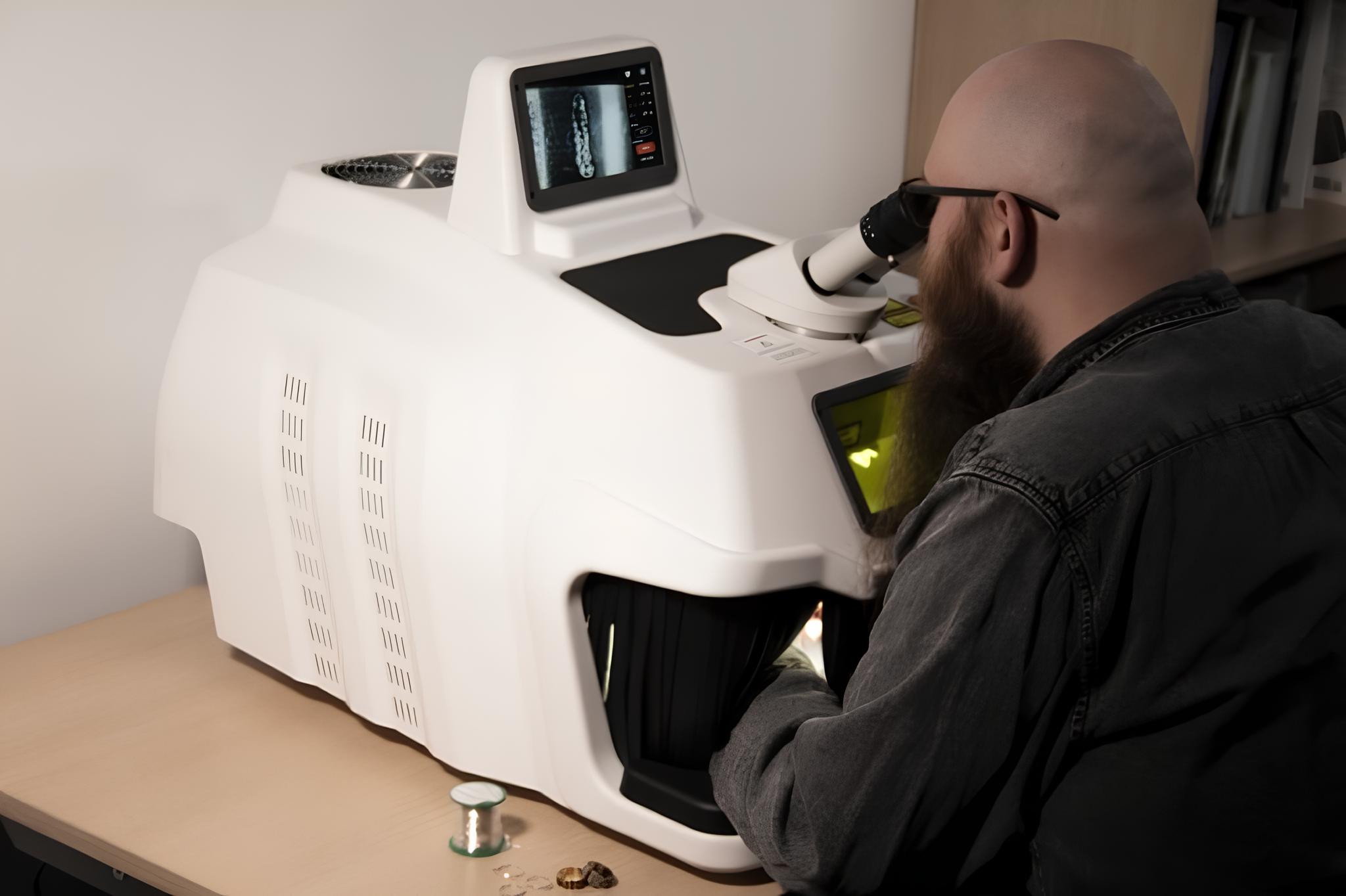
The sticker price is a lie — not a malicious one, just an incomplete truth.
A $6,000 mid-range laser welder doesn’t cost $6,000 to own. It costs $6,000 to acquire. The real cost to your shop over three to five years depends on five things the spec sheet never mentions: energy, consumables, maintenance, downtime, and what you recover when you sell it.
Here’s the formula that matters:
TCO = Purchase Price + Energy + Gas/Consumables + Maintenance + Downtime Losses − Residual Value
For a 60–200W pulsed jewelry laser, electricity is rarely the big expense. These machines draw a fraction of what industrial kW-class cutting systems use. The number that hits hardest is downtime and consumables: protective lenses, focusing optics, cooling filters, argon gas, and the labor hours lost when something breaks mid-job.
That last point matters more than most people realize. Across comparable TCO models for laser equipment, maintenance fees between entry-level and professional machines are closer than you’d expect. The real gap is downtime. A cheap machine that fails twice a year can cost you $15,000–$45,000 in lost production over five years. A more reliable system at twice the purchase price often costs less over the full period.
What to budget beyond the machine:
- Consumables (annual): Protective glass, focusing lenses, flash lamps, cooling filters — budget $300–$800/year for a mid-range unit
- Maintenance: Factor $800–$2,000/year based on how hard you run it and what your warranty covers
- Downtime: Every unplanned repair day has a real cost — lost jobs, delayed customers, referrals that don’t come back
- Residual value: Better-built machines hold their value. A professional-tier system sells for far more at resale than a generic import
The bottom line: a $4,000 machine that costs $3,000/year to run is more expensive than a $6,000 machine that costs $1,500/year. Run the full number before you sign anything.
ROI Calculator: How Fast Can a Jewelry Laser Welder Pay for Itself?
The math here is cleaner than most shop owners expect.
Take your machine cost. Divide it by what the machine adds to your bottom line each month. That’s your payback period. No spreadsheet needed.
Here’s how it breaks down across three price points and two income scenarios:
| Machine Price | Conservative (+$500/mo net) | Active (+$1,500/mo net) |
|---|---|---|
| $3,500 | 7 months | 2.3 months |
| $6,000 | 12 months | 4 months |
| $12,000 | 24 months | 6 months |
Most working jewelry repair shops land somewhere in the middle. The industry benchmark is 2–6 months for an active shop. That’s a far cry from the 1–2 years people assume when they see a five-figure quote.
Where the money comes from:
Two income streams drive this, not one.
The first is time. Laser welding cuts job time by 80–90% compared to torch-and-cleanup workflows. A 30-minute torch repair becomes a 4-minute laser job. That’s not a small difference — that’s 2 jobs an hour turning into 15.
The second stream is the jobs you used to turn away. Stone-set repairs. Fine filigree. Heat-sensitive pieces. A laser machine turns those refusals into billable work — at higher margins than standard torch jobs. Not every shop on the street can handle them. You can.
Upfront cost feels like a wall? Try the rental model. A $21,000 professional system financed at ~$450/month keeps cash pressure low. Most shops cover that within existing revenue. You’re paying for the machine with money the machine earns.
Run your own numbers: Payback months = Machine cost ÷ Monthly net gain. Plug in honest estimates. The answer tends to come back faster than you’d guess.
Jewelry Laser Welder Cost FAQ: Quick Answers for Repair Shop Owners
Repair shop owners ask the same questions. Here are straight answers.
What’s the absolute minimum I can spend and still get a usable machine?
Budget $3,000–$3,500 for a 60–100W Nd:YAG desktop unit that handles real repair work. Drop below that, and you start making real sacrifices. Optics get weaker. Cooling becomes a problem. Build stability takes a hit.
What does $5,000 buy?
You get a 100–130W pulsed system with a microscope, enclosed housing, and integrated cooling. It handles ring sizing, chain repair, prong re-tipping, and porosity filling. That covers most of what a mid-volume shop needs day to day. For just $500 more, the $5,500 MaxWave QW 300W offers air cooling, HD CCD viewing, a finer welding spot, and a compact open design.
Is higher wattage always better?
No. For jewelry work, pulse energy, spot diameter, and waveform control matter more than raw wattage. A 1,000W fiber welder burns thin prongs. A 100W pulsed Nd:YAG hits a 0.3mm spot with clean, precise results.
Can I finance instead of paying upfront?
Yes. A $5,000 machine at 30% down comes to $100–$140/month over 36 months. A busy shop earns that back fast on laser-specific jobs alone.
Should I buy used?
Go used only if the seller provides complete maintenance records and the machine still carries remaining warranty coverage. The price drop looks good — used units run 20–40% less. But laser source replacement can cost 30–50% of the original machine price. One bad part wipes out the savings.
Conclusion
The numbers don’t lie — a jewelry laser welder isn’t just a tool purchase. It’s a business transformation.
Need an entry-level machine to stop turning away delicate repairs? Or a professional-grade fiber laser welder for jewelry to handle high-volume production? Either way, the right investment pays for itself faster than most shop owners expect.
Here’s the bottom line: match the machine to your actual workload, not your wishlist. Run your own ROI numbers using the framework in this guide. Factor in TCO, not just the sticker price. Also, watch out for unusually low quotes from unknown suppliers. One bad decision there can set your shop back five years.
The repair shops winning in 2026 aren’t the ones with the cheapest equipment — they’re the ones who bought smart.
Ready to price out the right laser welder for your shop? Request a custom quote and let the specs — not the sales pitch — make the decision for you.

0 Comments