
Buying the wrong jewelry laser welder is an expensive mistake—often only discovered after it’s too late. Gold and silver require precise, controlled heat, and poor equipment can easily damage fine jewelry.
That’s why laser welding has become essential in modern jewelry repair and manufacturing, replacing traditional soldering in many workshops.
If you run a repair studio, work with custom jewelry, or are upgrading your tools, choosing the right machine is critical. This guide will show you what actually matters before you buy.
How To Choose A Laser Welder For Gold And Silver Jewelry

Six decisions determine whether your jewelry laser welder works for you — or against you.
This guide covers each one: laser type, power class, pulse energy, spot size, metal compatibility, and gas control. Not in the abstract. In real, numbered, spec-sheet terms you need to evaluate an actual machine.
Here’s what the framework covers:
- Laser type & wavelength — why 1064 nm pulsed Nd:YAG or fiber is the standard for gold and silver
- Power class — matching 60–150 W output to your actual workload
- Pulse energy & control — the numbers that separate a gold-capable machine from a silver-capable one
- Spot size precision — what “adjustable” needs to mean for fine jewelry work
- Metal compatibility & presets — built-in parameters that cut setup time and reduce human error
- Gas management — argon shielding as a non-negotiable for silver and white gold quality
Each section gives you clear, solid benchmarks. Use them as filters — not suggestions.
Types of Jewelry Laser Welding Machines Explained
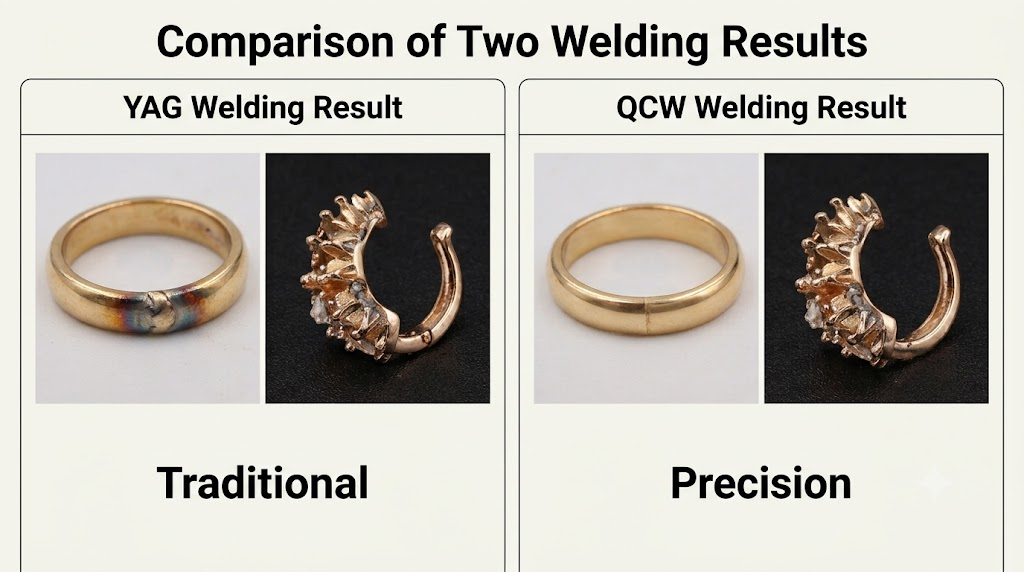
Two laser platforms dominate the jewelry welding market: YAG and QCW. Each one solves a different problem. Pick the wrong category and you’re not just overspending — you’re stuck with a machine that fights your workflow every single day.
Here’s how they break down.
YAG Laser Welders — The Repair Shop Standard
YAG machines run at 1064 nm wavelength. That’s the right wavelength for gold, silver, platinum, and palladium. The focused spot usually lands at 0.2–0.6 mm. That’s tight enough for prong re-tipping, porosity filling, ring resizing, and hairline crack repair. It won’t disturb the metal beside it.
The tradeoff is speed and output efficiency. Traditional YAG welders are proven, reliable, and widely used, but they are not built for the same level of peak power stability or production efficiency as QCW systems. For everyday bench repair, that usually isn’t a problem. These machines have gone through decades of refinement. They cover the broadest range of repair tasks. They’re well-supported. They’re what many bench jewelers use day to day.
Best for: Repair shops, custom studios, general bench work. Your business runs on repairs across mixed precious metals? This is your machine.
QCW Laser Welders — Higher Peak Power, Cleaner Control
QCW laser welders are designed for stronger pulse output, better beam stability, and more controlled energy delivery. Compared with traditional YAG systems, QCW machines can deliver higher peak power while keeping the heat-affected zone very small. That matters when you’re welding thicker jewelry structures, dense gold pieces, platinum parts, or detailed areas where the weld must be strong but the surrounding surface must stay clean.
QCW is especially useful when you need both precision and power. It can handle fine chain repair, prong work, ring resizing, bezel repair, and heavier structural welding with more consistent pulse control. For studios that want one machine to cover delicate work and more demanding repair jobs, QCW gives you more room to work.
The advantage is not just power. It’s control. A good QCW jewelry welder lets the operator adjust pulse energy, pulse width, frequency, and spot size more precisely. That gives jewelers better control over penetration depth, weld smoothness, and heat input.
Best for: Professional jewelry repair shops, high-end custom studios, platinum and gold repair, thicker jewelry structures, and workshops that need stronger welding performance without sacrificing precision.
Machine Format — Matching the Body to the Bench
Laser type is half the decision. Physical format matters just as much.
| Format | Weight / Footprint | Best Fit |
|---|---|---|
| Benchtop / Desktop | Compact, single-operator | Repair shops, small studios |
| Portable / Mini | From ~13.5 kg | Mobile jewelers, on-site repair |
| Industrial | Full cabinet, heavy cooling | High-volume manufacturing |
Industrial machines can push much higher peak power for continuous production runs. That’s not a repair shop number — that’s a factory number. Don’t pay for it if you don’t need it.
The short version:
- YAG + benchtop → most basic jewelry repair shops
- QCW + benchtop → professional repair shops and high-end precision studios
- Portable / mini → mobile work, light repair volume
- Industrial → batch manufacturing, not bench repair
Match the laser type to your material requirements. Match the format to your space and workflow. Get both right, and everything downstream — power selection, pulse settings, gas control — becomes much easier to evaluate.
Key Technical Specs You Must Understand Before Buying
Spec sheets are written to impress, not to inform. Four numbers matter when you’re buying a laser welder for gold and silver jewelry. Everything else is noise.
Here they are — and what they mean for bench work.
Power (Wattage): Match It to the Work, Not Your Ego
More watts doesn’t mean better welds. It means higher cost, heavier cooling demands, and zero improvement in fine detail quality.
For jewelry repair and fabrication, the practical range sits between 60W and 150W. That window covers prong re-tipping, porosity filling, bezel repairs, and chain work across gold, silver, and platinum. You don’t need a 500W machine. That’s sheet metal territory — not a jewelry bench.
The rule is simple: identify your most demanding task, then buy enough power to handle it cleanly. Extra headroom you’ll never use just inflates the invoice.
Pulse Energy: The Number That Controls Your Weld
Pulse energy determines how deep the laser penetrates. It also controls how consistent the weld bead comes out. For jewelry work, it’s the most important spec most buyers ignore.
Here’s what makes it complicated: pulse energy doesn’t exist in isolation. It moves in direct relationship with pulse width and repetition frequency. As frequency increases, pulse energy tends to drop and pulse duration stretches. That’s not a defect — it’s physics. The rated peak energy at one frequency setting tells you almost nothing about performance at a different one.
Ask for energy data across the full operating frequency range — not just the peak spec at optimal settings. A machine that holds stable pulse energy as frequency climbs is built for repeatable results. One that drops off hard is built for spec sheets.
For jewelry work specifically: deeper weld penetration on thicker gold sections needs higher single-pulse energy. Consistent seam quality on silver — which pulls heat away fast — needs stable energy across multiple pulses without drift.
Spot Size: Your Precision Ceiling
Spot size sets the upper limit on how fine your work can get. Full stop.
For jewelry-grade repair, you want an adjustable spot in the 0.2–0.6 mm range. That smaller end lets you re-tip a prong without disturbing the setting beside it. Larger spots cover more area faster, but you lose the edge control that fine jewelry requires.
One critical detail most buyers miss: spot size definitions vary by manufacturer. Some report beam radius. Some report diameter. Some measure at the exit aperture. Others measure at the working surface. These are not the same number.
Before comparing two machines side by side, confirm how each one defines and measures its spot. Ask the supplier straight out. No clear answer means no reliable data.
Frequency and Control System: Where Consistency Lives
A machine can hit the right power and pulse energy on a single weld. That’s not the hard part. The hard part is hitting it on the 200th weld with the same result as the first.
That’s a control system problem — not a power problem.
Key items to verify before buying:
- Frequency adjustment range — wider is more flexible, but only if energy stays stable across it
- Pulse energy behavior at different frequencies — get this data in writing
- Positioning repeatability — critical for batch repairs and production runs
- Software stability — smooth parameter adjustment without lag or drift between settings
For repair shops running high daily volume, control system quality determines how many pieces you process before a bad weld forces a rework. For custom studios, it determines whether your third attempt at a precision joint looks like your first.
The Four-Number Checklist — Use This Before You Buy Anything
| Spec | What It Controls | What to Ask |
|---|---|---|
| Power (W) | Material capacity, not weld quality | Does it match my most demanding task — without significant excess? |
| Pulse Energy (mJ) | Weld depth and consistency | What’s the energy output across the full frequency range, not just peak? |
| Spot Size (mm) | Precision ceiling on fine work | Is this diameter or radius — and measured where? |
| Frequency + Control | Repeatability at volume | Does energy stay stable as frequency changes? |
Ask every supplier for test data under identical conditions. Compare the same variables across machines. No numbers provided — or numbers that shift depending on who’s answering — means you don’t have enough information to buy.
Real-World Performance Factors That Matter More Than Specs
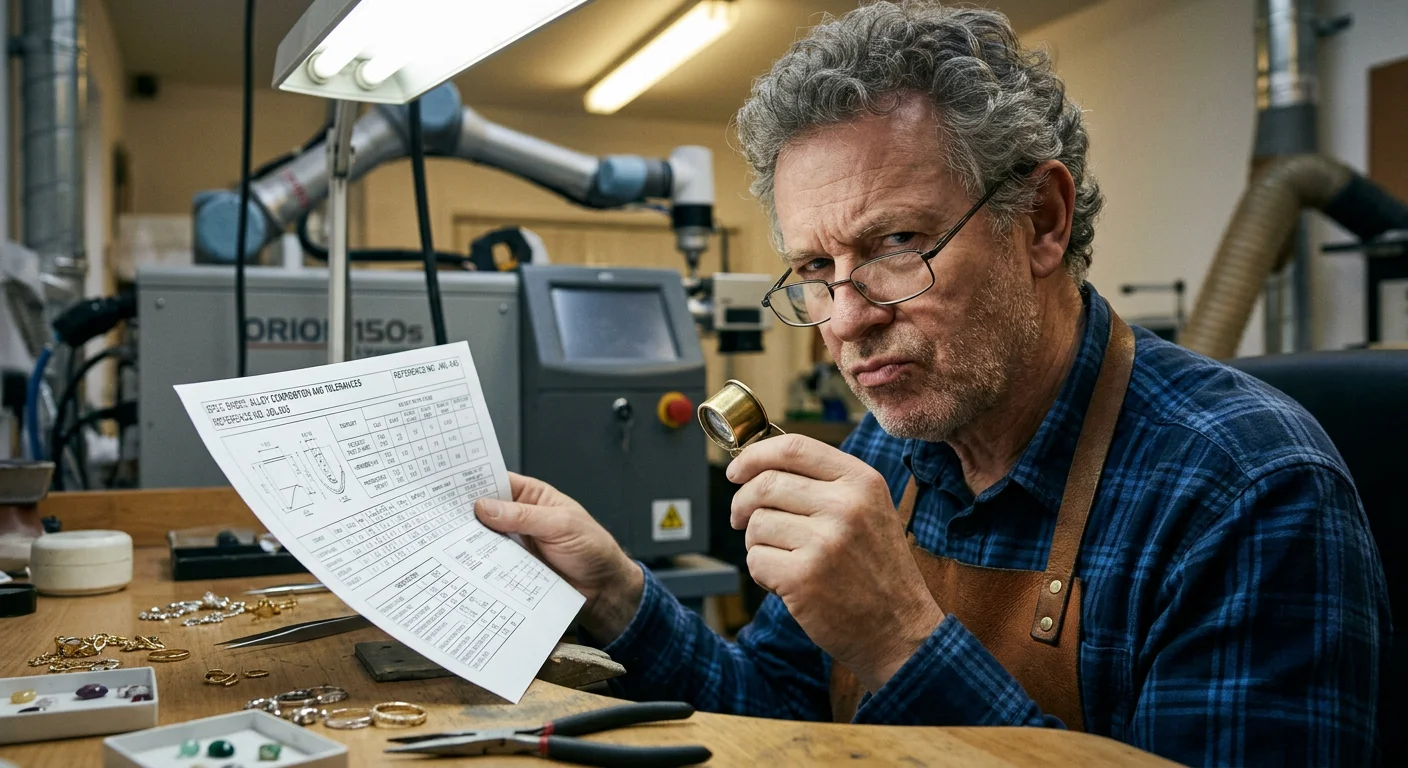
Spec sheets tell you what a machine can do under ideal conditions. They don’t tell you what it does on your bench, on your pieces, on your worst Tuesday afternoon.
Four real-world factors separate a laser welder that earns its place in your shop from one that collects regret. None of them show up in a brochure.
Surface Quality After the Weld
The weld is half the job. What you do after it is where the time goes.
With flame soldering, the heat-affected zone runs 2–5 mm in every direction. That means oxidation, surface discoloration, and warping across a wide band of your piece. You’re not just cleaning up a weld — you’re rescuing the surrounding metal.
Laser welding shrinks that damage zone to under 0.5 mm. On fine jewelry, often much less.
That difference changes the math on every repair:
- Post-weld polishing time drops by 50–70% compared to flame work on the same job type
- Weld seam width holds at ≤0.3 mm on well-tuned machines. That’s tight enough for brushed finishes, engraving, and milgrain to survive intact with minimal touchup
- Metal loss during finishing stays under 0.05–0.1 mm, versus 0.2 mm or more with traditional soldering
That last number matters more than most buyers expect. Less metal removed means the piece stays closer to its original shape. On thin bands and hollow settings, that gap separates a clean repair from a weakened one.
Working Near Stones — Without Pulling Them
This is where laser welding earns its premium in a repair shop.
Flame soldering near heat-sensitive stones — emeralds, opals, pearls, organics — is a removal job first. The stone comes out, the repair gets done, the stone goes back. That process adds time, adds risk, and creates a second chance to damage something expensive.
Laser welding changes that math.
The HAZ stays under 1 mm. So bench jewelers can complete repairs 0.5–1 mm from a stone’s girdle without cracking, color shift, or inclusion damage. The beam diameter at ≤0.2 mm puts energy into the metal, not the surrounding structure.
The result: repairs that would need full disassembly under flame can often be done without touching the setting at all. Time savings run 50–70% per job. Every stone that stays in place is a stone that can’t get lost, chipped on the way out, or set back wrong.
Pulse parameters do most of the work here. Power in the 50–200 W range, paired with fine pulse width and frequency control, keeps heat transfer to the stone well below critical levels — under 80–100°C at the girdle for sensitive materials.
Learning Curve and Workflow Integration
A machine no one uses right costs more than a machine no one bought.
The good news: modern jewelry laser welders are built for working jewelers, not laser engineers. Digital interfaces, programmable parameter sets, and real-time feedback displays make the core variables — power, pulse width, frequency, focus — adjustable without special training.
Most technicians with soldering experience are making usable welds within a few hours to two days. Getting repeatable results across different metals and joint types takes a bit longer — full optimization tends to settle within one to two weeks.
Two things speed that process up:
- Parameter cards by material and task. Build a simple reference sheet for each metal-and-joint combination you run. Log the power level, pulse setting, focus position, and frequency. Write it down. Stop guessing on every setup.
- Real-time process monitoring. Machines with energy waveform display or weld pool imaging let you catch parameter drift before it ruins a piece — not after. For shops running high volume day to day, that feedback loop is worth more than any single spec on the sheet.
Ergonomics matter more than most buyers admit, too. Foot pedal or finger-switch triggers, solid wrist support, and clear microscope optics cut fatigue across a full workday. A jeweler who’s worn out by noon makes worse weld calls than one who isn’t.
Long-Term Stability and What Maintenance Actually Costs
The purchase price is what you pay once. Maintenance is what you pay forever.
Laser welding systems need fewer consumables than traditional setups — no flux, no filler rod, no torch tips. But the maintenance they do need is technical:
- Power output stability should hold within ±2–5% of rated capacity. Verify this spec with your supplier and ask how they track it over time
- Optical path cleanliness matters more than most users expect. Dirty protective glass or focusing lenses degrade focal quality and weld consistency — often before you notice anything wrong
- Cooling system maintenance — water filters, coolant condition, flow rate — keeps the laser source running at full output. Skip it and power drops; beam quality follows
Here’s the honest cost picture: flame soldering setups burn through consumables at a steady rate. Laser systems have lower ongoing costs, but their service calls are technical work — not something the average bench tech handles in-house. Annual consumable costs run lower overall, but budget for real service when the laser does need attention.
Factor that into your total cost of ownership before you sign anything.
How to Choose the Right Jewelry Laser Welder (Decision Guide)
Six questions. Answer them straight, and the right machine picks itself.
Skip them, and you end up choosing from spec sheets written by people who want you to buy the most expensive unit on the page.
Here’s how to work through the decision, step by step.
Step 1: Define Your Business Type First
A repair shop running 30 ring resizes a day needs a different machine than a factory welding 2,000 clasps per shift. That gap isn’t small — it’s a different product category.
Match your operation to the right tier before you look at anything else:
- Retail repair shop (prong re-tipping, ring resizing, chain work): Desktop Nd:YAG or compact pulsed fiber, 60–200W. This is your range. Don’t let anyone push you above it.
- Custom fabrication studio (complex commissions, mixed metals, 50–200+ welds per day): Mid-power desktop or upright machine, 150–300W peak, built for extended sessions.
- Batch manufacturing (hundreds to thousands of welds per day, continuous runs): Industrial fiber laser, 1,000–1,500W continuous, peak output in the multi-kilowatt range.
Step 2: Know Your Metals
Gold is forgiving. Silver isn’t.
Gold (14K/18K): Most jewelry laser welders are built around gold alloys by default. Adjustable pulse width, energy control, and a focused spot are all you need. Starting parameters: pulse width 1–3 ms, energy 5–15 J, spot diameter 0.3–0.6 mm.
Silver: High reflectivity and fast thermal conductivity make silver a tough material to weld. You need higher peak power than gold, stable beam quality, and argon shielding to control oxidation. Ask the supplier directly — make sure any machine you’re evaluating is rated for silver, not just vaguely implied to handle it.
Platinum and palladium: These metals need higher energy density. Look for machines that support longer pulse widths (2–6 ms) and larger spot sizes (0.4–0.8 mm). That combination builds a proper melt pool without cracking.
Mixed metals and stone-set pieces: You need short pulses, a micro-adjustable spot size, and tight beam quality. The machine must handle delicate prong repairs at ≤0.2 mm without spreading heat beyond the target zone.
Step 3: Match Cooling to Your Workload
This single choice separates a machine that runs clean all day from one that starts drifting after lunch.
- Air-cooled: Works fine for light, intermittent use under two hours per day. Simple to maintain, with a smaller footprint.
- Water-cooled: Necessary for anything above four hours of welding per day, high-power machines, or batch production. Output stays stable across long sessions.
A cooling spec that doesn’t match your actual workload will show up in your welds. The spec sheet won’t warn you about that.
Step 4: Verify Supplier Support Before You Commit
The machine is just part of what you’re buying.
Key questions to ask every supplier:
- Warranty: Industry standard is 1–2 years. Get clear on what’s covered.
- Parts availability: Critical components — lenses, protective glass, cooling parts — should ship within 1–7 days. Longer lead times mean real downtime on your bench.
- Technical support response time: 24–48 hours should be the floor, not the ceiling.
- Training: Does the supplier hand over starting parameter tables for gold, silver, and platinum? Do they offer remote or on-site onboarding? Solid training cuts your learning curve by weeks.
Brands like LaserStar and Orotig back their hardware with structured application support. That matters a lot — especially for silver or platinum, where you need reliable starting points rather than burning through expensive stock on guesswork.
Conclusion
Choosing the right laser welder for gold and silver jewelry isn’t about the most expensive machine. It’s about finding the right machine for your hands, your bench, and your business.
You now know what separates a spec sheet from real-world performance. Wattage alone doesn’t tell the whole story. Pulse control matters more than most sellers admit. And the gap between jewelry soldering vs laser welding is wider than most jewelers expect — until they make the switch.
The next step is clear: define your primary use case first. Ask yourself a few direct questions:
- Repair shop or fabrication studio?
- Gold-heavy work or mixed metals?
- Occasional touchups or high-volume production?
Let those answers drive your spec decisions — not the other way around.
The best laser welder for fine jewelry is the one still running clean welds two years from now. It works on your terms, at your pace, without cutting corners.
Don’t buy a machine. Buy a long-term tool.
Ready to choose the right laser welder for gold and silver jewelry? Contact us today and get a machine recommendation based on your real repair work, metal types, and production goals.

0 Comments