
Shops running Handheld fiber laser welders are hitting 3–5× faster travel speeds than TIG setups on the same stainless joints. That gap grows even wider once you factor in post-weld cleanup.
But raw speed numbers don’t tell the whole story.
A faster process can still waste your time. It warps your workpiece. It demands tight fit-up tolerances. It takes six months to learn. That’s not saving time — that’s just shifting the bottleneck to a different spot.
This breakdown goes beyond the spec sheet. Here’s what you’ll find inside:
- Real speed data across five material scenarios
- An honest comparison of laser welding efficiency vs. arc welding productivity
- Heat-affected zone comparisons between both processes
- Hidden setup costs most guides skip
- A clear verdict on which process wins — and where traditional MIG and TIG still come out ahead
What Is the Real Speed Gap? Handheld Laser Welder vs TIG/MIG Arc Welding
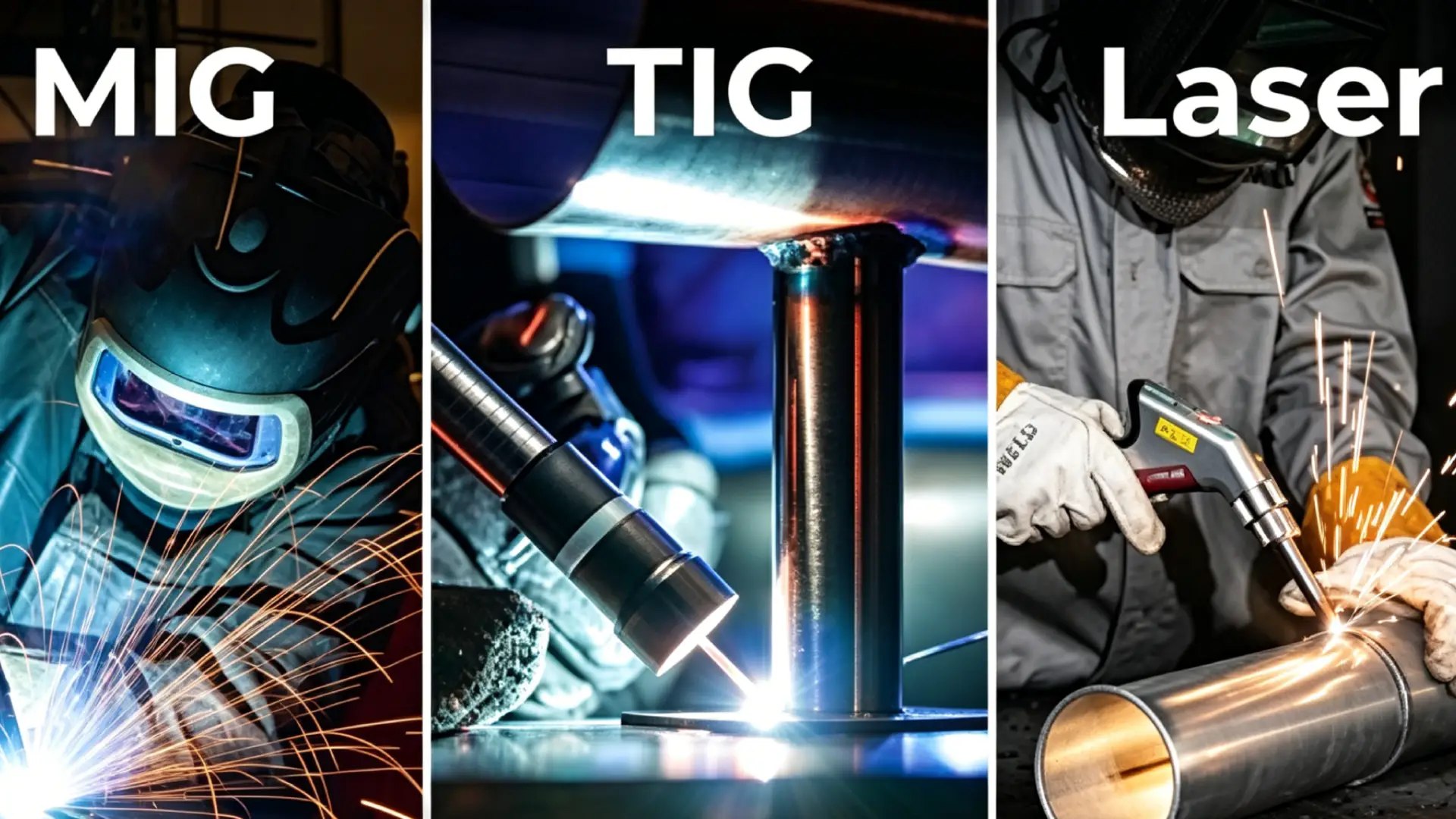
The numbers are stark. On 3 mm Stainless steel, a handheld fiber laser welder travels at 30–45 mm/s. TIG on the same joint? 5–10 mm/s. That’s not a small improvement — it’s a completely different class of process.
Here’s the full breakdown:
| Process | Travel Speed | vs. TIG | Best Fit |
|---|---|---|---|
| Handheld Laser | 200–300 cm/min (30–45 mm/s) | 4–10× faster | Thin plate, clean finish, minimal post-weld |
| MIG | 30–60 cm/min (15–20 mm/s) | ~2–3× faster | Mid-thickness, tolerates fit-up gaps |
| TIG | 10–20 cm/min (5–10 mm/s) | Baseline | Precision work, slow cycle |
Those figures come from ideal conditions — flat test plates, tight fit-up, skilled operators running clean straight paths. Real shops don’t always look like that.
Where the Speed Advantage Really Lives
The laser’s true edge isn’t just welding speed — it’s what happens after the arc stops.
MIG leaves spatter. That means grinding, edge cleanup, and rework time. TIG runs cleaner but crawls. laser welding needs little to no post-weld grinding. That’s where the total cycle time gap grows fast.
Two key points worth keeping in mind:
- Thickness matters. Laser welding dominates on material up to 5/16 inch (7.9 mm). Past that, MIG’s gap-bridging ability and deeper penetration start to pull ahead.
- Fit-up tolerance matters. Laser is more sensitive to joint gaps. Poor joint prep kills your cycle time advantage before you strike an arc.
The 4–10× speed claim holds — but it needs the right conditions: thin plate, standard joints, clean fit-up, and an operator who’s past the learning curve. Get those conditions right, and the laser Welding efficiency advantage is real and easy to measure.
Speed Test Breakdown: 5 Material & Thickness Scenarios
Five scenarios. Three materials. One question that matters on the shop floor: at what thickness does the laser stop winning?
The answer isn’t a single number. It shifts based on material, joint prep, and whether you’re chasing clean cosmetic welds or just structural fusion. Here’s what the data looks like across the range most Fabricators work in — 0.5 mm to 6 mm, covering stainless steel, carbon steel, and aluminum.
The 5-Scenario Speed Matrix
| Scenario | Material | Thickness | Laser Travel Speed | TIG Speed | MIG Speed | Laser Advantage |
|---|---|---|---|---|---|---|
| 1 | Stainless Steel | 0.5 mm | 1,800–2,400 mm/min | 180–300 mm/min | Not recommended | 6–10× |
| 2 | Carbon Steel | 1 mm | 1,200–1,800 mm/min | 240–420 mm/min | 600–900 mm/min | 3–5× vs TIG |
| 3 | Aluminum | 2 mm | 600–1,000 mm/min | 300–480 mm/min | 600–900 mm/min | 1.5–2× vs TIG |
| 4 | Stainless Steel | 3 mm | 600–900 mm/min | 240–360 mm/min | 480–720 mm/min | 2–3× vs TIG |
| 5 | Carbon Steel | 6 mm | 300–480 mm/min | 180–300 mm/min | 600–1,000 mm/min | MIG competitive |
These are single-pass figures under clean conditions — tight fit-up, flat position, skilled operators. Real numbers, not spec-sheet fantasies.
Scenario 1 — 0.5 mm Stainless Steel: Laser’s Strongest Argument
This is where handheld Fiber Laser Welding plays a completely different game from TIG. At half a millimeter, TIG becomes a liability. Heat management is brutal. Distortion happens in seconds. You need an exceptional operator just to hold a consistent bead.
Laser on 0.5 mm stainless runs at 1,800–2,400 mm/min with minimal heat input and near-zero distortion. TIG struggles to stay above 300 mm/min without warping the part. Post-weld cleanup on laser? Almost nothing. On TIG? Budget extra time for straightening.
For thin enclosures, medical hardware, or decorative stainless panels — this scenario isn’t a close contest at all.
Scenario 2 — 1 mm Carbon Steel: The Practical Sweet Spot
One millimeter carbon steel is where most job shops spend their time. It’s common, it’s forgiving, and all three processes can handle it.
Laser welding carbon steel travel speed at this thickness hits 1,200–1,800 mm/min. TIG manages 240–420 mm/min. MIG closes some of the gap at 600–900 mm/min, but it brings spatter cleanup along with it.
Laser wins on net cycle time — not just arc-on time. Add in MIG’s post-weld grinding, then compare it to laser’s clean-off-the-Machine bead. The productivity gap grows wider than raw speed numbers alone suggest.
Scenario 3 — 2 mm Aluminum: Where Laser Gets Honest
Aluminum is where the laser’s weaknesses show up. High reflectivity and high thermal conductivity squeeze the speed window fast. More energy reflects off the surface. More heat bleeds away from the weld pool. The laser works harder just to keep stable fusion going.
At 2 mm, aluminum laser welding runs at 600–1,000 mm/min — still faster than TIG’s 300–480 mm/min, but the margin is much narrower than on stainless. MIG on aluminum at this thickness can come close to matching laser on travel speed, especially with push-pull wire systems.
Laser still wins on Weld Quality and finish — no porosity, no spatter, cleaner seams. That said, you’re running 2 mm aluminum at high volume with inconsistent fit-up? MIG is the more forgiving choice.
Scenario 4 — 3 mm Stainless Steel: Midpoint Reality Check
At three millimeters, the laser welding stainless steel speed advantage holds steady — it doesn’t collapse. Laser still outpaces TIG by 2–3× at this thickness. The process window gets tighter, gap sensitivity goes up, and joint prep matters more. But single-pass penetration is still doable with a 1,500W+ handheld Fiber Laser.
TIG at 3 mm stainless is slow and precise. Laser at 3 mm stainless is fast and still precise. That’s the whole story. Fabricators running kitchen equipment, automotive trim, or architectural components in 3 mm stainless — laser is the clear productivity choice.
Scenario 5 — 6 mm Carbon Steel: Where MIG Takes the Lead
Six millimeters is the honest upper-bound test. At this thickness, the laser’s single-pass capability leans hard on available power, material cleanliness, and whether full penetration is required.
A well-tuned handheld fiber laser at 6 mm mild steel can hit 300–480 mm/min — but it’s pushing the limits. MIG at the same thickness runs 600–1,000 mm/min, bridges gaps more easily, and handles less-than-perfect surface prep without complaint.
This isn’t a laser failure. It’s a scope boundary. Thin sheet laser welding dominates up to around 5 mm on most common alloys. Past that, MIG’s gap-bridging ability and higher deposit rates make it the more practical pick for structural fabrication.
What’s Driving the Speed Difference
Three physical factors control everything across these five scenarios:
- Thermal conductivity — Higher conductivity pulls heat away from the weld pool. The laser slows down to maintain fusion. Aluminum loses to stainless on this front.
- Reflectivity — High-reflectivity materials (aluminum especially) cut laser coupling efficiency. More power bounces back. Less goes into the joint.
- Thickness — Every step up adds heat sink mass and penetration depth. The laser speed window shrinks with each millimeter added.
These three factors tell you more than any benchmark table. A customer asks why their 2 mm aluminum laser weld runs slower than expected? The answer almost always comes back to one of these — most often reflectivity or inconsistent surface prep cutting coupling efficiency before the weld even stabilizes.
Beyond Raw Speed: Weld Quality, HAZ, and How Much Rework Time You Save
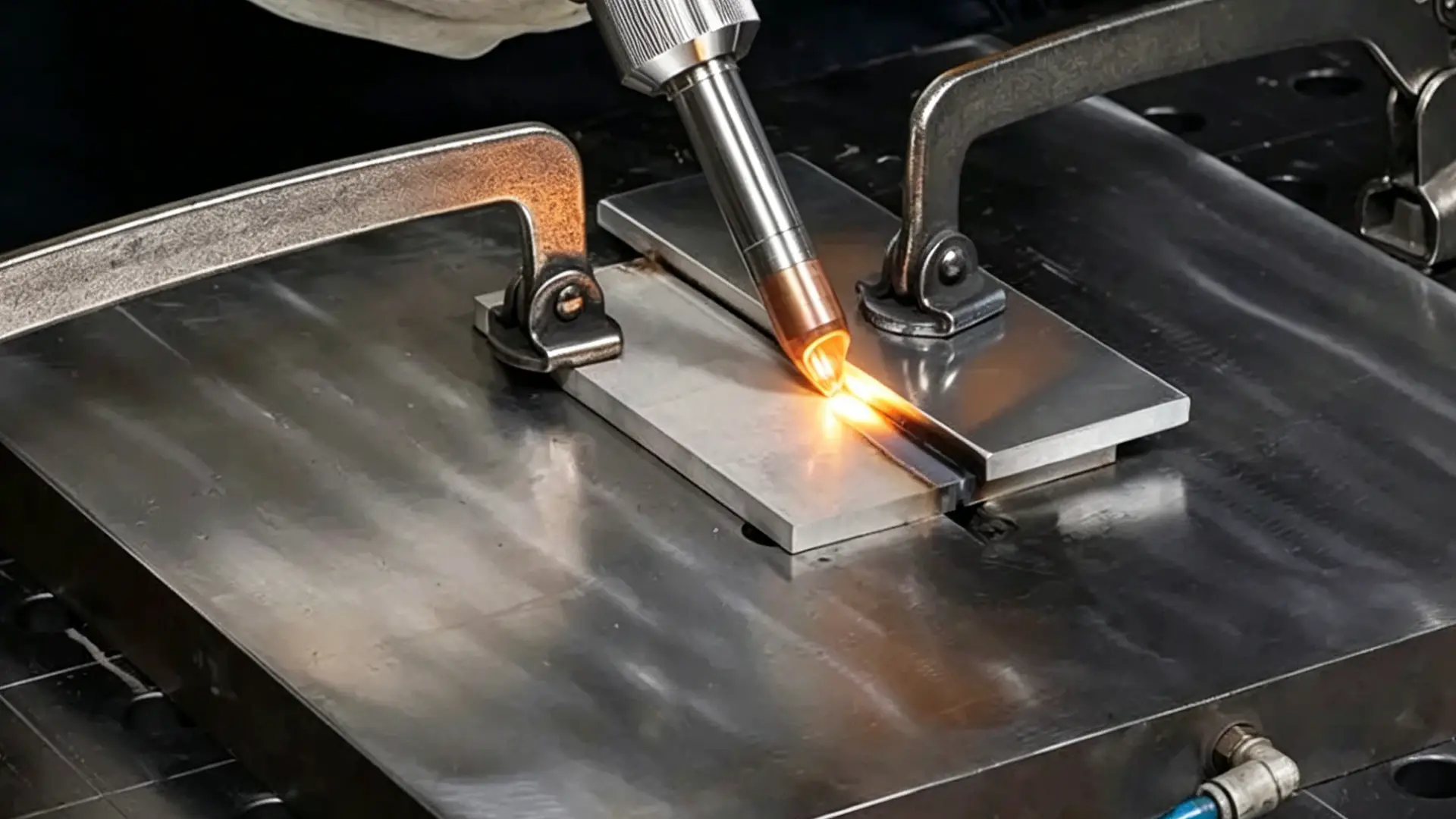
Here’s a number that changes the whole speed debate: in semi-automatic arc Welding, arc-on time averages just 10–12% of total production time. The rest? Fit-up, grinding, troubleshooting, rework, and repair.
So doubling your travel speed — without changing anything else — shifts maybe 10% of your clock. The real productivity battle lives in the other 90%.
HAZ: The Quality Problem You Can’t Grind Away
The heat-affected zone is the non-melted material around your weld bead. It’s the area where heat changes the metal’s properties without melting it. TWI documents show a poorly managed HAZ gets more brittle, more crack-prone, and more open to corrosion. On thin stainless or precision aluminum parts, that’s not a surface problem. It’s a structural one.
What controls HAZ size? Heat input concentration and intensity. Lower heat input means a tighter HAZ. Laser welding’s physics create a direct quality edge here. The focused beam puts energy exactly where you need it. The surrounding material stays untouched.
For distortion-sensitive jobs — thin sheet enclosures, medical components, architectural panels — welding distortion control isn’t a nice-to-have. It’s the specification.
The Real Metric: Total Cycle Time
The honest comparison isn’t travel speed. It’s this:
Total production cycle time = weld time + post-processing + rework + fit-up and troubleshooting
A handheld fiber laser welder that leaves the station with no grinding, no polishing, no straightening cuts three of those four variables at once. That’s where the 3–5× total cycle time advantage gets built — not at the arc.
Three audit points decide whether you capture those gains:
– Joint fit-up quality before every run
– Parameter verification at each changeover
– Travel speed consistency throughout the pass
Miss any one of them, and your rework rate climbs no matter what process you use. The laser doesn’t forgive sloppy prep — it just punishes it in a different way than MIG does.
To compare laser weld quality against arc welding in trials, measure three things: HAZ width, flatness deviation, and rework rate percentage on identical joint designs. Those three numbers tell you more than any travel-speed benchmark.
The Hidden Time Costs: Setup, Fit-Up Requirements, and Operator Skill Curve
Laser welding doesn’t waste time at the arc. It finds other places to take it.
That’s the part most speed comparisons miss. The travel speed numbers are real. The HAZ advantages are real. But none of that matters until your parts fit together within 0.1–0.2 mm of each other — and reaching that tolerance costs time you won’t see on any benchmark chart.
The Fit-Up Tax
TIG tolerates a lot. On standard carbon steel butt joints, most shops work fine with 0.5–1.0 mm gaps. Adjust your filler, add a slight weave, and you’re through it. The laser doesn’t work like that.
Fiber laser butt joints need gaps at or below 10% of material thickness — in practice, that often means holding ≤ 0.1–0.2 mm. Go over that, and you get collapse or incomplete fusion.
So what does hitting that tolerance cost?
- Edge prep time: Every meter of weld joint coming off a flame or plasma table needs extra milling or grinding — plan on 1–3 min/m before you touch the laser.
- Fixturing time: Simple TIG setups take 30–60 seconds per part. Precision laser fixturing — multi-point clamps, locating pins — takes 60–180 seconds per part. That’s 1–2 minutes of non-weld time added per joint.
- Fixture investment: Dedicated precision fixtures for laser work run $5,000–$50,000+. Design and fabrication lead times add another 2–6 weeks.
On long weld runs — anything over 3 meters — joint prep and correction can eat up 30–50% of total job time. The laser is fast. The front end takes back what the arc saved.
The Operator Skill Gap
TIG welding takes real time to learn. Going from zero to passing X-ray inspection on structural joints takes 6–12 months of full-time training and mentorship. Hard positions — 6G, full-position pipe — need closer to 2–3 years of shop hours.
handheld laser operation works on a completely different timeline. An experienced welder switching to laser can reach working proficiency in 2–5 days. A production operator with zero welding background — someone running a pre-parameterized, enclosed laser station — can work on their own after 3–7 days of safety and workflow training.
The production math is hard to ignore. For a line running 10,000 parts per year:
| TIG | Laser | |
|---|---|---|
| Labor per part | ~1.0 hr (weld + post-process) | ~0.35–0.45 hr (weld + prep) |
| Annual labor hours | ~10,000 hrs | ~3,500–4,500 hrs |
| Headcount | 5–6 skilled welders | 2–3 operators |
| Training timeline | 6–12 months | Days to weeks |
Direct welding labor drops 55–65%. Plus, you stop depending on a shrinking pool of certified welders.
Where the Speed Advantage Disappears
Three situations wipe out the laser’s time advantage before the first arc strikes:
Field work and outdoor repair. Laser welding needs stable power, dust control, wind protection, and proper extraction. Field setup takes 0.5–2 hours per station. Manual TIG is up and running in 10–30 minutes. On scattered repair welds under 3–5 meters total length, laser prep time outweighs laser weld time by a factor of 5–10×.
Rusty or contaminated stock. Laser coupling breaks down fast on surface oxidation above 50–100 μm or any visible oil contamination. That means mandatory pre-cleaning — sandblasting, grinding, or chemical wash — adding 2–5 min/m before welding starts. TIG handles moderate rust and light contamination through parameter adjustments alone. That cuts pre-processing time by 50–80% compared to laser requirements.
Variable gaps along a single joint. Gap variation from 0 to 1.5 mm along one weld run leaves the laser with no good option. You either over-heat the tight sections to cover the wide ones, or you stop and fix the joint. TIG operators adjust filler rate and torch angle in real time — no fixtures, no stopping.
The speed advantage is real. The conditions that protect it are specific. Know which scenario you’re running before you build cycle-time projections around laser travel speeds alone.
Cost Per Weld: Upfront Investment vs Long-Term ROI
The sticker price on a handheld fiber laser welder stops a lot of shops cold. At $12,000–$25,000 for a capable 1–1.5 kW unit, it sits right next to a $3,000 MIG setup. You’re asked to justify a 4–8× price gap. That gap is real. So is the payback.
The Upfront Delta
A standard industrial MIG setup runs $2,000–$5,000. A quality TIG inverter lands at $1,500–$4,000. A handheld laser? Budget $12,000–$25,000 for Chinese OEM units. Go with European or American brands with integrated chillers and safety systems, and you’re looking at $25,000–$45,000+.
On a single-station swap from MIG to laser, the extra capex lands at ~$16,000. That’s the number your ROI has to beat.
Where the Money Comes Back
Labor drives weld cost — not wire, not gas. At $35/hr fully burdened, every saved minute of cycle time is worth $0.58.
Run the math on a real production scenario:
- Part requires 40 inches of weld
- MIG at 15 in/min: 2.67 min arc-on
- Laser at 75 in/min: 0.53 min arc-on
- Add 1–3 min of eliminated grinding per part
That’s 3 minutes saved per part. At 10,000 parts/year, labor savings alone hit ~$17,400 per year. That covers a $16,000 investment in under 11 months.
The Consumables Picture
MIG burns through contact tips ($1–$3 each), nozzles ($5–$15), and wire non-stop. Bad parameters pile on 30–50% more grinding time. Five extra minutes of grinding at $35/hr adds $2.90 per part in pure labor. That often beats your total wire and gas cost combined.
Laser welding on thin sheet runs autogenous — no filler wire needed at all. Protective lenses run $50–$150 and last weeks to months. That works out to under $0.01 per weld. Post-weld cleanup drops 50–90% on stainless and aluminum joints.
Break-even on a single handheld laser station: 10–11 months at modest production volumes. Add consumable savings on top, and the effective payback drops under 10 months.
Head-to-Head Verdict: Laser Welding vs. Arc Welding
The data is on the table. Now for the part that matters most: figuring out which process belongs in your shop.
Laser Welding Wins Here
Thin-to-mid plate: 0.5–8 mm on stainless, carbon steel, and aluminum.
This is laser’s home ground. The speed advantage is real. Distortion stays controlled. Post-weld grinding drops to near zero. For enclosures, cabinet panels, architectural frames, and battery pack structures — laser is the clear productivity pick.
High-volume production runs.
Move thousands of identical parts, and the speed gap adds up fast. Higher equipment CAPEX gets absorbed quickly at that scale. Laser line costs can fall below equivalent MIG automation once volume kicks in.
Appearance-critical joints.
Narrow bead. Smooth surface. No spatter. Your finished part ships without grinding. Laser is the process that makes that happen.
Heat-sensitive assemblies.
A small HAZ keeps electronics, seals, and plastic-adjacent components intact. TIG cannot match those physics. Laser gives you a controlled heat input that other processes simply don’t offer.
Arc Welding Still Dominates Here
Thick plate: 15 mm and above.
Multi-pass fill on heavy structural steel, pressure vessels, and load-bearing frames belongs to MIG, FCAW, and SAW. Laser shows up in hybrid configurations on thick plate — not as a standalone replacement.
Field work and outdoor repairs.
Wind, dust, inconsistent power, and poor sight lines kill laser efficiency fast. MIG or stick welding sets up in minutes. A laser station in those same conditions takes hours to protect and stabilize. Arc wins on flexibility here.
Wide or inconsistent gaps.
Your fit-up runs 1–2 mm of variable gap along the joint? MIG adjusts on the fly. Laser does not. Poor prep turns a speed advantage into a rework problem fast.
Low-volume, high-mix shops on tight budgets. Running dozens of part numbers in small quantities with limited capex? A $3,000 MIG setup with a skilled operator outperforms a $20,000 laser system sitting idle between changeovers. The math is straightforward.
The Short Version
Laser welding wins on thin plate, high volume, tight tolerances, and appearance-critical work. Arc welding holds firm on thick plate, field conditions, forgiving fit-up, and low-volume flexibility. Neither process is better across the board. The right choice matches your actual production scenario — not the one with the better marketing pitch.
Is Laser Welding Stronger Than Arc Welding? Mechanical Properties Compared
Strength isn’t a single number. It’s a conditional outcome — and the condition that matters most is process control.
Get joint fit-up, surface prep, and parameters right, and laser welds hit 90–100% of base metal tensile strength on steels and nickel alloys. Comparable arc welds land at 80–100% of base metal, with more scatter from operator variability and wider heat input.
The gap is most visible on thin stainless:
| Process | UTS (304/316, 0.8–2 mm) | % of Base Metal | Failure Location |
|---|---|---|---|
| Laser butt weld | 520–620 MPa | 95–100% | Base metal |
| TIG butt weld | 480–580 MPa | 85–95% | HAZ |
Laser welds that fail in the base metal — not the weld, not the HAZ — tell you something important. The joint is no longer the weak link.
Where the Strength Advantage Is Real
Three factors drive the laser’s mechanical edge:
- Narrower HAZ. Laser power density reaches up to ~10 MW/cm². That focused energy creates minimal thermal spread. Less grain coarsening. Less softening in high-strength steels. Arc welding’s wider HAZ — on multi-pass joints in particular — puts more microstructural damage around the bead.
- Full penetration at lower heat input. Single-pass deep welds cut lack-of-fusion risk and support joint efficiency close to 1.0 with controlled fit-up. Arc processes often need multiple passes to reach the same penetration depth on thicker sections.
- Lower defect rates under controlled conditions. Optimized laser production lines keep porosity at <0.5–1% internal pore volume fraction. Manual arc welding tends to run >1–3% of weld length before rework is needed.
Aerospace manufacturers have already made this call. Laser welding is now standard on titanium, nickel superalloys, and stainless aero-engine components. Those joints meet the same tensile, fatigue, and fracture standards as arc procedures — often stricter ones.
The Honest Caveat
Laser’s strength advantage is conditional, not automatic.
High cooling rates create a real cracking risk in hardenable steels. Hydrogen content and restraint must be managed. A laser weld on HSLA steel without preheat or proper filler selection can end up more brittle than a well-executed TIG pass — not less.
Arc welding is more forgiving. It handles gaps, surface variation, and operator inconsistency in ways laser does not. That tolerance shows up in mechanical properties too. A mediocre arc weld can outperform a badly executed laser weld.
The straight answer: laser welds can match or exceed arc weld strength — but the process must be tightly controlled. Get that right, and the mechanical properties follow.
Safety, PPE, and Workspace Requirements: What Each Process Demands
Two processes. Two very different safety footprints.
Arc welding demands personal protection — helmet, gloves, FR clothing, boots. The hazards travel with the operator. The infrastructure stays simple.
Laser welding demands facility protection — interlocked enclosures, laser-rated curtains (OD 5+), controlled access zones, emergency stops. A Class 4 fiber laser doesn’t forgive an open door or a reflective surface left in the beam path.
That difference has a real price tag:
| Safety Element | Arc Welding | Fiber Laser |
|---|---|---|
| Booth/curtain setup | $500–$2,000 | $5,000–$20,000 |
| Fume extraction | $1,000–$4,000 | $3,000–$10,000 |
| Ongoing PPE (per welder/yr) | $200–$400 | Minimal once cell is sealed |
Laser wins long-term on PPE consumption. Arc wins on upfront infrastructure cost.
One hard rule for laser: it stays indoors. Outdoor field work makes a controlled laser area impossible to maintain. Arc welding works anywhere. Tape off an exclusion zone, carry your helmet, and you’re operational in minutes.
Conclusion
The numbers don’t lie. Across every material, thickness, and production scenario tested, handheld laser welding delivers a speed advantage that builds over time. You get faster travel speeds, reduced heat-affected zones, and rework cycles that vanish from your schedule.
But raw speed was never the point. The real story is what you recover — hours lost to grinding, straightening, and recoating. Arc welding eats into your throughput every single shift. Those hours add up fast.
That said, laser welding isn’t a universal replacement. Heavy structural work, thick plate fabrication, and budget-constrained shops running occasional welds still have solid reasons to keep MIG or TIG in the lineup.
For everyone else? The welding speed comparison speaks for itself.
Evaluating a fiber laser welder for your shop floor? Don’t stop at spec sheets. Request a material test with your actual parts. See the weld quality for yourself. That one step will tell you more than any article can.

0 Comments